
Highlights
- China's official rare earth price index stands at 269.6 as of May 8, 2026—nearly 2.7 times the 2010 baseline—highlighting persistently elevated prices driven by geopolitical competition and supply chain tensions despite recent softening in some heavy rare earth categories.
- Heavy rare earths like dysprosium and terbium oxide declined while strategically important magnet materials, including neodymium oxide, remained stable, illustrating mixed market conditions shaped by China's industrial policy rather than transparent free-market forces.
- With China controlling 85–90% of global rare earth refining capacity, the pricing data underscores Beijing's extraordinary leverage over supply chains and reinforces the challenge facing US and allied efforts to establish independent rare earth processing capabilities.
First, Beijing’s pricing gauge remains historically high. The China Rare Earth Industry Association released its May 8, 2026, pricing update showing China’s official rare earth price index at 269.6, nearly 2.7 times the 2010 base-year benchmark of 100. While the index remains below the early-2026 peak visible on the association’s chart—when prices briefly moved above 300—it still reflects a historically elevated pricing environment tied to intensifying strategic competition around critical minerals.
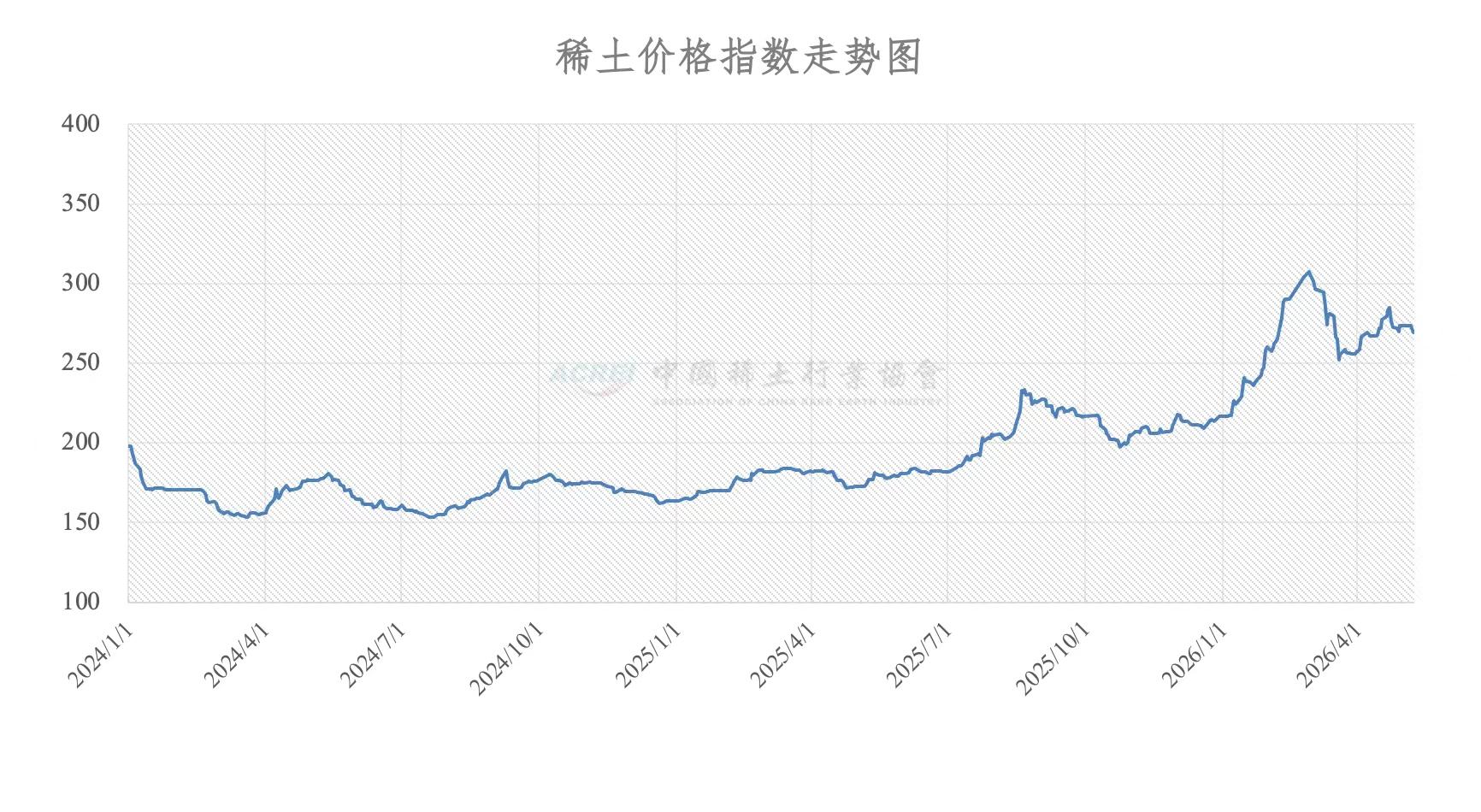
According to the association, the index is calculated using domestic transaction data collected from Chinese rare earth enterprises. The model uses 2010 transaction activity as the baseline and compares it against average daily transaction data reported by participating firms.
Since mid-2025, the broader market has reflected intermittent supply tightening, export controls, industrial policy interventions, and heightened geopolitical competition surrounding rare earth supply chains.
Heavy Rare Earths Slip While Magnet Materials Stabilize
The latest pricing table reveals a mixed market with weakness concentrated in several heavy rare earth categories:
- Dysprosium oxide fell to 6,070–6,130 yuan/kg ($910.50–$919.50/kg)
- Terbium oxide declined to 8,370–8,570 yuan/kg ($1,255.50–$1,285.50/kg)
- Gadolinium oxide softened to 1,325–1,365 yuan/kg ($198.75–$204.75/kg)
- Holmium oxide eased to 4,650–7,650 yuan/kg ($697.50–$1,147.50/kg)
Meanwhile, several strategically important magnet materials remained comparatively stable:
- Neodymium oxide held at 418–438 yuan/kg ($62.70–$65.70/kg)
- Praseodymium-neodymium metal (PrNd metal) edged lower to 915.5–935.5 yuan/kg ($137.33–$140.33/kg)
- Lanthanum oxide remained stable at 4.1–6.1 yuan/kg ($0.62–$0.92/kg)
One notable exception was erbium oxide, which posted gains, potentially signaling tighter niche supply conditions or specialized downstream demand.
Why Rare Earth “Prices” Are Hard to Interpret
Western investors should approach Chinese rare earth pricing data cautiously. China’s rare earth sector does not operate as a fully transparent free-market system. State ownership, production quotas, export licensing, environmental enforcement, industrial policy, and national security priorities all influence pricing behavior.
China is widely estimated to control roughly 85–90% of global rare-earth refining and separation capacity, meaning much of the world’s effective price formation continues to originate within China’s industrial ecosystem. Importantly, the index reflects domestic Chinese transaction activity and may not fully represent pricing available to foreign buyers operating under export controls, licensing restrictions, or confidential bilateral supply agreements. At the same time, the so-called “ex-China” market remains fragmented and immature. Outside China, pricing often depends on confidential bilateral contracts, government-supported strategic deals, limited spot liquidity, and early-stage industrial policy initiatives rather than transparent exchange-based trading.
Some analysts also caution that published Chinese pricing data may reflect broader industrial policy objectives and market-signaling dynamics, in addition to purely market-driven transactions.
The Strategic Signal for America and Allies
The softening of some heavy rare-earth prices despite ongoing geopolitical tensions highlights China’s extraordinary influence over both supply and market psychology. Beijing retains substantial leverage across the midstream refining and separation chain—arguably the most important bottleneck in the global rare earth industry.
For the United States and allies, the report reinforces a difficult reality: despite billions in subsidies and years of policy discussion, China still exerts dominant influence over global rare earth pricing, refining access, and downstream availability.
Disclaimer: This report is based on data published by the China Rare Earth Industry Association and associated Chinese state-linked industry sources. The information should be independently verified where possible.


0 Comments
No replies yet
Loading new replies...
Moderator
Join the full discussion at the Rare Earth Exchanges Forum →