
Highlights
- China's Rare Earth Price Index stands at 251.3 on June 11, 2026, roughly 151% above its 2010 baseline, reflecting persistent supply security concerns and geopolitical risk.
- Heavy rare earths including Dysprosium, Holmium, and Yttrium remain at historically elevated levels, with ex-China pricing potentially exponentially higher due to ultra-thin liquidity.
- NdPr Oxide softened modestly to ¥682–702/kg but remains supportive of continued investment in ex-China magnet supply chains and separation capacity.
- China's domestic rare earth prices are shaped by production quotas, state policy, and export licensing, making them reference indicators rather than true free-market prices.
- No universally accepted ex-China benchmark exists for most rare earth products, as the majority of transactions occur through private bilateral agreements with confidential pricing terms.
China's rare earth trade association charged with tracking pricing reported its June 11, 2026 Rare Earth Price Index at 251.3, indicating that the basket of rare earth products tracked by the association remains approximately 151% above the 2010 base year level of 100 according to China Rare Earth Industry Association (CREIA).
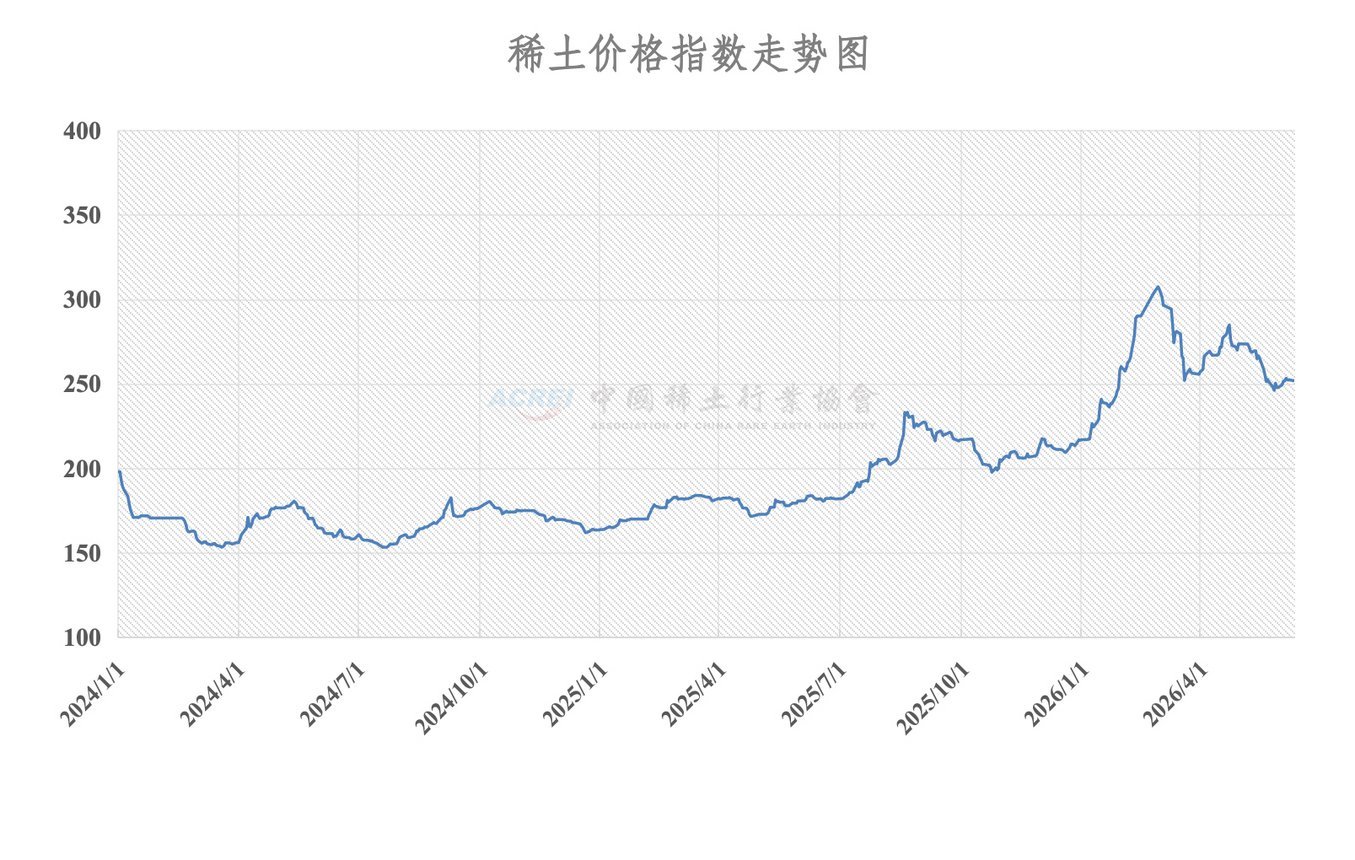
While the index has retreated from the sharp spike seen during the first quarter of 2026, prices remain significantly elevated compared with most of the past decade. The broader trend reflects persistent concerns over supply security, export restrictions, geopolitical risk, and the growing strategic importance of rare earths across defense, energy, robotics, artificial intelligence, and electric vehicle supply chains
.
Heavy Rare Earths Continue to Command Attention
Several heavy rare earth products remain at historically elevated levels despite modest week-over-week softness.
Dysprosium Oxide was reported at ¥1,310–1,350/kg ($196.50–$202.50/kg), while Dysprosium Metal was listed at ¥1,660–1,680/kg ($249.00–$252.00/kg). Gadolinium Oxide declined to ¥191.8–211.8/kg ($28.77–$31.77/kg), while Holmium Oxide increased to ¥537.3–557.3/kg ($80.60–$83.60/kg).
One of the more notable moves came from Yttrium Oxide, which rose to ¥6,150–6,210/kg ($922.50–$931.50/kg).
Given limited liquidity and scarce availability outside China, yttrium pricing remains one of the opaquer segments of the global rare earth market. Importantly ex-China pricing for these heavies can be exponentially higher.
NdPr Prices Ease but Remain Strategically Important
The industry's benchmark magnet feedstock, NdPr Oxide (75% Nd₂O₃ equivalent), softened modestly to ¥682.3–702.3/kg ($102.35–$105.35/kg). Similarly, NdPr Metal Alloy was reported at ¥830–850/kg ($124.50–$127.50/kg).
Although lower than the highs reached earlier this year, these levels remain supportive of continued investment in ex-China magnet supply chains and separation capacity.
The Reality Behind Rare Earth Pricing
Investors should be cautious when interpreting both Chinese and ex-China rare earth pricing.
China's domestic market is not a purely free-market environment. Production quotas, state-directed industrial policy, environmental controls, export licensing requirements, state-owned enterprises, and broader national security considerations all influence market behavior. Consequently, Chinese prices should be viewed as important reference indicators rather than pure market-clearing prices.
At the same time, ex-China pricing remains underdeveloped. And be cautious of any group declaring they have comprehensive industry spot pricing. China still accounts for roughly 90% of global rare earth separation and refining capacity, meaning relatively little material trades in transparent spot markets outside the country. Most transactions occur through private bilateral agreements (often facilitated by brokers and traders) that include confidential provisions covering volume commitments, purity specifications, delivery schedules, qualification requirements, and pricing formulas.
As a result, no universally accepted ex-China benchmark exists today for most rare earth products.
This is especially true for strategic heavy rare earths such as Dysprosium, Terbium, and Yttrium, where liquidity remains now ultra-thin and physical availability can be highly constrained. Adding further complexity, the U.S. government's support package for MP Materials established a $110/kg NdPr price floor for MP's production under specific contractual arrangements. While many market participants increasingly reference this figure when discussing future U.S. production economics, it should not necessarily be interpreted as a universal market floor for all producers or all rare earth transactions.
REEx Assessment: The World Still Lacks a True Rare Earth Market
The most important story is not today's price movement. It is the continued absence of transparent global price discovery. Oil has Brent and WTI. Copper has COMEX and the London Metal Exchange. Rare earths remain largely governed by bilateral negotiations, fragmented supply chains, government intervention, export controls, qualification barriers, and limited liquidity. Until substantial separation, refining, and trading capacity develops outside China, rare earth pricing will remain fragmented and opaque both in China and ex-China but for different reasons.
The CREIA index, based on Chinese enterprise transaction data and a proprietary methodology using a 2010 base year, provides a useful snapshot of China's domestic market. It does not, however, represent a definitive global benchmark. For investors, policymakers, and industrial consumers, understanding that distinction may be as important as the prices themselves.
Source Disclosure: This information originates from the China Rare Earth Industry Association (CREIA), which collected pricing data from participating Chinese industry enterprises. CREIA explicitly states that the information is provided for reference purposes only and does not constitute investment advice. As with all rare earth pricing data, figures should be independently verified where possible.


0 Comments
No replies yet
Loading new replies...
Moderator
Join the full discussion at the Rare Earth Exchanges Forum →