
Highlights
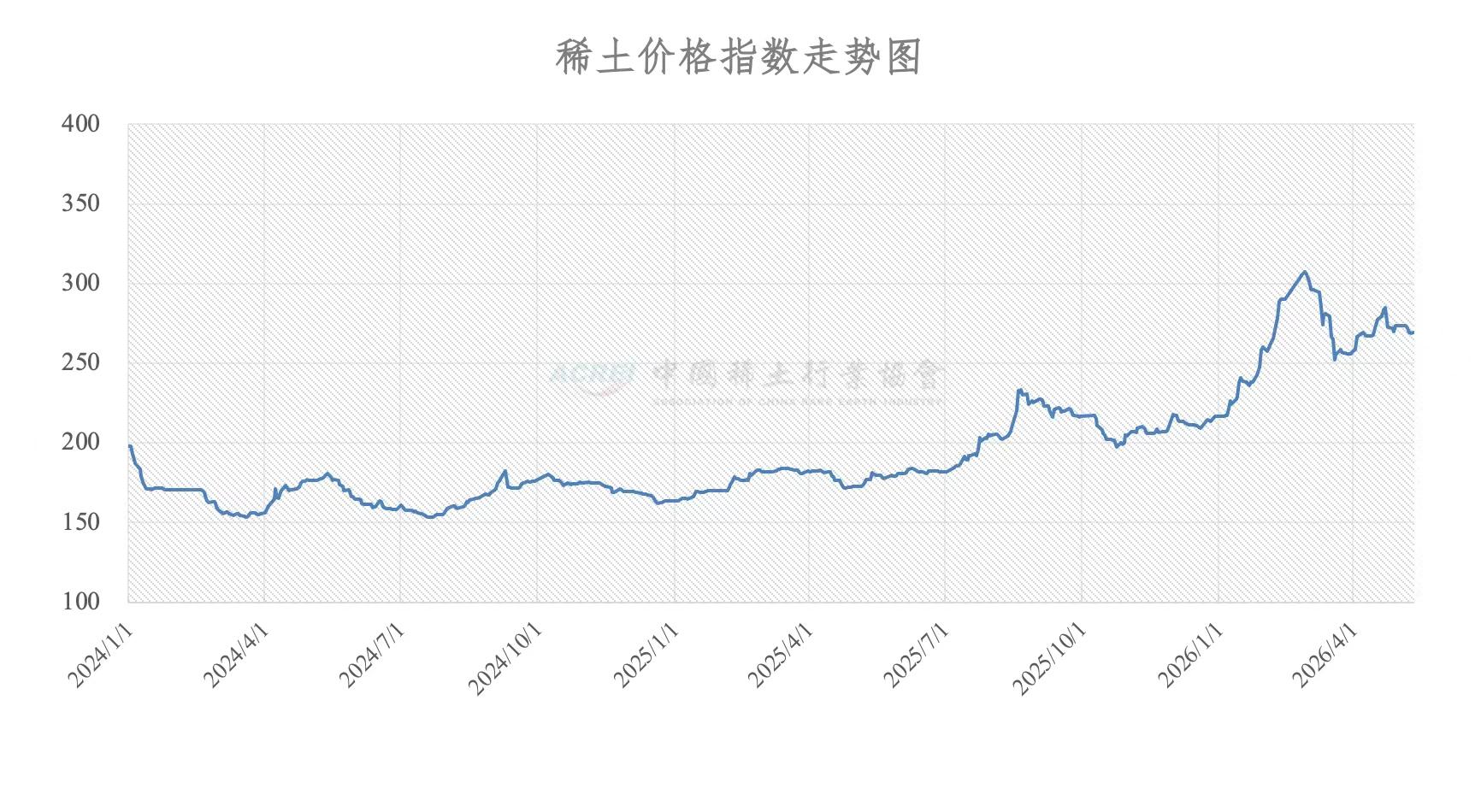
- China's rare earth price index reached 269.5 on May 11, 2026, with strategically critical heavy rare earths like dysprosium oxide (~$122-$125/kg) and terbium oxide (~$892-$901/kg) posting gains amid supply tightness for defense, EV, and aerospace applications.
- Chinese rare earth pricing reflects state industrial policy, export controls, and strategic objectives rather than transparent market dynamics, while the ex-China market remains structurally immature and dominated by opaque bilateral contracts.
- Despite Western supply chain diversification efforts, China continues to control the overwhelming majority of global rare earth separation and refining capacity, defining the pricing architecture and industrial tempo of the global rare earth economy.
China’s official rare earth price index climbed to 269.5 on May 11, 2026, according to data released by the China Rare Earth Industry Association, underscoring continued strength in strategically important rare earth pricing despite recent volatility. Heavy rare earth products tied to high-temperature permanent magnets—including dysprosium and terbium—moved higher again, reinforcing ongoing supply tightness across critical defense, EV, robotics, and aerospace applications.
Yet investors should resist interpreting these figures as conventional market-discovery price signals. China’s rare earth ecosystem remains deeply intertwined with state industrial policy, export controls, quotas, environmental directives, and strategic national objectives. Meanwhile, the so-called “ex-China” market remains structurally immature, opaque, and dominated by bilateral contracting rather than transparent spot pricing.
Heavy Rare Earths Reassert Strategic Importance
Several strategically significant heavy rare earth products posted gains in the latest pricing release:
- Dysprosium oxide: 833.2–853.2 yuan/kg (~$122–$125/kg USD)
- Dysprosium metal: 1017.7–1037.7 yuan/kg (~$150–$153/kg USD)
- Terbium oxide: 6070–6130 yuan/kg (~$892–$901/kg USD)
- Terbium metal: 7475–7575 yuan/kg (~$1,099–$1,113/kg USD)
Meanwhile, NdPr oxide—a foundational input for NdFeB permanent magnets used in EV drivetrains and wind turbines—was quoted at 746.6–766.6 yuan/kg ($110–$113/kg USD), while NdPr metal traded around 913.5–933.5 yuan/kg ($134–$137/kg USD).
At current assumptions, 1 Chinese yuan converts to approximately $0.147 USD.
Importantly, dysprosium and terbium remain among the most strategically sensitive rare earths globally due to their role in high-temperature permanent magnets used in missiles, drones, advanced aerospace systems, robotics, and next-generation electrification infrastructure. The price point for these elusive commodities ex-China can be several times higher, depending on the situation and circumstances.
The Pricing Illusion Beneath the Headlines
Rare earth investors should avoid treating Chinese prices as fully transparent free-market benchmarks.
China still controls the overwhelming majority of global rare-earth separation and refining capacity—particularly for heavy rare-earth processing. Domestic pricing reflects not only supply-demand dynamics, but also state-owned enterprise coordination, production quotas, export restrictions, stockpiling behavior, environmental enforcement campaigns, and broader geopolitical priorities.
The ex-China market remains equally difficult to interpret with precision.
Despite aggressive Western political rhetoric surrounding supply chain diversification, most rare earth transactions outside China still occur through confidential bilateral contracts featuring customized specifications, tolling structures, logistics adjustments, and non-public pricing terms. Transparent spot liquidity remains extremely limited.
A widely discussed pricing reference emerged from U.S. government-linked support arrangements involving MP Materials, where NdPr economics near $110/kg became an important signaling benchmark. Whether that evolves into a durable global pricing floor remains uncertain.
Strategic Takeaway
The uncomfortable reality for Western policymakers and investors remains unchanged: even as the United States, Australia, Canada, and Europe race to build alternative supply chains, China still largely defines the pricing architecture, processing capability, and industrial tempo of the global rare earth economy.
Important Disclaimer: This pricing information originates from the China Rare Earth Industry Association, which operates within China’s state-linked industrial ecosystem. The published figures, methodologies, and interpretations should be independently verified and should not be interpreted as fully transparent global market pricing or investment advice.


0 Comments
No replies yet
Loading new replies...
Moderator
Join the full discussion at the Rare Earth Exchanges Forum →