
Highlights
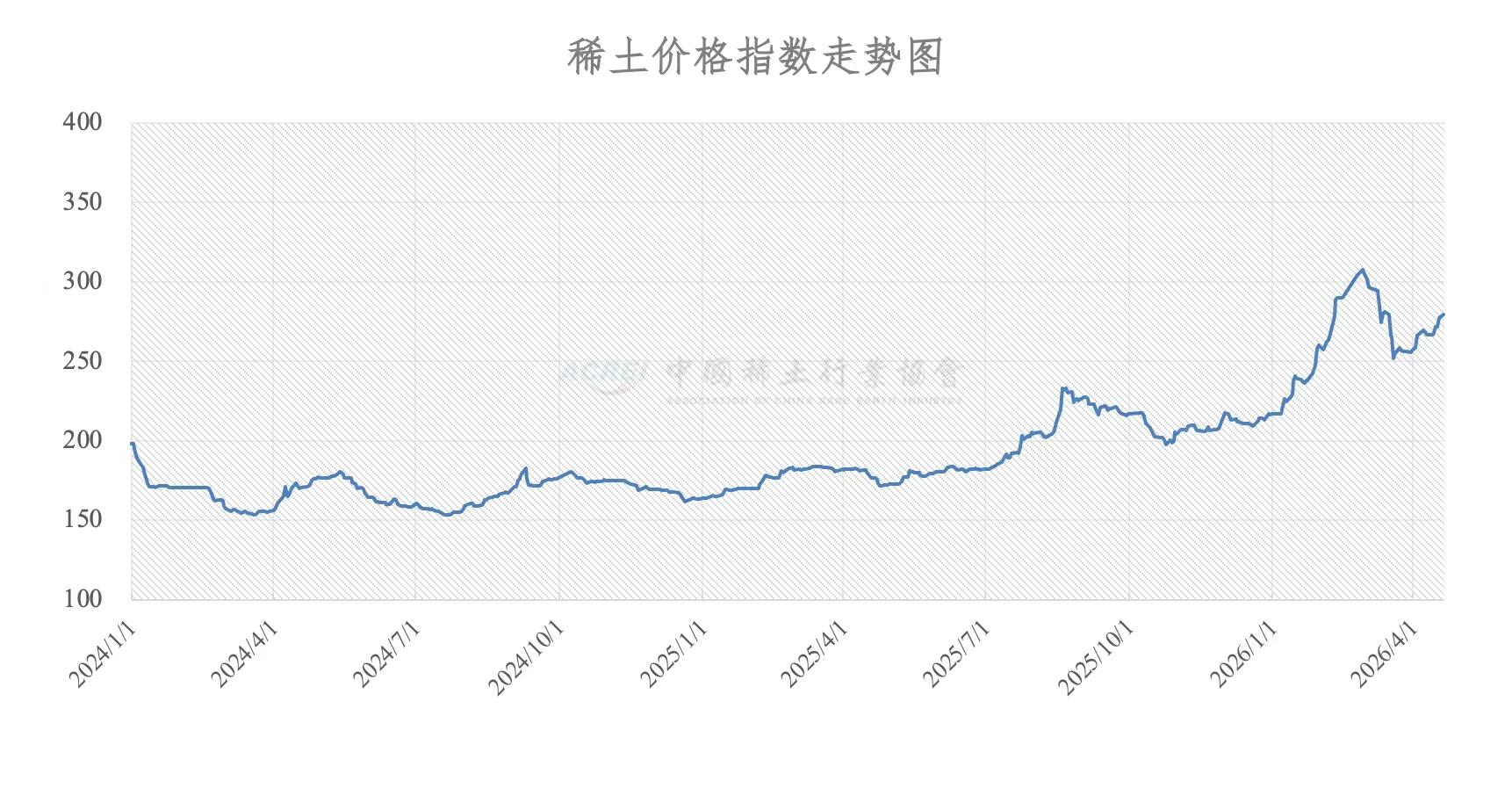
- China's rare earth price index reached 279.6 (2010=100) in April 2026, with magnet-critical PrNd oxide rising to ¥792-812/kg while heavy rare earths like dysprosium remain stable, reflecting managed market control rather than free-market dynamics.
- Upstream feedstock materials show early tightening signals with mixed rare earth carbonate and concentrates creeping higher, potentially signaling broader downstream price movements ahead.
- China's state-controlled pricing framework continues to shape 85-90% of global rare earth processing, emphasizing that Western nations have access but not sovereignty over critical mineral supply chains.
China’s China Rare Earth Industry Association released its April 20, 2026 pricing update, placing the rare earth price index at 279.6 (2010 = 100), reinforcing a steady upward trajectory into 2026. The index is calculated from aggregated daily transaction data across domestic enterprises—meaning it reflects internal market activity, not a transparent or fully market-driven global benchmark.
Light Rare Earths: Stability with Strategic Lift
Key light rare earth (LREE) inputs remain broadly stable, with targeted upward pressure in magnet-critical materials:
- Praseodymium-Neodymium (PrNd) Oxide: ¥792–812/kg → ~$110–113/kg ↑
- PrNd Metal: ¥966–987/kg → ~$134–137/kg ↑
- Lanthanum Oxide: ¥4–6/kg → ~$0.55–0.83/kg (flat)
- Cerium Oxide: ¥4–6/kg → ~$0.55–0.83/kg (flat)
Interpretation: Magnet inputs continue to firm, while abundant elements remain anchored—consistent with structural demand from EVs, wind turbines, and defense systems.
Heavy Rare Earths: Controlled Strength, No Breakout
Heavy rare earths (HREEs) show price firmness without volatility:
- Dysprosium Oxide: ¥1,350–1,390/kg → ~$187–193/kg (flat)
- Dysprosium Metal: ¥1,720–1,740/kg → ~$239–242/kg (flat)
- Terbium Oxide: ¥8,400–8,600/kg → ~$1,165–1,195/kg ↑
- Gadolinium Oxide: ¥167–187/kg → ~$23–26/kg (flat)
Interpretation: Tightness persists—particularly in terbium—but pricing remains orderly, reflecting controlled supply rather than open-market price discovery.
Feedstock Signals: Early-Stage Tightening
- Mixed Rare Earth Carbonate (REO 100%): ¥11.8–13.8/kg → ~$1.64–1.92/kg ↑
- Mixed Concentrates (TREO ≥92%): ¥250–260/kg → ~$35–36/kg ↑
Interpretation: Upstream inputs are tightening incrementally, often a precursor to broader downstream price movements.
Why This Isn’t “True” Global Pricing
From a Western market perspective, these figures should be read as managed price signals—not free-market prices. China’s rare earth sector operates within a framework of production quotas, export controls, state consolidation (the “Big Six”), and licensing regimes introduced and expanded through 2025–2026. These mechanisms influence not just volume, but timing, counterparties, and transaction pricing.
Critically, China still controls ~85–90% of global rare-earth processing and ~90%+ of magnet production, with near-total dominance in heavy rare-earth separation. As a result, a fully independent ex-China pricing system has not yet emerged. What exists outside China is fragmented, opaque, and often negotiated bilaterally with embedded geopolitical and security premiums. In short, the world consumes prices shaped in China, not discovered globally.
What Matters for the West
No breakthroughs—just reinforcement of the core reality: control beats volatility. China is allowing selective appreciation in magnet-critical materials while maintaining stability in heavies, preserving leverage without triggering panic. For the U.S. and allies, the message is unchanged: access is not control, and supply is not sovereignty.
REEx Reflection
The market isn’t spiking—it’s tightening by design. Light rare earth magnet inputs are rising, heavies are steady (in China but ex-China far more pricey), and feedstock is creeping higher. This is a managed ascent, signaling discipline and control—not disorder.
Disclaimer: This pricing data originates from the China Rare Earth Industry Association, a state-affiliated source. Prices are based on aggregated domestic transactions and should be independently verified before use in investment or commercial decision-making.


0 Comments
No replies yet
Loading new replies...
Moderator
Join the full discussion at the Rare Earth Exchanges Forum →