
Highlights
- China's Rare Earth Price Index rose to 269.2 on July 6, with terbium oxide reaching up to US$982/kg amid continued heavy rare earth strength.
- China's domestic rare earth prices operate within a state-directed system of quotas, export licensing, and national security priorities—not a transparent commodity market.
- Outside China, most rare earth transactions occur through confidential bilateral contracts, making published prices snapshots of a thin, opaque market.
- Heavy rare earth availability—not price—is increasingly the critical signal, with buyers reporting difficulty sourcing dysprosium, terbium, and lutetium in commercial quantities.
- Investors should prioritize who controls physical supply and qualified processing capacity over any single published price benchmark.
China's Rare Earth Price Index climbed to 269.2 on July 6, remaining well above levels seen before Beijing tightened export controls earlier this year. Heavy rare earth products—including terbium oxide, dysprosium metal, and lutetium oxide—continued to exhibit strength, while NdPr products softened modestly. Rare Earth Exchanges® analysis: today's report is about far more than prices. Investors should understand that China's domestic rare earth prices reflect transactions occurring within a state-directed industrial system—not a fully transparent commodity market. Outside China, price discovery is equally challenging because most rare earth products trade through confidential bilateral contracts rather than liquid exchanges. In today's market, availability increasingly matters as much as price, particularly for heavy rare earth elements.
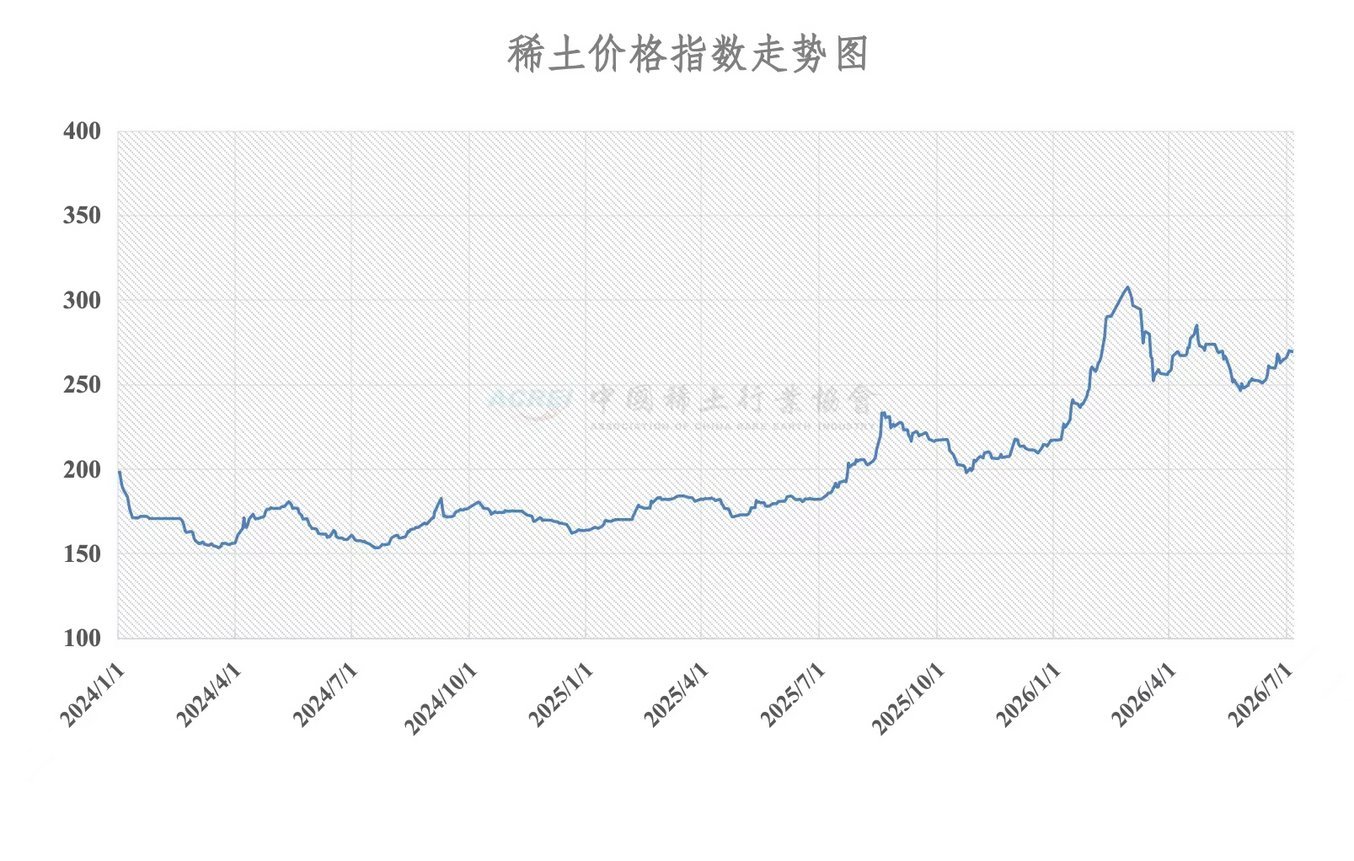
Heavy Rare Earths Continue to Tell the Story
The China Rare Earth Industry Association (CREIA) reported its daily Rare Earth Price Index at 269.2 (2010 = 100), calculated from reported domestic transactions among Chinese rare earth enterprises.
Notable prices included:
- Terbium oxide: ¥6,490–6,550/kg (US$973–982/kg) ▲
- Dysprosium oxide: ¥1,395–1,435/kg (US$209–215/kg) ▬
- Dysprosium metal: ¥1,765–1,785/kg (US$265–268/kg) ▬
- Lutetium oxide: ¥469–489/kg (US$70–73/kg) ▲
- NdPr oxide: ¥744.8–764.8/kg (US$112–115/kg) ▼
- NdPr alloy: ¥909–929/kg (US$136–139/kg) ▼
(Conversions use approximately US$0.15 per Chinese yuan.)
A Market Unlike Copper—or Gold
China's reported prices are useful indicators of domestic conditions, but investors should avoid treating them as directly comparable to globally traded commodities such as copper or gold.
China's rare earth sector operates within a framework shaped by production quotas, export licensing, state ownership, industrial policy, environmental regulation, and national security priorities including those of the Communist Party. These mechanisms influence supply, liquidity, and pricing behavior, making China's domestic market fundamentally different from a conventional exchange-driven commodity market.
The situation outside China is also far from a textbook free market. Because roughly 10% or less of global rare earth separation occurs outside China, most transactions remain privately negotiated through over-the-counter bilateral contracts with confidential pricing, specifications, and delivery terms. Opacity and asymmetric information flows rule the day. Published price assessments therefore represent snapshots of a thin and highly specialized market rather than universally accepted spot prices. Quoted numbers are subject to trader biases, as we know of situations where hyper profit maximization based on opacity and scarcity is a consideration.
The Real Commodity Is Availability
The most important signal is not today's incremental price changes but the continued scarcity of heavy rare earth materials. Outside China, supplies of dysprosium, terbium, yttrium, holmium, and lutetium remain constrained. In some cases, buyers report difficulty sourcing commercial quantities regardless of published quotations. This increasingly resembles an availability market rather than a conventional price market.
Recent REEx reporting illustrates why caution is warranted. The U.S. Department of Defense's support agreement with MP Materials established a US$110/kg floor for NdPr under that specific transaction—not a universal industry benchmark, although it is discussed as such even by government officials. Likewise, commercial pricing arrangements involving Serra Verde's heavy rare earth production reflect project-specific negotiations rather than standardized global pricing.
Rare Earth Exchanges® takeaway: Investors should focus less on individual published prices and more on who controls physical supply, qualified production, and downstream processing. And when reviewing published pricing, remember that a confluence of factors may bias those numbers. Each deal is unique to some extent. In the emerging rare earth economy, access to material may prove more valuable than any quoted price.
Disclaimer: This report is based on pricing published by the China Rare Earth Industry Association (CREIA). The data reflect reported domestic Chinese transactions and have not been independently verified by Rare Earth Exchanges. Readers should corroborate pricing with multiple commercial sources before making procurement or investment decisions.
Register today: REEx Marketplace™ (opens in a new tab)


0 Comments
No replies yet
Loading new replies...
Moderator
Join the full discussion at the Rare Earth Exchanges Forum →