
Highlights
- Australia's forced divestment of China-linked investors in Northern Minerals marks a pivotal shift where rare earth assets are being securitized like defense infrastructure, reflecting broader geopolitical competition over critical minerals.
- Northern Minerals' Browns Range project in Western Australia is strategically significant because 70% of its value comes from dysprosium and terbium—heavy rare earths essential for EVs, defense systems, and advanced technology that China dominates downstream.
- The divestment underscores that mining rare earths alone creates no industrial power; true strategic leverage requires control of separation, refining, and magnet manufacturing—capabilities where China maintains overwhelming global dominance.
Australia is now forcing a divestment order targeting China-linked investors in Northern Minerals (opens in a new tab) (ASX:NTU), ranked number 10 in Rare Earth Exchanges (REEx) Insights for heavy rare earth elements upstream. The event signals something much larger than a shareholder dispute. The next great geopolitical struggle may not begin with aircraft carriers or tariffs. It may begin with voting rights inside a little-known mining company in Western Australia.
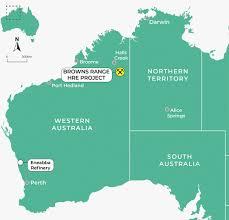
Australia’s decision to force China-linked investors to divest stakes in Northern Minerals, as cited in Reuters, (opens in a new tab) is not merely a corporate governance issue. It is another visible crack in the rapidly evolving battle over industrial sovereignty, strategic materials, and control of the technologies powering the twenty-first-century economy. Reuters correctly reports that Canberra intervened after concerns emerged that Chinese-linked parties were attempting to consolidate influence over the company developing the Browns Range heavy rare earth project.
For most readers, the immediate takeaway is simple: heavy rare earths matter enormously. Dysprosium and terbium are essential for high-performance permanent magnets used in EV motors, advanced robotics, semiconductors, drones, wind turbines, and modern defense systems. Without these materials, many pillars of advanced industrial civilization weaken rapidly.
The Mine Is Only the First Gate
What about the national security dimension surrounding Northern Minerals? This is captured via Reuters; however, as REEx readers fully understand the deeper strategic reality, it sits further downstream. Rare earth mining alone does not create industrial power. The true chokepoints remain separation chemistry, oxide purification, metallization, alloying, and ultimately magnet manufacturing at an industrial scale. China still dominates these layers of the supply chain by overwhelming margins, particularly in heavy rare earth processing, where global dependence remains extreme.
This distinction is critical for investors.
Western governments increasingly understand that owning ore bodies without midstream and downstream capability solves little. A mine can produce concentrate. But modern industrial leverage comes from transforming those materials into qualified magnetic systems embedded inside motors, missiles, AI infrastructure, aerospace systems, and electrified transportation networks.
China’s Long Game Is Becoming Visible
The Reuters article remains measured and largely factual. But it omits the larger geopolitical architecture now emerging around critical minerals.
For decades, Western economies have largely optimized for efficiency, financialization, and low-cost globalization. China pursued something different: industrial depth. Beijing systematically built vertically integrated ecosystems spanning mining, chemical engineering, refining, metallization, magnet manufacturing, workforce development, infrastructure, and strategic financing. That strategy now appears less accidental and far more civilizational.
The Northern Minerals dispute reflects a broader transition now unfolding across the world: strategic mineral assets are increasingly being treated like ports, semiconductors, telecommunications infrastructure, or energy grids. Ownership itself is becoming securitized.
And this may only be the beginning.
The bigger picture emerging is not simple “decoupling.” The West remains deeply dependent on Chinese midstream and downstream rare earth infrastructure. This was at least one reason for the American delegation to Beijing last week. Rather, what is unfolding resembles a slow and unstable rewiring of the industrial world—one where governments increasingly intervene to secure supply chains deemed existential to national resilience, defense, AI, energy systems, and advanced manufacturing. In that environment, rare earths stop being commodities.
They become instruments of statecraft.
Profile
Northern Minerals is an Australian rare earth development company focused on the Browns Range Heavy Rare Earth Project in Western Australia, one of the most advanced dysprosium (Dy) and terbium (Tb)-rich deposits outside China. The company’s flagship Wolverine deposit underpins a JORC-compliant Mineral Resource of 11.7 million tonnes at 0.77% TREO, including 7.3 million tonnes at 0.96% TREO at Wolverine alone. Browns Range is notable because roughly 70% of its projected basket value derives from dysprosium and terbium—critical heavy rare earths used in high-temperature permanent magnets for EVs, wind turbines, robotics, semiconductors, and defense systems.
The company is attempting to position itself as a cornerstone of an emerging ex-China heavy-rare-earth supply chain. Northern Minerals plans to produce approximately 4,350 tonnes per annum of TREO concentrate over an 11-year mine life, with concentrate intended as feedstock for Iluka Resources’ Eneabba refinery in Australia. The project has attracted strategic attention from Australia and the United States, including discussions of conditional support with Export Finance Australia (EFA) and the U.S. EXIM Bank. However, Browns Range remains a pre-production development-stage project facing substantial execution risks, including financing requirements estimated at A$592 million or more, rare-earth price volatility, dependence on downstream processing infrastructure, and broader geopolitical tensions surrounding China’s dominance in heavy rare-earth separation and magnet manufacturing.
Northern Minerals has historically maintained an unusually fragmented and geopolitically sensitive shareholder base dominated by retail investors alongside several China-linked private investment entities. Prior to the Australian government's intervention, some of the largest holders included Beijing-based Vastness Investment Group (6.8%), Hong Kong-based Ying Tak (6.6%), Real International Resources (6.5%), and Qogir Trading & Service Co. (5.5%). These investors appeared to represent strategic, commercially motivated capital seeking exposure to one of the few advanced heavy rare earth projects outside China, particularly given Browns Range’s unusually high dysprosium and terbium exposure. However, Canberra’s national security concerns fundamentally altered the ownership landscape. Australian authorities determined that coordinated influence by China-linked shareholders in a strategically important heavy rare earth company posed potential national-interest risks, leading to forced divestment orders targeting multiple investors.
Today, Northern Minerals remains largely retail-owned, with general public investors estimated to control roughly 38–49% of the register, private companies about 28–29%, and insiders approximately 16%. Institutional ownership remains relatively limited, reflecting both the speculative nature of pre-production rare earth developers and broader Western investor caution toward the sector’s volatile pricing, long development timelines, and dependence on Chinese downstream infrastructure. The forced unwinding of China-linked stakes is notable because it reflects a larger geopolitical transition now unfolding globally: rare earth ownership itself is becoming securitized. Strategic mineral companies are increasingly being treated less like ordinary mining equities and more like critical infrastructure assets tied to defense, industrial resilience, and technological sovereignty.


4 Comments
4 replies
Loading new replies...
Active member
Administrator
Administrator
Active member
Join the full discussion at the Rare Earth Exchanges Forum →