
Highlights
- Starting January 1, 2027, DFARS restricts covered-country involvement across the entire rare-earth supply chain—from mining through finished NdFeB and samarium-cobalt magnets.
- China, Russia, Iran, and North Korea are covered countries, and Executive Order 14415 tightens the waiver process by requiring formal, funded mitigation plans.
- Most U.S. and allied mine-to-magnet projects are still commissioning, scaling, or qualifying—meaning industrial timelines don't align with the 2027 compliance deadline.
- Provenance documentation—proving where material was mined, processed, and manufactured—may prove as difficult as physically sourcing compliant material.
- REEx proposes a 'Supply-Chain IND' framework where contractors document funded transition plans to bridge the gap between legal deadlines and industrial reality.
On January 1, 2027, the Pentagon's rare-earth sourcing rules undergo a fundamental change. Today, the Defense Federal Acquisition Regulation Supplement (DFARS) primarily restricts covered-country production beginning with melting the rare-earth alloy and continuing through finished neodymium-iron-boron (NdFeB) and samarium-cobalt magnets. In 2027, that restriction reaches backward through the entire supply chain—from mining through the finished magnet. China, Russia, Iran and North Korea are the covered countries. Meanwhile, much of America's replacement mine-to-magnet capacity remains under construction, commissioning or qualification. President Donald Trump's July 20 Executive Order 14415 (opens in a new tab) further tightens the waiver environment, requiring accepted formal mitigation plans for specified waivers. The result is a collision between two clocks: Washington's compliance clock strikes January 1; America's industrial-development clock runs years longer.
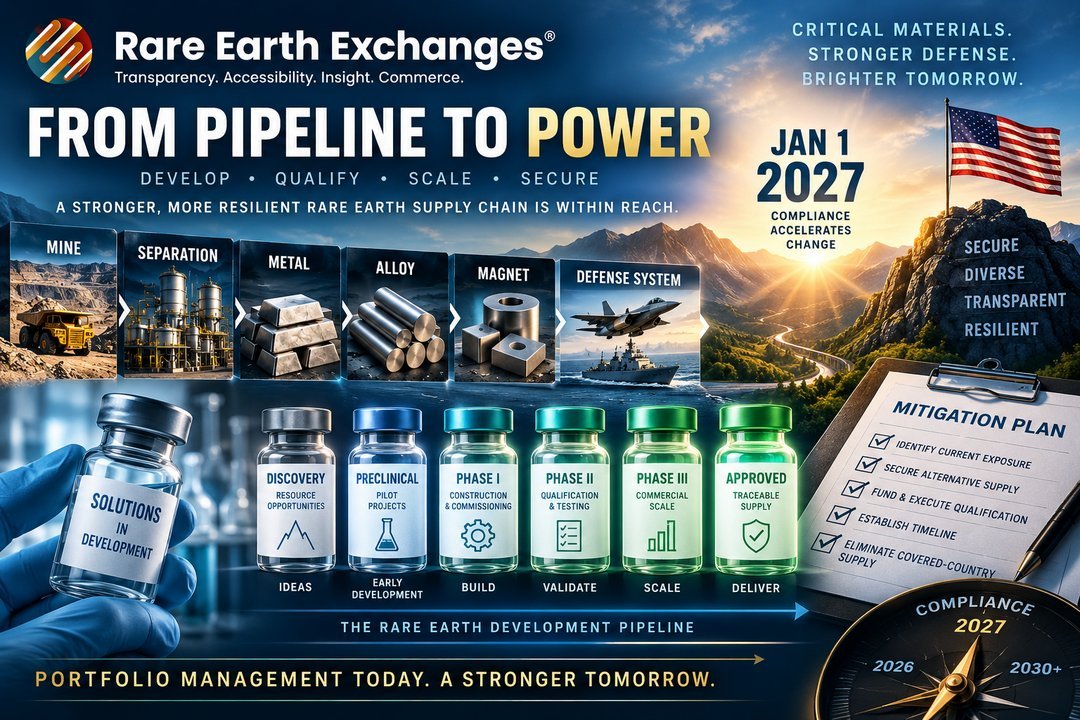
REEx Insight — January 1 Is Really a Provenance Deadline
Rare Earth Exchanges® has tracked this approaching collision throughout 2026 in Mine-to-Magnet or No Contract, An Illusion of Control?, The Magnet Deadline, Pentagon Rewrites the Rulebook, DFARS 2027 Will Break Before Industry Bends and America's Next Defense Challenge Isn't Mining Rare Earths—It's Proving Where They Came From.
The critical point is easily missed: DFARS 2027 is not simply a magnet-manufacturing rule. It becomes a mine-to-magnet provenance rule. A magnet pressed, sintered and magnetized in America may not solve the problem if restricted inputs passed through a covered country upstream.
That creates two simultaneous challenges:
1. Physical availability: Is enough compliant material actually available?
2. Provenance: Can the contractor establish where it came from and where it was processed?
The second could become almost as difficult as the first.
Today Versus January 1, 2027
Through December 31, 2026, the NdFeB and samarium-cobalt restrictions cover melting the constituent elements into magnet alloy and subsequent production steps such as powder formation, pressing, sintering or bonding, and magnetization.
Beginning January 1, DFARS goes upstream. For NdFeB magnets, the rule expressly covers the entire supply chain from mining neodymium, iron and boron through finished magnets. For samarium-cobalt magnets, it similarly reaches from cobalt and samarium ore or feedstock—including recycled material—through the finished magnet.
In plain English: Today: Where was the magnet alloy melted and magnet produced?
2027: Where did the material originate, where did it travel through the supply chain, and where was the magnet ultimately made? That is a radically harder question.
Why Midstream May Become the Real Chokepoint
The rare-earth chain looks deceptively simple: Resource → Separation → Metal → Alloy → Magnet → Qualification → Defense System. But producing ore does not produce a defense-ready magnet.
China continues to dominate magnet-rare-earth refining and sintered permanent-magnet manufacturing. Heavy rare earths such as dysprosium and terbium are especially important because small additions can help NdFeB magnets retain performance at high temperatures—critical in demanding aerospace, motor and defense applications.
That means opening another Western mine does not necessarily solve DFARS if its material must still travel through restricted processing.
Mining capacity is not separation capacity. Separation is not metallization. Metal is not alloy. Alloy is not a qualified magnet. And a qualified magnet without defensible provenance may still present a compliance problem.
Waivers — Washington Is Closing the Easy Exit
Executive Order 14415 significantly changes the waiver landscape.
For specified 10 U.S.C. §4872 waivers, the order requires the contractor or subcontractor to provide a formal mitigation plan identifying the noncompliant source, documenting exhaustive efforts to obtain compliant material, describing how the prohibited source will be removed, and establishing a strict implementation timeline.
Importantly, merely saying "our alternative supplier isn't qualified yet" is insufficient. Failure to qualify a domestic source does not establish nonavailability unless the company demonstrates active, adequately funded and ongoing efforts to qualify one. The order also directs contractual remedies where contractors deliberately mislead the government or knowingly or willfully fail to implement an approved plan.
So REEx would characterize the shift this way: A waiver is no longer intended to be a parking lot. It is supposed to become a bridge. But there is an important legal distinction. A mitigation plan does not itself make prohibited material compliant. Where a contractor cannot satisfy DFARS, continued use requires an applicable exception or legally authorized waiver.
America Has a Development Pipeline—Not Yet a Replacement Industry at Scale
The easiest way to understand the problem is to borrow a concept from pharmaceuticals.
A biotech company may have ten drugs in clinical development. It does not have ten approved medicines.
Rare earths increasingly look similar. America and its allies now possess an impressive portfolio of mines, separators, metal facilities and magnet plants. But these assets sit at very different stages of development. Some are commercially operating. Others are commissioning, scaling or qualifying. Still others remain development projects. Think of the stages as:
- Resource = discovery
- Pilot separation = early clinical development
- Commercial commissioning = late-stage development
- Customer qualification = regulatory review
- Qualified, traceable volume production = approved medicine
The analogy matters because announced capacity is not deliverable capacity.
Ex-China Mine-to-Magnet Development Portfolio — The Race to Qualified DFARS Supply
REEx tracks the emerging U.S. and allied rare-earth portfolio by what matters most for 2027: not announced capacity, but the ability to move from resource → separation → metal/alloy → magnet → qualification → traceable commercial supply.
| Platform | Current Position | Missing Link / Risk | REEx Assessment |
|---|---|---|---|
| MP Materials | Mountain Pass mining and NdPr separation operating; Independence magnet production ramping; HREE separation commissioning activities underway | HREE production must scale; larger 10X magnet expansion still developing | Closest integrated U.S. mine-to-magnet platform |
| USA Rare Earth / Serra Verde / LCM / Carester | Serra Verde producing MREC; Phase 1 targets ~6,400 t/y TREO by end-2027; LCM provides metals/alloys capability; Caremag commissioning targeted; U.S. magnets scaling | Must integrate and qualify multiple assets across Brazil, Europe and the U.S. | Broad mine-to-magnet platform; significant integration ahead |
| Lynas Rare Earths | Large commercial mine/separation system spanning Australia and Malaysia; HREE separation underway; DoD-backed U.S. HREE initiative | Proposed U.S. HREE facility remains uncertain; lacks integrated magnet manufacturing | Most important established allied upstream/midstream bridge |
| Energy Fuels / ASM / VAC | White Mesa can produce up to 1,000 t/y NdPr; HREE expansion underway; ASM adds Korean metals/alloys; VAC Sumter provides ~2,000 t/y magnet capacity | Commercial Dy/Tb scale and full integration still developing; larger Phase II capacity comes later | One of the broadest emerging U.S.-allied chains after MP |
| Neo Performance Materials | Silmet separation operating in Estonia; Narva magnet manufacturing ramping | Long-term feedstock security, HREE depth and upstream provenance remain issues | Real European industrial platform; not yet fully sovereign mine-to-magnet |
| REalloys / Saskatchewan Research Council | SRC expansion funded; targets ~30 t/y Dy oxide and 15 t/y Tb oxide; REalloys developing HREE metallization | Commercial ramp, metallization and customer qualification required | Potentially important North American HREE bridge |
| Evolution Metals & Technologies | Korean magnet operations; reports OEM qualification across six NdFeB grades, including HREE-containing grades; received non-China NdPr metal from Vietnam | Must demonstrate sustained compliant feedstock, provenance and production at projected scale | Advanced downstream position; upstream chain still being secured |
| ReElement Technologies | Indiana demonstration/commercialization operations; chromatography-based separation designed for light and heavy REEs; larger Marion commercial facility under development | Must prove sustained commercial-scale throughput, economics and purity across multiple feedstocks while securing compliant supply | Potentially disruptive U.S. separator; scale-up is the critical test |
| Phoenix Tailings / Freedom Facility | Planned U.S. facility designed to process multiple feedstocks into light and heavy REE products and metals; ~$1B initiative anchored by conditional $500M federal financing | Construction, financing conditions, feedstock qualification, commissioning and commercial ramp; initial operations targeted for 2028 | Potentially major separation-to-metal bridge—but arrives after the 2027 deadline |
| Aclara Resources | Brazil/Chile ionic-clay resources; U.S. pilot separation; Louisiana commercial separation facility planned | Commercial resource production, Louisiana scale-up, metallization and downstream qualification remain ahead | Strategically promising HREE platform; pre-commercial at integrated scale |
| Meteoric Resources / Ucore | Caldeira offers potentially significant Brazilian HREE feedstock; possible pathway into Ucore's Louisiana separation platform | Mine development, commercial separation, metals/alloys and magnet qualification | Promising resource-to-separation pathway; still development stage |
| Brazilian Rare Earths | Large Bahia rare-earth resource portfolio advancing, including high-grade discoveries | Resource definition, metallurgy, permitting and commercial downstream pathway remain ahead | Potentially strategic future source; earlier development stage—but vast holding with huge potential |
| Caldera Holding / Pea Ridge Mine | Historic Missouri mine with existing infrastructure and permits; Caldera reports ~130,000 tonnes of REEs in tailings, including HREEs, plus underground mineralization | Financing | Compelling domestic HREE opportunity with brownfield advantages; in final financing discussions |
The table reveals the central problem: the portfolio is real, but the timelines do not line up with January 1. How to resolve this issue? See the sections below.
The "Supply-Chain IND"
This is where formal mitigation plans could become strategically important.
An Investigational New Drug application or "IND" tells regulators what a drug developer is building, how it will test it, how it will manufacture it and how development progresses toward an approvable medicine.
A defense supplier could construct the equivalent of a "Supply-Chain IND" around its mitigation plan.
It could identify its existing prohibited source, select a replacement mine/separator/metals/magnet pathway, document contracts and committed capital, establish qualification milestones, maintain legitimate inventory buffers and set a firm date for eliminating the covered-country dependency.
Consider a contractor whose Chinese Dy/Tb supply cannot immediately be replaced. Its transition could potentially look like this:
A Plausible DFARS Transition Path
| Period | Supply-Chain Stage | Contractor Milestone |
|---|---|---|
| Jan. 2027 | Authorized transition, where legally available | Applicable waiver/exception + accepted mitigation plan + legitimate inventory; demonstrate funded replacement effort |
| 2027–28 | Ex-China separation qualifies | Energy Fuels, SRC, Lynas or another permissible supplier enters qualified supply |
| 2028 | Metals/alloys and magnets qualify | Convert compliant oxide and complete customer/program testing |
| 2029 | Covered-country dependency eliminated | Remove prohibited material from affected pathway and complete mitigation milestones |
| 2030+ | Redundancy | Establish second qualified sources rather than replacing one chokepoint with another |
This is illustrative—not a guarantee that DoD will approve such a timeline. But it exposes the policy question Washington and industry increasingly face: What happens when a contractor cannot physically obtain qualified compliant material on January 1—but can prove that it has contracted, funded and begun qualifying the replacement?
Like a pharmaceutical portfolio, America now has numerous candidates in development. The January 2027 problem is that too few have reached "approval"—qualified, scalable and traceable commercial supply.
Lynas Shows Why "Ex-China" Is Not Necessarily "U.S.-Only"
Lynas provides another important lesson. It already operates one of the world's largest rare-earth systems outside China, spanning Mt Weld in Australia and processing in Malaysia and Australia. The Pentagon has supported Lynas as part of its strategy to establish alternative supply. That illustrates an essential distinction: The strategic objective is not necessarily to make every stage American. It is to build permissible, traceable supply chains that do not depend upon covered countries. Australia, Canada, Europe, Brazil, South Korea and other allied or permissible jurisdictions can therefore matter enormously—subject always to the precise DFARS requirements, exceptions and contract involved.
The Hard Questions Begin January 1
Suppose an F-35, submarine, drone, radar or precision-munition supplier has exhausted reasonable alternatives but its replacement magnet remains eighteen months from qualification.
- Does production stop?
- Can existing compliant inventory bridge the gap?
- Can DoD legally authorize temporary relief?
- Can an allied separator bridge supply while a domestic source qualifies?
- What if the mine is compliant but separation occurred in China?
- What if the oxide is compliant but the origin of the metal cannot be demonstrated?
And perhaps most importantly: What happens when a contractor can prove compliance is physically unavailable today—but can also prove it has spent real money making compliance achievable within, say, 24 months?
These are no longer abstract questions. The rule itself says that beginning January 1, covered material cannot have been mined, refined, separated, melted or produced in a covered country, subject to the regulatory exceptions and waiver authorities.
REEx Bottom Line — Industrial Time Versus Compliance Time
The United States does not lack rare-earth projects. It lacks enough fully integrated, qualified and traceable supply at scale. That distinction should drive industrial policy. Washington should measure progress not by mines announced, grants awarded or nameplate tonnes promised, but by how rapidly supply chains move through: Resource → Separation → Metal → Alloy → Magnet → Qualification → Traceable Defense Supply.
January 1 should remain a forcing mechanism. But where legally available, tightly controlled mitigation-plan waivers could connect legal urgency to physical industrial development—provided contractors demonstrate real capital, real contracts, measurable milestones and a hard exit from prohibited sourcing.
Until enough projects reach qualified commercial scale, the Pentagon faces two obligations that may increasingly collide: enforce DFARS and, critically, keep the defense industrial base operating while replacement supply finishes development. Energy Fuels, REalloys/SRC, Aclara, and numerous other projects illustrate the timing problem. These are not necessarily failed projects. Their industrial clocks simply do not match Washington's January 2027 compliance clock.


0 Comments
No replies yet
Loading new replies...
Moderator
Join the full discussion at the Rare Earth Exchanges Forum →