
Highlights
- The U.S. Supreme Court invalidated Trump's emergency China tariffs in February 2026, removing a key negotiating tool just weeks before a planned summit with President Xi Jinping.
- While the ruling may provide tactical advantage to Beijing in negotiations, China's rare earth leverage stems from controlling 85–90% of global processing capacity—not tariff dynamics.
- Investors must distinguish between diplomatic posturing and structural reality: China's rare earth dominance is built on 30 years of industrial policy, not short-term trade measures.
What happens when a president loses his tariff hammer days before sitting across the table from Beijing — and rare earth metals sit quietly in the background?
According to a February 22, 2026, report by Bloomberg, the U.S. Supreme Court invalidated former President Donald Trump’s sweeping emergency tariffs, stripping away a key negotiating tool just weeks before a planned summit with Chinese President Xi Jinping. The ruling eliminates Trump’s second-term China-specific levies and leaves Beijing facing the same temporary 15% global tariff applied to U.S. allies, reportedly capped with a 150-day expiry window.
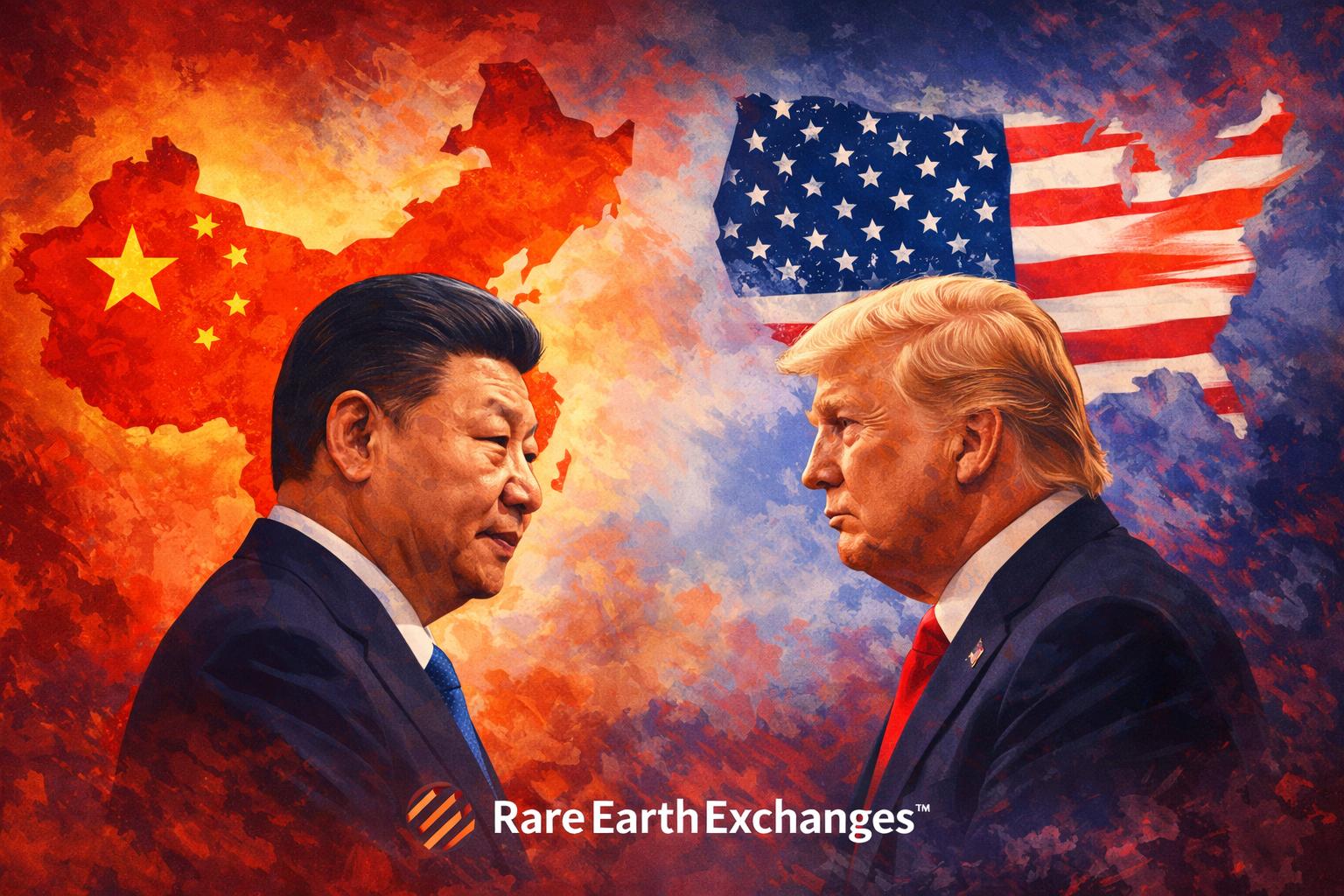
So, at least one interpretation: Washington just lost the leverage it had used aggressively. The question is whether that loss materially strengthens China’s hand — particularly where rare earth elements (REEs) are concerned.
Tariff Shockwaves — But How Deep?
Bloomberg frames the decision as a strategic setback for the U.S., quoting Wu Xinbo of Fudan University, who argues the ruling puts China “in a much stronger bargaining position.” The article suggests diminished U.S. tariff power may weaken Washington’s ability to extract concessions — from soybean purchases to rare earth supply continuity.
That interpretation is plausible in negotiation optics. Tariffs were a visible pressure tool.
But here is where we separate headline drama from industrial reality.
The Rare Earth Reality: Structure Beats Symbolism
China controls roughly 60–70% of global rare earth mining and approximately 85–90% of processing and separation capacity. In heavy rare earth separation — dysprosium and terbium critical for high-temperature magnets — Beijing’s dominance is even more acute, as we have continuously conveyed.
Those numbers are not political talking points. They are structural industrial facts.
Rare earth leverage historically operates through export licensing, quota management, environmental inspections, and state consolidation — not tariff retaliation. The consolidation of China’s “Big Six” rare earth groups is a state-engineered industrial strategy decades in the making—frankly, that most in the West still don’t quite understand.
Tariffs regulate trade flows. Rare-earth power stems from upstream geology, midstream separation chemistry, and division-of-labor chokepoints. Those are fundamentally different levers.
Negotiation Theater or Strategic Reversal?
Is Xi suddenly empowered? Perhaps tactically. Losing a tariff threat narrows one negotiating channel.
But the U.S. still wields export controls on advanced semiconductors, defense restrictions, industrial subsidies via the Inflation Reduction Act, and reshoring incentives. Trade leverage today is multidimensional. Bloomberg’s framing leans toward portraying the ruling as a decisive strategic win for Beijing. That interpretation may overstate the impact on critical mineral dynamics due to the factors and forces cited herein.
Why Rare Earth Investors Should Care
What matters is timing. The U.S. is accelerating domestic heavy-rare-earth separation and magnet reshoring projects. Any perceived weakening of trade leverage highlights how dependent Western industry remains on Chinese processing capacity.
The Supreme Court decision may shift diplomatic posture. It does not alter the physics of the rare earth supply chain.
China’s dominance rests on 30 years of coordinated industrial policy — not tariff brinkmanship.
Investors must separate political theaterfrom metallurgical reality.
Rare Earth Exchanges™ will continue to hold both narratives accountable.


0 Comments
No replies yet
Loading new replies...
Moderator
Join the full discussion at the Rare Earth Exchanges Forum →