
Highlights
- A hydrogen scooter using solid-state rare earth alloy storage debuted on Chinese national television, emitting only water and enabling cartridge swaps instead of recharging.
- A pilot fleet of 1,000 scooters launched in Baotou has logged roughly 350,000 kilometers with no reported safety incidents, though results remain independently unverified.
- Solid-state hydrogen storage could reshape clean mobility in cold climates, military logistics, and industrial fleets where batteries underperform.
- The development signals rare earths evolving into advanced functional engineering materials beyond permanent magnets, including catalysts, lasers, and now hydrogen storage.
- Nations mastering rare earth materials science and hydrogen storage manufacturing may capture far greater value from the clean-energy transition than raw material exporters alone.
A hydrogen-powered two-wheeled vehicle built around solid-state rare earth hydrogen storage has emerged as another example of how rare earth elements are moving beyond permanent magnets into advanced energy applications. The scooter, recently featured on Chinese national television, uses a proprietary rare earth alloy capable of storing hydrogen at relatively low pressure, reducing the need for high-pressure tanks while enabling onboard electricity generation through a hydrogen fuel-cell system. Water is the only reported tailpipe emission.
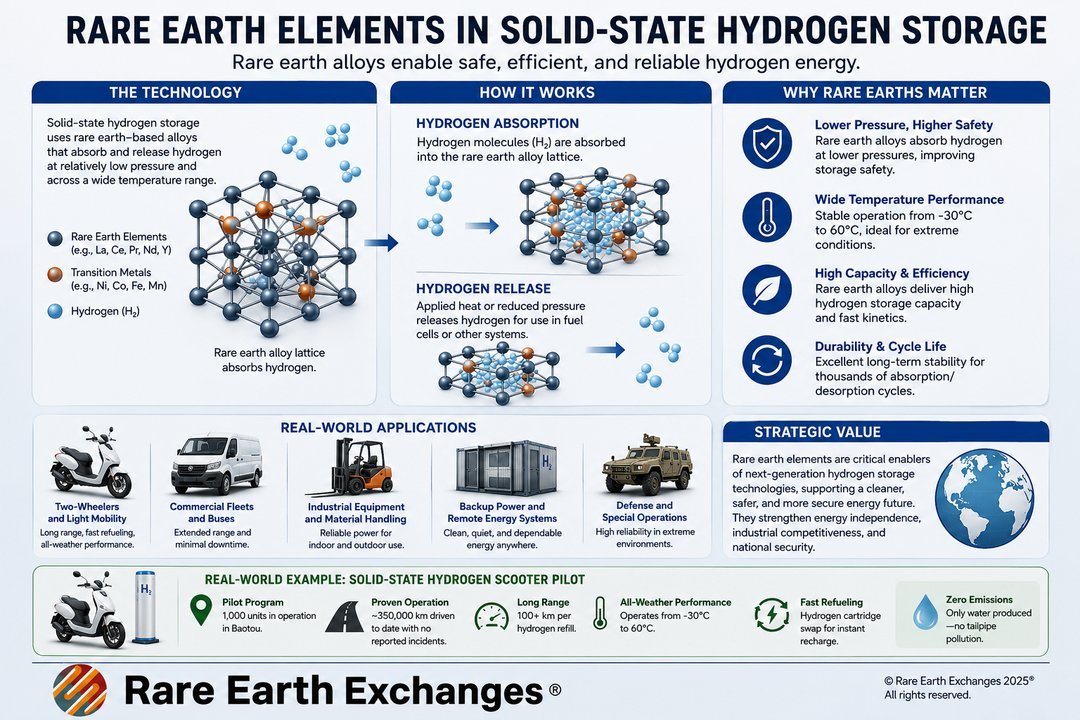
According to the developer, the vehicle incorporates continuous monitoring of pressure and temperature, travels more than 100 kilometers (62 miles) per hydrogen refill, and operates across an unusually wide temperature range of -30°C to 60°C (-22°F to 140°F). Rather than waiting to recharge a battery, riders can reportedly swap hydrogen cartridges and immediately continue their journey.
Pilot Program Moves Into Real-World Testing
The company reports that a pilot fleet of 1,000 hydrogen scooters began operating in Baotou in late May. Officials say the vehicles have collectively accumulated roughly 350,000 kilometers (217,000 miles) of operation without reported safety incidents. While these claims remain independently unverified, the project has progressed beyond a laboratory demonstration into an operational field trial intended to gather reliability and customer-use data before broader commercialization.
Why This Matters for the West
The significance extends well beyond scooters.
If solid-state hydrogen storage matures commercially, it could reshape portions of the hydrogen economy by offering safer, lower-pressure storage systems for applications where batteries struggle, particularly in cold climates, remote operations, military logistics, industrial fleets, and light commercial transportation. While lithium-ion batteries remain dominant, hydrogen technologies continue to compete in niches requiring rapid refueling, long operating hours, or reliable performance in extreme temperatures.
For investors and policymakers, the announcement illustrates another important trend: rare earths are increasingly becoming functional engineering materials rather than simply inputs for permanent magnets. Rare earth alloys already play critical roles in catalysts, polishing compounds, lasers, and defense technologies. Solid-state hydrogen storage could represent another high-value downstream market if technical and economic hurdles can be overcome.
The broader strategic implication is equally noteworthy. Nations that control not only rare earth mining but also advanced materials science, hydrogen storage technologies, manufacturing, and deployment may capture significantly more value from the clean-energy transition than countries focused primarily on raw material extraction. This reflects the increasingly important competition over intellectual property, materials engineering, and integrated industrial ecosystems—areas where commercial leadership may ultimately prove more valuable than resource ownership alone.
Disclaimer: This report is based on information released through Chinese state-owned media and statements from a state-owned enterprise. The reported technical performance, operational results, and commercialization prospects have not been independently verified and should be confirmed through independent sources before informing investment or business decisions.


0 Comments
No replies yet
Loading new replies...
Moderator
Join the full discussion at the Rare Earth Exchanges Forum →