
Highlights
- Energy Fuels executives participated in key panel discussions about advancing mineral projects across the Americas.
- Company emphasizes bridging supply chain gaps in processing and refining critical minerals beyond Chinese dominance.
- Symposium underscores the strategic importance of developing domestic mineral infrastructure and non-Chinese supply chains.
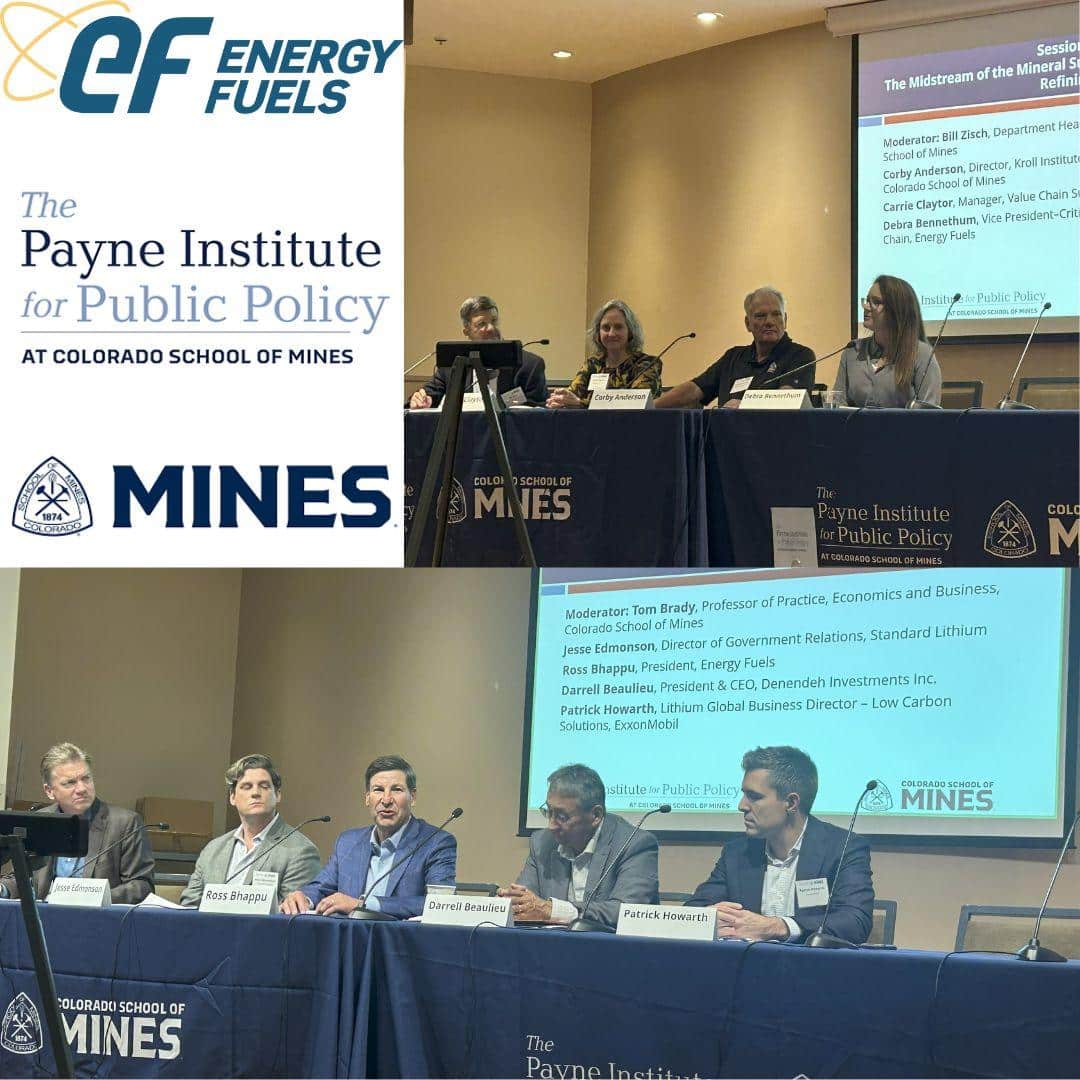
Last week, Energy Fuels Inc. (opens in a new tab) ($UUUU / $EFR) demonstrated its growing presence in the North American critical minerals conversation as President Ross R. Bhappu and Vice President of Critical Minerals Debra Porter Bennethum participated in high-profile panel discussions at the Payne Institute for Public Policy’s Critical Minerals Symposium (opens in a new tab) hosted by the Colorado School of Mines (opens in a new tab).
Front-End of the Supply Chain: New Projects in the Americas
Bhappu joined a panel featuring Tom Brady (Colorado School of Mines), Jesse Edmondson, P.G. (Standard Lithium), Darrell Beaulieu (Denendeh Investments Inc), and Patrick Howarth (ExxonMobil).
- Key theme: Advancing new mineral projects across the Americas, with emphasis on unlocking resources beyond China’s dominance.
- Takeaway: The panel highlighted both opportunities and headwinds—from permitting delays to financing hurdles—but pointed toward strategic alignment with U.S. industrial policy as a lever for progress.
Midstream Matters: Processing & Refining
Bennethum participated in a separate panel with William Zisch (Colorado School of Mines), Dr. Corby G. Anderson, PE (Kroll Institute for Extractive Metallurgy), and Carrie Claytor (Freeport-McMoRan).
- Key theme: The “midstream gap”—processing and refining capacity outside China.
- Takeaway: The panel underscored that mining alone is insufficient; as Rare Earth Exchanges (REEx) often chronicles, without domestic refining and separation infrastructure, the U.S. risks remaining dependent on imports. Bennethum emphasized Energy Fuels’ unique positioning as a U.S.-based uranium and rare earths player already scaling separation capacity at its White Mesa Mill.
Why This Matters
Energy Fuels’ dual representation at both ends of the value chain—Bhappu on project development and Bennethum on midstream refining—illustrates the company’s attempt to position itself as a bridge across the supply chain. The presence of major industry names like ExxonMobil and Freeport-McMoRan only reinforces the stakes: securing reliable, non-Chinese supply chains is no longer a niche topic but a central pillar of U.S. industrial policy.
REEx Take
The Colorado School of Mines symposium is more than just academic chatter—it’s where policy, industry, and capital converge. Energy Fuels’ visibility here shows it is actively shaping the narrative around U.S. mineral independence. That said, the path from conference panels to scaled production remains fraught with permitting, cost, and technology risks. Investors should view this as a signal of strategic positioning, not yet proof of market dominance.
©!-- /wp:paragraph -->


0 Comments
Discuss this article