
Highlights
- Supply chains are brittle, not resilient—hidden chokepoints expose industrial fragility as Great Powers Era 2.0 makes control over refining, metallization, and critical materials the new definition of national power.
- The Trump doctrine may be strategic disruption: tariffs and sanctions as catalysts to break dependencies, fracture global flows, and force U.S. reindustrialization through controlled instability.
- A U.S.-Iran alignment could reshape global power—converting Iran's strategic assets into U.S.-aligned industrial infrastructure to preempt China and rewire supply chains through integration, not force.
The global economy is sending a clear signal: supply chains are not resilient—they are brittle. Beneath headline commodities like oil, hidden chokepoints—from naphtha to helium—are fracturing under stress, exposing how fragile the modern industrial system has become.
This may not be accidental. Rather it could be structural—and increasingly geopolitical.
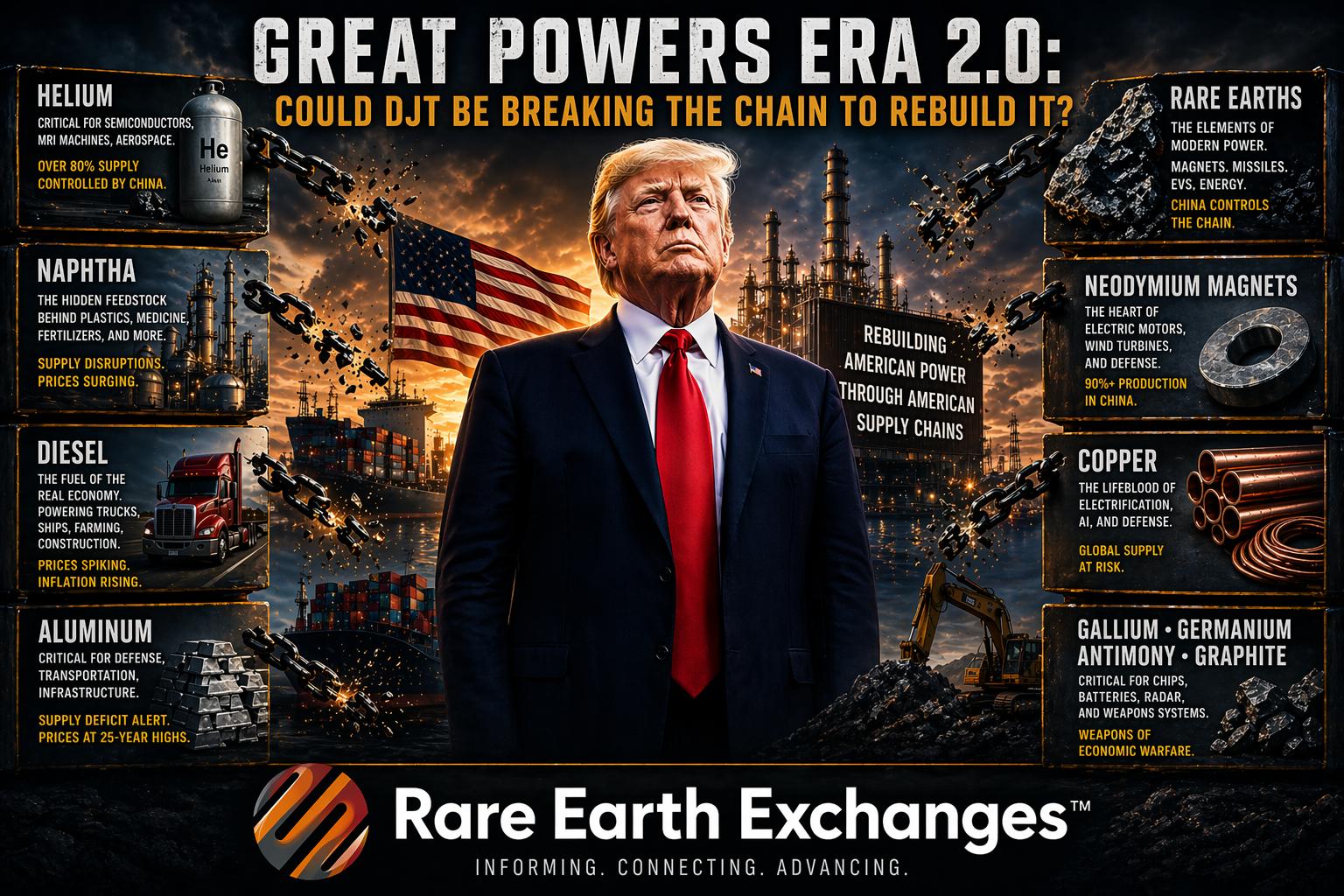
We have entered what Rare Earth Exchanges™ calls Great Powers Era 2.0, where control of supply chains—not just military strength—defines national power. A navy can secure sea lanes. It cannot secure refining capacity, metallization, or magnet production, let alone the vast array of petroleum-based products in Middle East supply chains. Those reside in industrial ecosystems, and today, China dominates many of them—especially rare earths.
But what if disruption itself is a strategy?
The Trump doctrine—often interpreted as chaotic or destructive—may reflect a deeper thesis: break the existing system to force a new one into existence. Tariffs, sanctions, and economic confrontation are not just pressure tools; they are catalysts. They expose dependencies, fracture global flows, and compel capital to rebuild domestically.
The risks are obvious: inflation, volatility, near-term dislocation, and the absolute human tragedy that could unfold in the Middle East. At the same time, the upside becomes difficult to ignore—a forced reindustrialization of the United States and its allies, anchored in control over critical supply chains.
In this framing, today’s instability is not failure. It is phase one of a multi-phased unfolding execution.
The question is not whether supply chains will break. They already are. The real question is who rebuilds them—and who controls what comes next.
What if the unthinkable happens—not conflict, but alignment? If Washington and Tehran strike a deal that moves beyond nuclear containment into industrial reconstruction, the implications could be profound. Iran sits atop vast energy reserves, critical minerals, and one of the most strategically important chokepoints on earth—the Strait of Hormuz. Today, that leverage is weaponized; in a deal framework, it could be industrialized.
Recent negotiations already signal the potential for momentum toward de-escalation, driven by economic pressure and geopolitical necessity for all sides involved. If the U.S. were to co-lead reconstruction—rebuilding energy systems, petrochemicals, and downstream supply chains—it could preempt China’s long-standing infrastructure ambitions and dilute the emerging China–Russia–Iran axis shaping global trade corridors.
The play would be bold: convert a destabilizing node into a controlled partner, anchor supply chains in U.S.-aligned capital and standards (including a reform trajectory for Iran), and reclaim strategic ground not through relentless, lethal and expensive force, but through industrial integration.
In Great Powers Era 2.0, that is what winning could look like—not just breaking systems, but rewiring them before rivals do.


0 Comments
No replies yet
Loading new replies...
Moderator
Join the full discussion at the Rare Earth Exchanges Forum →