
Highlights
- China controls 98% of global heavy rare earth element (HREE) refining capacity, creating a systemic strategic chokepoint beyond geology—spanning extraction, separation, and processing of critical materials like dysprosium and terbium.
- Over 90% of HREE supply comes from ion-adsorption clay deposits, with extraction evolving from surface leaching to in-situ methods that improve recovery but cause persistent environmental damage including soil degradation and water contamination.
- The U.S. lacks meaningful HREE separation and refining capacity at scale, leaving it structurally exposed as demand accelerates for high-temperature magnets in defense systems, aerospace, and electrification technologies.
A 2026 review (opens in a new tab) led by Yilin He of the Chinese Academy of Sciences, with a consortium of Chinese academic collaborators, delivers a comprehensive assessment of heavy rare earth elements (HREEs)—the most strategically critical and supply-constrained subset of the rare earth family. The paper highlights a stark and uncomfortable reality: more than 90% of global heavy rare earth supply originates from ion-adsorption clay deposits, and China controls approximately 98% of global HREE refining capacity—the stage where true economic and strategic value is created. These materials, including dysprosium and terbium, are indispensable for high-temperature permanent magnets used in advanced defense systems, aerospace platforms, and electrification technologies.
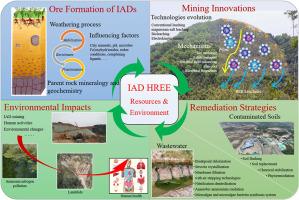
The Science Behind the Constraint
The study organizes HREE research into four pillars: formation, extraction, environmental impact, and remediation. Unlike light rare earths, as Rare Earth Exchanges™ has reported, HREEs are largely sourced from weathered clay deposits formed through long-term geochemical processes. Extraction has evolved from surface leaching to in-situ ammonium-based methods—improving recovery but introducing persistent environmental damage, including soil degradation and water contamination. Emerging techniques such as bioleaching and electrokinetic extraction show promise but remain unproven at scale.
Why It Matters: Control Lives in the Midstream
Demand for HREEs is accelerating, with dysprosium and terbium critical for maintaining magnet performance at high temperatures—especially in military systems and electric drivetrains. Yet supply remains both geologically scarce and industrially concentrated. The United States has limited separation capabilities and no meaningful heavy rare-earth refining at scale, leaving it structurally exposed. China’s dominance is not just geological—it is systemic, spanning extraction, separation, and downstream processing.
What the Study Doesn’t Fully Address
While technically rigorous, the review is not geopolitically neutral. It emphasizes sustainability and environmental remediation but largely avoids confronting the implications of China’s near-total control over refining. The paper also highlights deep-sea muds as a potential future source, but economic viability, regulatory barriers, and environmental risks remain unresolved.
REEx Bottom Line
This is not a mining problem. It is a refining chokepoint problem.
In GreatPowers Era 2.0:
- Mining = access
- Refining = control
Until the West builds non-China HREE separation and refining capacity—at scale—strategic dependency remains intact.
Citation: He, Y. et al. (2026). Heavy rare earth elements: Critical resources, environmental challenges and pathways to sustainability. Journal of Rare Earths.


0 Comments
No replies yet
Loading new replies...
Moderator
Join the full discussion at the Rare Earth Exchanges Forum →