
Highlights
- India invites firms to build integrated NdFeB magnet plants through a March 2026 tender, offering up to ₹1,440 crore ($170m) per project to close the gap between oxide production and finished magnets.
- The scheme targets 6,000 tonnes annual capacity across five plants with output-linked subsidies capped at 40% of sales, but faces a critical feedstock constraint—domestic oxide supply covers only 1,500 MTPA.
- Success depends not on subsidy bidding but on bringing process expertise, feedstock strategy, and execution discipline to scale complex magnet metallurgy within tight timelines.
India is making its boldest push yet into the rare-earth midstream—the narrow, strategic layer where ores become magnets. A March 2026 government tender invites firms to build integrated NdFeB magnet plants, aiming to convert domestically produced oxides into finished components at scale.
For a lay reader: India already extracts and refines some rare earths, but largely exports value by importing finished magnets. This policy is meant to keep that value at home.
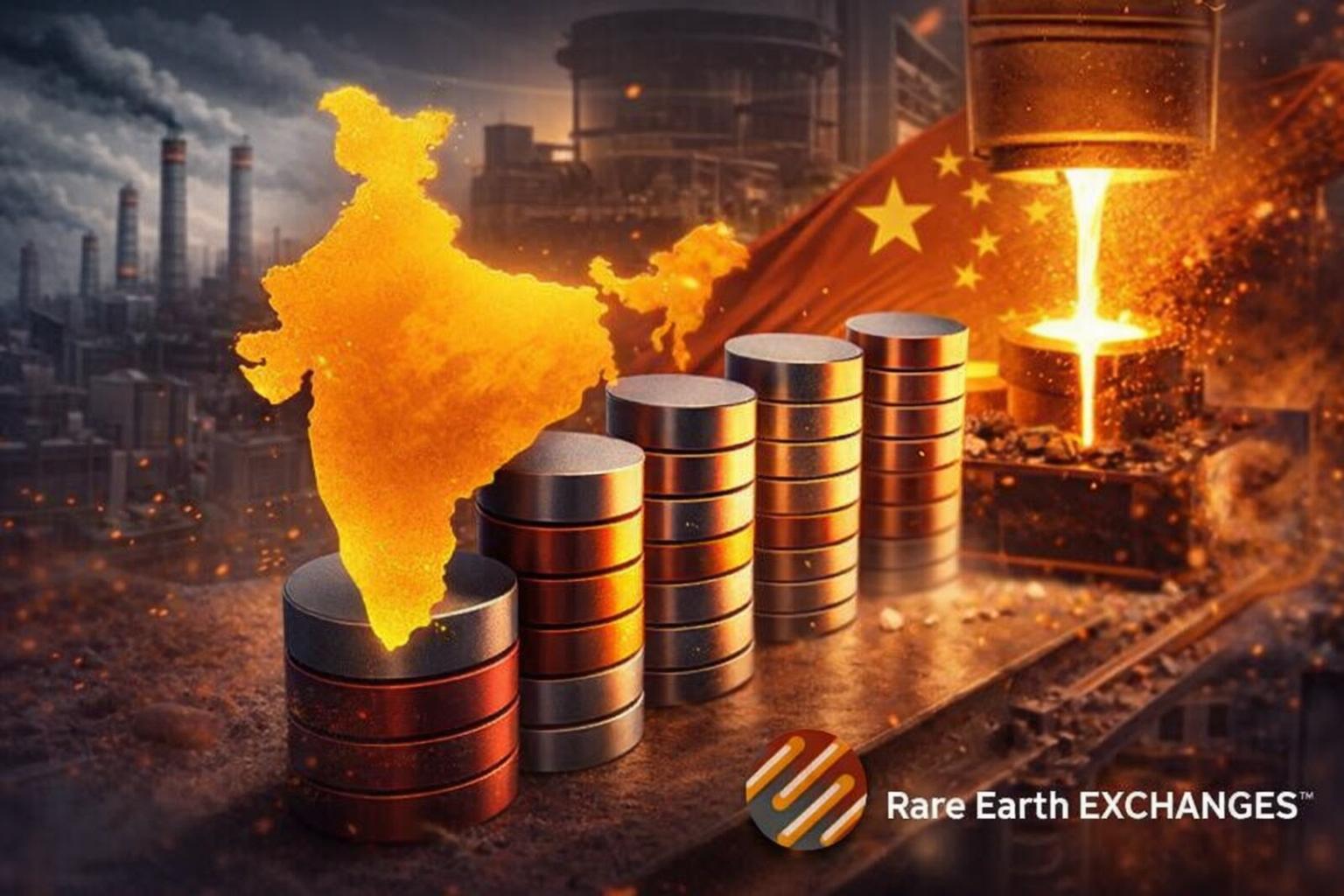
Building the missing middle
The target is explicit: close the gap between oxide production and magnet manufacturing—oxide → metal → alloy → magnet. India’s upstream base, led by IREL (India) Limited, is modest but real. Its midstream, however, is largely absent. As a result, India imports most of its NdFeB magnets despite having reserves.
The scheme is therefore less about mining than about industrial upgrading.
A sizeable, structured subsidy
The incentives are meaningful but disciplined. Each project can receive:
- Capital subsidy: up to ₹150 crore
- Sales incentives: up to ₹1,290 crore
That implies a ceiling of roughly ₹1,440 crore ($170m) per plant. Across five winners and 6,000 tonnes of annual capacity, total exposure approaches ₹7,000–₹8,000 crore (about $0.9bn–$1bn).
Crucially, subsidies are tied to output and capped at 40% of sales—suggesting an attempt to avoid open-ended fiscal support.
Factories, not façades
Bidders must build genuinely integrated facilities:
- Minimum capacity: 600 MTPA; maximum: 1,200 MTPA
- Minimum investment thresholds: ₹300–₹600 crore depending on scale
- 50% commissioning within three years
This is not an assembly. It requires metallurgical capability across the full chain.
The feedstock constraint
Here, the ambition meets reality. India’s current NdPr oxide output is about 400 MTPA, with stockpiles lifting near-term support to roughly 1,500 MTPA of magnets—well below the scheme’s 6,000 MTPA ambition.
Only the top-ranked bidders are assured a limited supply from IREL; the rest must source independently.
In practice, that likely means imports—often from China.
Sensible design, familiar risks
The scheme gets several things right: it targets the true bottleneck, uses competitive bidding, and mandates integration. Yet risks are evident. Feedstock security is thin. Technology must often be imported. And scaling complex magnet metallurgy on tight timelines is difficult.
A careful step into the fray
India’s effort is serious—and overdue. It signals that the contest for the rare-earth midstream is widening beyond China. Yet the paradox remains:
Capital can build factories faster than supply chains, and know-how can be secured.
For investors, the signal is clear. The winners will not simply be those who bid lowest for subsidies, but those who bring process expertise, feedstock strategy, and execution discipline.


0 Comments
Discuss this article