
Highlights
- India launched a ₹34,300 crore National Critical Mineral Mission and a ₹7,280 crore permanent magnet manufacturing incentive targeting 6,000 MTPA of NdFeB capacity.
- Despite policy momentum, India imported over 53,000 tonnes of permanent magnets in FY2025 with roughly 90% sourced from China, exposing deep supply chain dependence.
- India's biggest challenge is the industrial 'missing middle'—the complex chain from separation and metals to alloys, powders, magnets, and customer qualification.
- Four federally backed rare-earth corridors span Odisha, Kerala, Andhra Pradesh, and Tamil Nadu, with states competing aggressively to anchor the emerging ecosystem.
- Recycling firms and urban mining could offer India one of its fastest paths to strategic resilience as end-of-life magnets become a domestic feedstock source.
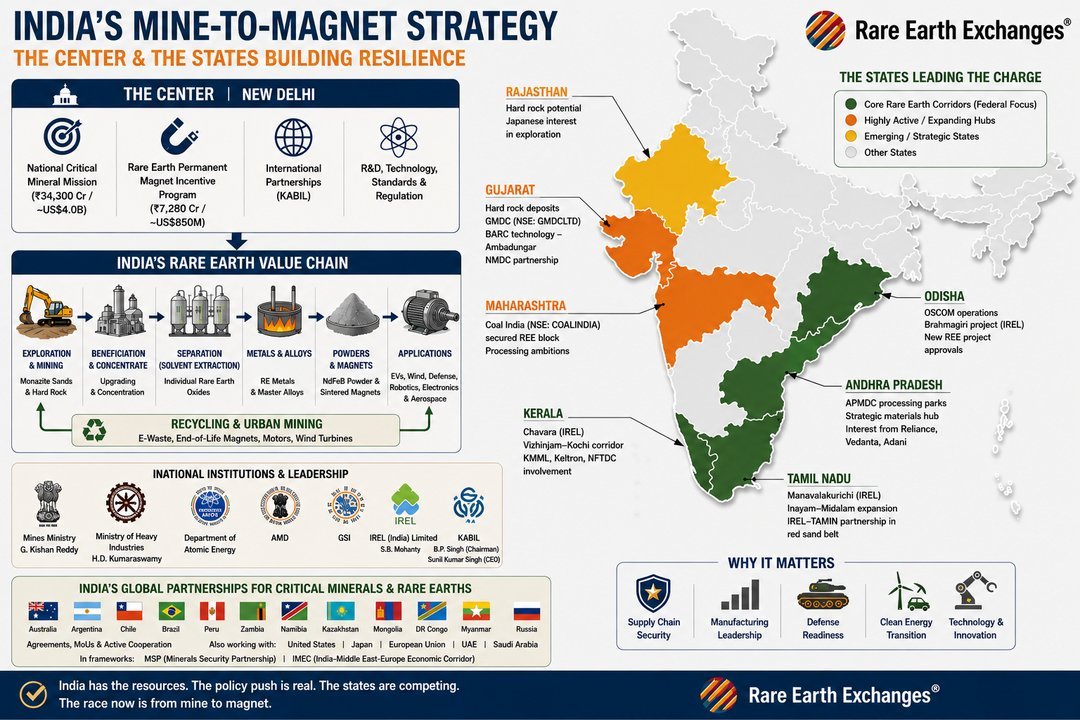
India has finally moved from speeches to industrial architecture. The government has launched a ₹34,300 crore (approximately US$4.0 billion) National Critical Mineral Mission, a ₹7,280 crore (approximately US$850 million) rare-earth permanent magnet manufacturing incentive program, and four federally backed rare-earth corridors spanning Odisha, Kerala, Andhra Pradesh, and Tamil Nadu. This marks India's first comprehensive mine-to-magnet strategy.
The urgency is obvious. India imported 53,748 tonnes of permanent magnets in FY2025, with approximately 90%+ sourced from China. Even after Beijing tightened export controls, China still supplied roughly 88% of India's imports during the first half of FY2026.
Rare Earth Exchanges® believes India's geology is significant, its policy shift is genuine, and state-level competition is accelerating. But the country's greatest challenge remains what we call the industrial "missing middle"—commercial-scale separation, metals, alloys, powders, magnet manufacturing, qualification, recycling, and supply-chain integration. Until those capabilities mature together, China will continue to own the strategic advantage.
Delhi Has Finally Drawn the Battle Map
India's rare-earth strategy is no longer aspirational. It has become industrial policy. The National Critical Mineral Mission spans exploration, mining, beneficiation, separation, processing, downstream manufacturing, recycling, and international resource acquisition. Complementing it is a permanent magnet manufacturing program targeting approximately 6,000 metric tonnes per annum (MTPA) of integrated NdFeB magnet capacity, supported by guaranteed NdPr oxide supplied by IREL (India) Limited to successful bidders.
The objective is simple but profound: India cannot become a manufacturing superpower in electric vehicles, wind energy, robotics, aerospace, semiconductors, defense systems, and artificial intelligence while importing the magnetic heart of those industries from China.
Leadership is increasingly coordinated. Mines Minister G. Kishan Reddy (opens in a new tab), Heavy Industries Minister H.D. Kumaraswamy (opens in a new tab), the Department of Atomic Energy, Atomic Minerals Directorate (opens in a new tab) (AMD), Geological Survey of India (opens in a new tab) (GSI), IREL Limited under Chairman and Managing Director S. B. Mohanty (opens in a new tab), and Khanij Bidesh India Ltd. (KABIL) (opens in a new tab), chaired by Brijendra Pratap Singh (opens in a new tab) with CEO Sunil Kumar Singh, now form the backbone of India's national strategy.
India's Strategy Doesn't Stop at Its Borders
New Delhi understands a lesson China learned decades ago: resource security cannot be built on domestic geology alone. And the nation's leading figures likely understand at least intuitively that we have crossed into the Great Powers Era 2.0.
Through KABIL—the joint venture of National Aluminium Company Limited (NSE: NALCO), Hindustan Copper Limited (NSE: HINDCOPPER), and Mineral Exploration and Consultancy Limited (opens in a new tab) (MECL)—India is assembling a diversified global portfolio of strategic mineral partnerships.
The diplomatic footprint continues expanding. India has signed agreements, memoranda of understanding, or active cooperation frameworks involving Australia, Argentina, Chile, Brazil, Peru, Zambia, Namibia, Kazakhstan, Mongolia, and the Democratic Republic of Congo, while continuing discussions across Africa, Latin America, and Central Asia. KABIL has already secured lithium exploration rights in Argentina while evaluating additional opportunities spanning lithium, cobalt, nickel, copper, graphite, uranium, titanium, and rare earth elements.
Rare-earth diplomacy has become increasingly important. Indian officials have held discussions with Myanmar, whose ion-adsorption clay deposits produce many of the heavy rare earth elements feeding China's supply chain today. Although political instability complicates investment, access to dysprosium and terbium remains strategically important.
India has also expanded cooperation with Russia, including discussions involving Rosatom, the state-owned nuclear corporation whose expertise extends beyond nuclear power into advanced materials, mineral processing, and strategic resource development.
Beyond bilateral agreements, India continues strengthening critical mineral cooperation with the United States, Japan, the European Union, the United Arab Emirates, and Saudi Arabia, while participating in initiatives including the Minerals Security Partnership (MSP) and the India-Middle East-Europe Economic Corridor (IMEC).
China built its dominance through decades of overseas investment coupled with relentless domestic industrialization. India appears to be following a similar playbook—but under a far more compressed timeline.
India's Geology Is Better Than Many Investors Realize
India's resource base is considerably larger than many global investors appreciate. AMD estimates approximately 7.23 million tonnes REO-equivalent within monazite-bearing beach sands, teri sands, and inland placer deposits across Andhra Pradesh, Odisha, Tamil Nadu, Kerala, West Bengal, Jharkhand, Gujarat, and Maharashtra. Another 1.29 million tonnes REO-equivalent occurs in hard-rock deposits in Gujarat and Rajasthan, while xenotime-bearing heavy mineral concentrates have been identified in Chhattisgarh and Jharkhand.
Meanwhile, GSI has identified approximately 482.6 million tonnes of rare-earth-bearing ore across 34 exploration projects.
Unlike southern China's ion-adsorption clay deposits, India's future is dominated by monazite. That distinction matters. Monazite demands different processing chemistry, higher capital investment, and far stricter radiological controls because of thorium content. Those characteristics will determine which states can realistically become competitive mine-to-magnet hubs.
The Industrial Reality Is More Difficult Than the Headlines
India is producing rare earths. It is not yet producing resilience. IREL's operating backbone remains Chavara (Kerala), Manavalakurichi (Tamil Nadu), and OSCOM (Odisha). OSCOM's Rare Earth Extraction Plant possesses (opens in a new tab) installed capacity of approximately 11,200 tonnes annually of mixed rare-earth chlorides, while Aluva refines high-purity oxides.
Yet IREL's FY2025 Annual Report shows mixed rare-earth chloride production declined approximately 11% year-over-year, while Aluva intentionally curtailed production because downstream domestic demand remains limited. Reuters estimates India's annual production at roughly 2,900 tonnes REO-equivalent, with more than 1,000 tonnes exported to Japan during 2024.
The Toyota relationship illustrates both opportunity and dependence. Toyotsu Rare Earths India, (opens in a new tab) backed by Toyota Tsusho Corporation (TSE: 8015), processes Indian feedstock for Japanese supply chains. More recently, Toyota Tsusho has indicated that India's separation capability could support broader diversification efforts beyond Japan. India's decision to reserve more material for domestic manufacturing therefore represents a strategic shift—not merely industrial symbolism.
Encouraging signs continue emerging. IREL reports that its Visakhapatnam Rare Earth Permanent Magnet facility (opens in a new tab) has begun samarium-cobalt magnet production for defense, atomic energy, and space applications. Its Bhopal facility is validating industrial-scale production of cerium, lanthanum, and neodymium metals. Midwest Advanced Materials has likewise received government support to establish NdFeB magnet production. These remain important milestones—but they are still early chapters in building a national industry.
Proposed Visakhapatnam Rare Earth Permanent Magnet facility

India's Missing Middle Is the Real Battlefield
India possesses enormous rare-earth resources, particularly within its coastal mineral sands. Yet possessing monazite is not the same as producing world-class magnets. The country's greatest bottleneck lies in the interconnected industrial chain between mining and finished products. Monazite must first be chemically cracked before entering complex solvent-extraction circuits capable of producing high-purity individual oxides. Those oxides must then be converted into metals through calciothermic reduction or electrolysis before being alloyed with iron and boron, strip cast, hydrogen decrepitated, jet milled into powders, pressed, sintered, machined, coated, magnetized, tested, and ultimately qualified by automotive, aerospace, robotics, defense, medical, and industrial customers.
Every stage requires specialized equipment, proprietary know-how, skilled engineers, sophisticated quality systems, and years of customer qualification.
India also faces shortages of specialized reagents, processing engineers, advanced powder metallurgy capability, and commercial-scale NdFeB manufacturing. Policy implementation has accelerated, but technology transfer, ecosystem development, and private-sector scale remain works in progress. The bottleneck is not one missing factory.
It is an entire industrial ecosystem.
India's States Are Competing to Build That Ecosystem
The federally designated corridor states—Odisha, Kerala, Andhra Pradesh, and Tamil Nadu—remain central to India's strategy. But the competition is rapidly broadening.
Andhra Pradesh has emerged as perhaps the most aggressive. Chief Minister N. Chandrababu Naidu (opens in a new tab) is promoting integrated rare-earth and critical-mineral corridors while Andhra Pradesh Mineral Development Corporation (opens in a new tab) (APMDC) develops processing parks. Investment interest has come from Reliance Industries Limited (opens in a new tab) (NSE: RELIANCE), Vedanta Limited (opens in a new tab) (NSE: VEDL), and Adani Enterprises Limited (opens in a new tab) (NSE: ADANIENT).
Tamil Nadu combines legacy mineral sands, IREL's Manavalakurichi operations, proposed Inayam-Midalam expansion, and the IREL-TAMIN partnership across the Sathankulam-Kuthiraimozhi red-sand belt.
Kerala is leveraging Chavara alongside an industrial corridor stretching from Vizhinjam to Kochi, involving Kerala Minerals and Metals Limited (opens in a new tab) (KMML), Keltron (opens in a new tab), and Nonferrous Materials Technology Development Center (opens in a new tab) (NFTDC).
Odisha continues expanding around OSCOM, Brahmagiri, and additional IREL investments.
Meanwhile, Gujarat and Maharashtra are forcing themselves into the conversation. Gujarat Mineral Development Corporation (opens in a new tab) (NSE: GMDCLTD) has licensed BARC technology for Ambadungar hard-rock ore processing. NMDC Limited (NSE: NMDC) (opens in a new tab) has partnered with GMDC, while Coal India Limited (opens in a new tab) (NSE: COALINDIA) has secured a Maharashtra rare-earth block. Rajasthan's hard-rock potential continues attracting international attention, including Japanese exploration interest.
Rather than a centrally orchestrated plan, India increasingly resembles a federation competing to build the nation's future rare-earth economy.
Recycling Could Become India's Fastest Shortcut
India's long-term strategy cannot rely exclusively on mining. As electric vehicles, wind turbines, industrial motors, consumer electronics, and defense systems reach end-of-life, permanent magnet recycling will become an increasingly important domestic source of strategic materials.
Companies such as Attero (CEO was interviewed on Rare Earth Exchanges (opens in a new tab)) have already demonstrated India's capabilities in recovering critical materials from electronic waste and are expanding into higher-value strategic minerals. Internationally, firms including Geomega Resources Inc. (TSXV: GMA (opens in a new tab)), Evolution Metals & Technologies (NSDQ:EMAT), HyProMag (partially owned by Mkango Resources), and Cyclic Materials illustrate how recycled magnets can provide high-quality feedstock while shortening supply chains and reducing import dependence.
Urban mining will never replace primary production. It could become one of India's fastest paths toward strategic resilience.
The REEx View: India Has Entered the Race—China Still Leads It
India deserves considerable credit. First, it has recognized that magnets—not mines—are the strategic product. Second, it is encouraging interstate competition instead of relying exclusively on New Delhi. Third, it is finally attempting to connect public-sector science with private capital. More than 25 companies have reportedly expressed interest in the government's magnet incentive program, including Vedanta Limited (NSE: VEDL), Hindustan Zinc Limited (NSE: HINDZINC), NLC India Limited (NSE: NLCINDIA), Sona BLW Precision Forgings Limited (NSE: SONACOMS), and Larsen & Toubro Limited (NSE: LT).
But China's competitive advantage was never simply larger mineral reserves. It spent more than three decades building a deeply integrated industrial ecosystem spanning separation chemistry, metals, alloys, powders, magnets, manufacturing equipment, engineering talent, customer qualification, logistics, recycling, and export infrastructure. India has begun constructing that architecture. It has not yet built the system.
For investors, that distinction matters. The greatest opportunities may not lie solely in new mines, but in the companies solving India's industrial "missing middle"—commercial separation, metals, alloys, powders, permanent magnets, recycling, engineering services, digital traceability, and qualified downstream manufacturing.
In the Great Powers Era 2.0™, nations will not compete by counting mineral deposits alone. They will compete by mastering complete strategic value chains. India has finally entered that race. China, however, still holds a three-decade head start.


0 Comments
No replies yet
Loading new replies...
Moderator
Join the full discussion at the Rare Earth Exchanges Forum →