
Highlights
- Jiangxi University of Science and Technology reports an ICP-MS/MS method that detects trace rare-earth impurities in high-purity material without requiring matrix separation.
- The advance targets a key metrology bottleneck in rare-earth quality control, potentially enabling faster testing and tighter process feedback for producers.
- China is building analytical infrastructure—reference materials, calibration, and traceability systems—alongside production capacity to dominate rare-earth quality assurance.
- No detection limits, validation datasets, or peer-reviewed studies were provided, so REEx treats this as a promising but unverified analytical development.
- Western supply-chain builders are reminded that rare-earth independence requires robust metrology systems, not just mines and separation facilities.
China says it has solved an important measurement problem hiding deep inside the rare-earth supply chain: accurately detecting tiny quantities of unwanted rare-earth elements inside already high-purity material. Researchers at a State Administration for Market Regulation (opens in a new tab) key laboratory based at Jiangxi University of Science and Technology (opens in a new tab) report developing an inductively coupled plasma tandem mass spectrometry (ICP-MS/MS) method capable of directly measuring trace rare-earth impurities while avoiding a cumbersome matrix-separation step required by traditional approaches.
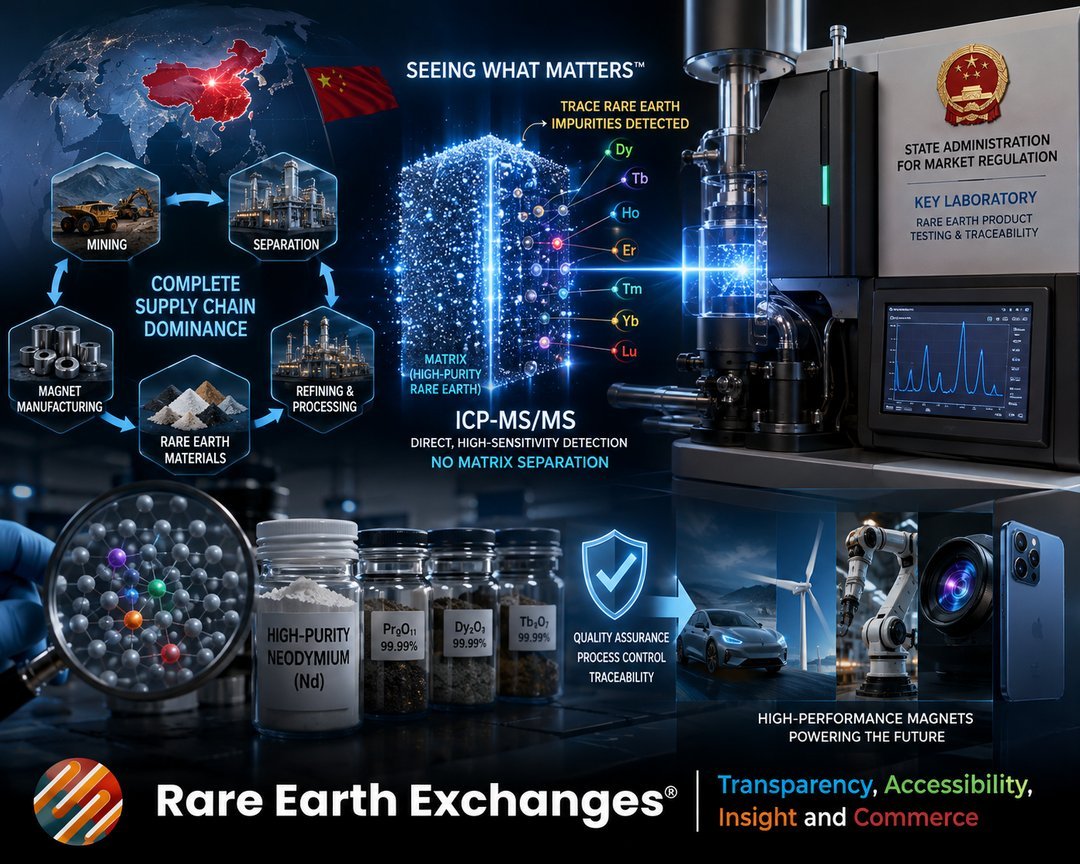
The reported advance could improve quality control for increasingly demanding high-purity rare-earth products, although the source provides no detection limits, validation datasets, or peer-reviewed study establishing its performance.
REEx Insight: You Cannot Manufacture What You Cannot Measure
This may sound like laboratory housekeeping. It is actually part of China's deeper rare-earth industrial infrastructure. Separating chemically similar lanthanides is extraordinarily difficult. Even after separation, producers must determine whether trace quantities of neighboring rare earths remain. Conventional analytical methods can struggle because the overwhelmingly dominant rare-earth matrix interferes with measurement of tiny impurities.
The reported ICP-MS/MS technique attacks that metrology bottleneck by enabling direct trace analysis without first separating the matrix. If independently validated, that potentially means faster testing, fewer preparation steps, lower analytical error, and tighter process feedback.
For Western supply-chain builders, the larger lesson is important. Rare-earth independence requires more than mines, solvent-extraction circuits, and magnet factories. It also requires reference materials, analytical chemistry, calibration, standards, laboratories, and traceability systems capable of proving that material meets customer specifications.
Metrology becomes particularly important as material moves toward high-performance magnets, electronics, optics, and other applications where small compositional deviations can matter. China is therefore strengthening not simply production capacity but the measurement infrastructure governing production quality.
China Tightens the Quality Loop
The research team also reports advances in rare-earth sample preparation and instrument calibration, creating what the source describes as an upgraded workflow from sample handling through final measurement.
Chinese producers and testing organizations are reportedly already using related technologies to improve purity control, testing efficiency, and regulatory oversight. However, no numerical sensitivity, accuracy, reproducibility, adoption figures, or economic benefits are disclosed. REEx therefore views this as a potentially meaningful analytical advance requiring independent technical validation—not evidence of a revolutionary rare-earth processing breakthrough.
Source disclaimer: This news originates from Chinese state-owned/state-affiliated media or government-linked communications. Technical performance, commercial adoption, and claimed benefits should be independently verified before being relied upon for investment or commercial decisions.


0 Comments
No replies yet
Loading new replies...
Moderator
Join the full discussion at the Rare Earth Exchanges Forum →