
Highlights
- Africa produces roughly 17% of global copper but only 9% of refined output, with China holding nearly half of global refining capacity.
- The Lobito railway secured $753M in financing including $553M from the U.S. DFC, but comparable funding for processing, power, and industrial zones is absent.
- Kamoa-Kakula has already shipped 99.7%-pure copper anodes via Lobito to European refiner Aurubis, proving midstream processing in Africa is viable.
- Researchers recommend a sequenced industrial buildout—anode to cathode to wire rod to cable—before pursuing battery manufacturing ambitions.
- A railway diversifies transportation; competitive midstream processing is what truly diversifies a critical mineral supply chain.
A July 2026 paper (opens in a new tab) by Lobito Corridor researcher Alex Stonor, collaborating with Marit Y. Kitaw of United Nations Economic Commission for Africa (UNECA), challenges the prevailing measure of success for the Western-backed Lobito Corridor: how quickly minerals reach Angola's Atlantic coast. Instead, they argue the railway should anchor an African industrial cluster spanning the Democratic Republic of Congo (DRC), Zambia, and Angola—processing more copper locally, building suppliers, sharing infrastructure, and retaining more value. REEx finds the argument strategically important because supply-chain security and African industrialization need not be competing objectives—but current capital allocation still favors transport over transformation.
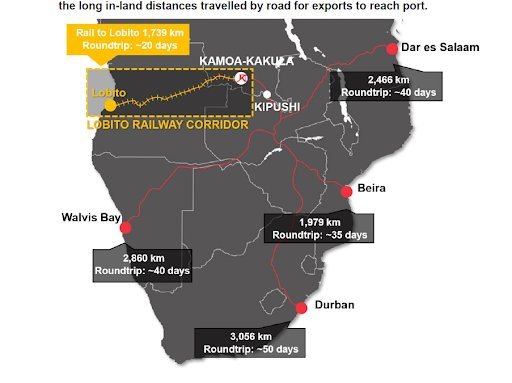
Source: Africa Policy Research Institute
REEx Insight — The Missing Middle Is the Real Battleground
The paper identifies Lobito's central contradiction: Western governments want diversified access to Copperbelt minerals, while African economies want to move downstream before those minerals leave.
REEx sees this through its upstream → midstream → downstream framework. The DRC and Zambia already possess extraordinary upstream strength and meaningful smelting/refining capacity. Yet the paper estimates Africa produces roughly 17% of global copper but only 9% of refined output, versus nearly half of refining capacity in China.
Lobito can therefore reduce China's logistical leverage without necessarily reducing its processing leverage. That distinction is critical.
The authors' strongest insight is sequencing: don't jump from ore to EV dreams. Build anode → cathode → wire rod → cable, then progressively pursue batteries. REEx agrees with the industrial logic. Processing requires reliable power, technical expertise, financing, customers, and competitive economics—not political aspiration alone.
The capital mismatch is telling. The existing Lobito railway has reached financial close on $753 million, including $553 million from the U.S. DFC. Meanwhile, the paper argues processing, power, skills, and industrial zones lack a comparable financing coalition.
Proof Is Already Riding the Rails
This isn't theoretical. Kamoa-Kakula has already sent 99.7%-pure copper anodes through Lobito toward European refiner Aurubis (based in Germany). The question is whether increasingly sophisticated processing stays in Africa—or follows the train overseas.
REEx takeaway: A railway diversifies transportation. A competitive midstream diversifies a supply chain. Investors should watch where the next billion dollars goes.


0 Comments
No replies yet
Loading new replies...
Moderator
Join the full discussion at the Rare Earth Exchanges Forum →