
Highlights
- Metalysis used its FFC Cambridge process to convert metal oxides directly into C-103 alloy powder, bypassing the need to source and melt high-purity hafnium metal.
- C-103—roughly 89% niobium, 10% hafnium, 1% titanium—is prized for rocket propulsion, hypersonics, and extreme-heat aerospace applications.
- Metalysis targets ~15 tonnes per year of C-103 capacity by 2027, but current output across its entire portfolio was roughly one tonne over the past 12 months.
- REEx flags a mathematical inconsistency in the company's stated 32% CAGR projection for the C-103 market, which appears overstated based on the figures provided.
- Commercial specification is a meaningful milestone, but customer qualification, contracted production, and profitable scale remain ahead.
Britain’s Metallium Ltd. (ASX: MTM; OTCQX: MTMCF) (Metalysis (opens in a new tab)) says it has produced C-103 refractory-alloy powder to commercial specification, giving Western space, defense, and hypersonics manufacturers another potential source of a material built for extreme heat. C-103—roughly 89% niobium, 10% hafnium, and 1% titanium—is hardly new. What could be new is how Metalysis makes it: converting oxides directly into alloy powder rather than first sourcing and melting the constituent metals. The achievement is meaningful, but investors should distinguish material specification from customer qualification, contracted production, and profitable industrial scale.
REEx Insight: Don't Watch the Alloy—Watch the Missing Middle
This is a miniature version of the problem Rare Earth Exchanges® sees across critical minerals.
The West can mine material and still remain strategically vulnerable because mining is not processing. Metalysis's Fray-Farthing-Chen (FFC) Cambridge (opens in a new tab) process attacks that middle step, electrochemically reducing metal oxides in molten salt and producing alloy powders through in-situ alloying.
Why does that matter? Hafnium oxide is more accessible than high-purity hafnium metal. If Metalysis can start with oxide sourced from countries including the United States and Australia, it potentially sidesteps one expensive conversion bottleneck before C-103 is even made. That is the strategic prize: shortening the chain between mineral and advanced material.
An Old Space Metal Gets a New Launch Window
C-103 was developed during the first space age. Its niobium-rich chemistry gives it unusual high-temperature strength and makes it attractive for rocket propulsion, spacecraft, missiles, and other extreme-temperature systems. NASA continues to investigate additive manufacturing of C-103 for propulsion applications.
Additive manufacturing changes the economics further. Instead of machining expensive refractory metal away, manufacturers can print complex combustion chambers, nozzles, and other components closer to final geometry.
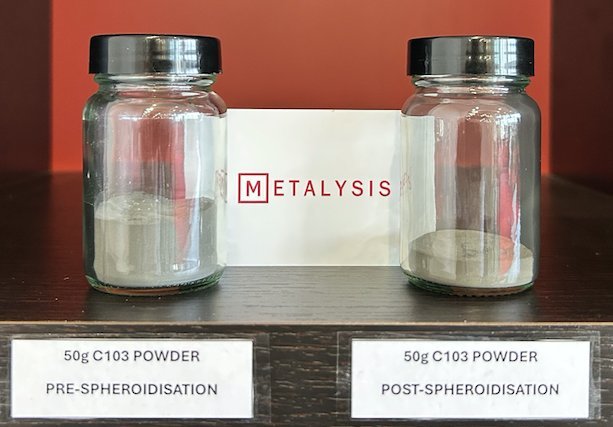
Metalysis says its powder contains less than 500 ppm oxygen and can be spheroidised to improve powder flow—important attributes for additive manufacturing.
Commercial Specification Is the Starting Gun, Not the Finish Line
Here investors should keep one hand on the excitement and another on the calculator.
Metalysis says Gen 4 equipment can produce tens of tonnes annually, and The Times reports management expects C-103 capacity of about 15 tonnes per year from 2027. But the newspaper also reports that Metalysis produced roughly one tonne of powders across its portfolio during the past 12 months.
REEx also flags an apparent mathematical inconsistency in the company's market projection. Metalysis says the C-103 market is currently worth roughly $46 million and will reach $200 million by 2032, representing a CAGR of approximately 32%. Those three figures do not reconcile under the standard CAGR formula. If 2026 is the base year, $46 million growing to $200 million by 2032 implies approximately 27.7% annual growth; using 2025 implies about 23.4%. Metalysis may be relying on a different base year, market definition, or underlying forecast, but based on the figures provided in the release, the stated 32% CAGR appears overstated. Even the mathematically implied rate, however, would represent exceptionally rapid growth, and a good thing for the West.
The Times (opens in a new tab) is right about the larger story: the West needs alternatives to concentrated critical-material processing. While Metalysis has not yet broken anyone's monopoly, this incremental advancement could be part of that process over time. That is, it may, however, possess something increasingly valuable in Great Powers Era 2.0™: a Western machine capable of turning strategically sourced oxides into the advanced powders industry actually needs.


0 Comments
No replies yet
Loading new replies...
Moderator
Join the full discussion at the Rare Earth Exchanges Forum →