
Highlights
- Meteoric Resources secured $40M at no discount for its Caldeira ionic clay project in Brazil, targeting 13,500 tonnes annual production by 2028 with strong institutional backing.
- The 1.5 billion-ton Caldeira deposit offers strategic scale outside China, but remains an upstream MREC play dependent on third-party separation and exposed to midstream bottlenecks.
- Execution risks include tight timelines, full project financing needs, and converting the resource story into integrated supply chain participation with binding offtake agreements.
This piece examines Meteoric Resources’ (ASX: MEI (opens in a new tab)) recent capital raise and REEx podcast appearance—clarifying what’s real, what’s promising, and what still requires proof.
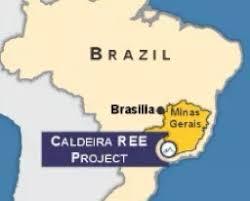
Meteoric Resources is telling a story investors want to hear: scale, speed, and strategic relevance. On the Rare Earth Exchanges™ podcast (opens in a new tab), CFO Andy Thomson (opens in a new tab) described the Caldeira project in Brazil as a 1.5 billion-ton ionic clay resource with the potential to underpin Western supply chains. Within days, the company reinforced that narrative with a $40 million capital raise at market pricing—no discount—backed by institutional demand . The pitch is compelling: favorable geology, large scale, and a pathway to production by 2028. But in rare earths, scale is only the opening move.
The Allure: Scale, Clay, and Speed
Caldeira stands out. Ionic clay deposits—similar to those in southern China—offer simpler, lower-cost extraction relative to hard rock. Meteoric reports:
- ~1.5 billion tonnes of resource, with only ~20% explored and healthy amounts of heavy rare earths
- Target production of ~13,500 tonnes of rare earth oxides annually
- Early mining zones grading ~4,000 ppm
Layer in Brazil’s relatively efficient permitting pathway and the company’s 2028 target, and the narrative gains momentum quickly.
Andy Thompson, CFO
Capital Speaks—But It’s Early Money
The $40M placement is meaningful. It was:
- Strongly supported by institutional and strategic investors
- Priced at no discount to the prior close, signaling market confidence
But this is development-stage capital. Proceeds fund DFS completion, environmental licensing, pilot operations, and early works—not full construction. A multi-hundred-million-dollar buildout still lies ahead.
Where the Story Gets More Complex
1. Still an Upstream Play
Meteoric plans to produce mixed rare earth carbonate (MREC) initially, not separated oxides. That implies:
- Dependence on third-party separation
- Exposure to the midstream bottleneck is still dominated by China
2. Timelines: Feasible, Not Forgiving
A 2028 production target is achievable—but tight. It hinges on:
- DFS completion and validation
- Securing full project financing
- Construction (~18–24 months)
- Converting MOUs into binding offtake
Each step introduces execution risk.
3. The System Constraint Remains
As Thomson outlined, the chain is sequential:
mine → MREC → separation → metals → magnets
Meteoric controls the first stage. Value—and bottlenecks—sit downstream.
What’s Real vs. What’s Aspirational
Real:
- Large-scale ionic clay resource outside China
- Strong early investor backing
- Progress on permitting and feasibility work
Aspirational:
- Integrated supply chain participation
- Durable, long-term offtake at scale
- Execution within compressed timelines
REEx Bottom Line
Meteoric stands out as a credible upstream player with uncommon scale in ionic clay rare earths outside China—and that alone places it in a strategically important position. The opportunity is clear: assets like Caldeira could underpin long-term Western supply if developed correctly. At the same time, investors should be precise—scale is only the starting point, not the solution. Today, this is still a resource-led story, not a fully integrated supply chain play. The real inflection will come as midstream processing and downstream partnerships take shape. If management executes across those layers—financing, permitting, processing, and offtake—the upside is not incremental; it is transformational.
The Company
Meteoric Resources NL (ASX: MEI) is an Australian-based exploration and development company focused on rare earth elements (REEs), with a strategic pivot from gold and copper toward ionic clay-hosted deposits in Brazil. Its flagship Caldeira Project in Minas Gerais—spanning a large licensed area—is a high-grade ionic clay resource targeting key magnet materials such as neodymium, praseodymium, dysprosium, and terbium, and is positioned as a potentially low-cost, scalable operation.
The company also holds earlier-stage exploration assets in Australia, including the Webb JV and Warrego North projects. Led by Executive Chairman Andrew Tunks and CEO Stuart Gale, Meteoric is advancing Caldeira as its primary value driver, aiming to supply critical materials for electric vehicles, electronics, and energy systems. However, despite its strategic positioning, the company remains in the development phase and carries elevated governance risk indicators relative to peers, reflecting its early-stage profile and execution challenges ahead.
Investors
MEI has a highly retail-driven ownership structure, with approximately 78.5% held by the general public, while institutional participation remains limited at around 2.6%, led primarily by Sprott funds. Insider ownership is meaningful at roughly 11%, signaling some alignment with management, while private companies account for about 7.8%. The largest individual shareholder is Tolga Kumova (opens in a new tab), holding approximately 5.9%–6.6%, followed by Executive DirectorAndrew Tunks, whose stake ranges from roughly 1.6% to as high as ~5.9% depending on filings. Other notable holders include smaller private entities such as DC & PC Holdings and R & S Russell Investments.
Overall, the cap table reflects a speculative, early-stage profile—dominated by retail investors with relatively low institutional validation, a common pattern for emerging critical minerals developers still in the pre-production phase.


0 Comments
No replies yet
Loading new replies...
Moderator
Join the full discussion at the Rare Earth Exchanges Forum →