
Highlights
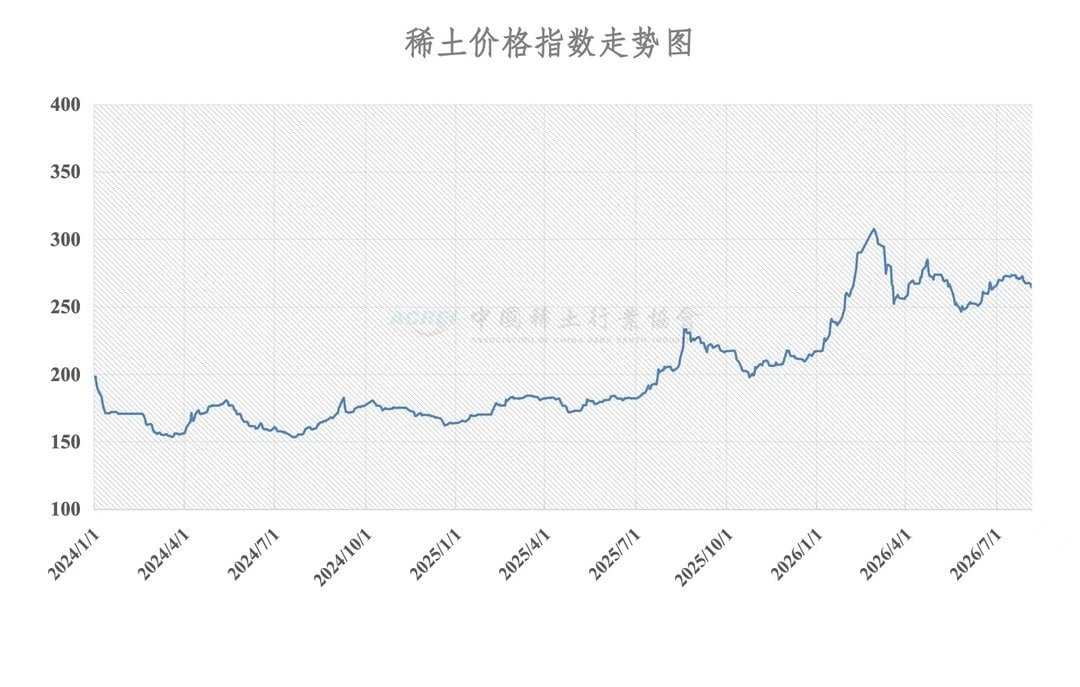
- China's Rare Earth Price Index held at 264.6 on August 5, 2026, near its highest sustained levels since early 2024, with heavy rare earths remaining historically expensive.
- Heavy rare earths including dysprosium, terbium, and holmium are so scarce outside China that qualified commercial quantities are sometimes unavailable regardless of price.
- Published rare earth prices represent only part of the story—most ex-China transactions occur through confidential bilateral contracts shaped by purity, origin, qualification status, and export licensing.
- Contract structure often determines economic value as much as headline price, with terms covering product form, traceability, floor pricing, and force majeure clauses becoming critical in the Great Powers Era.
- Governments increasingly treat heavy rare earth separation, metals production, and magnet fabrication as national security priorities, as secure access outside China remains extraordinarily limited.
China's Rare Earth Price Index registered 264.6 on August 5, 2026, remaining near its highest sustained levels since early 2024 despite modest declines across several heavy rare earth products. Most light rare earth oxides and metals traded largely unchanged, while strategic heavy rare earths—including dysprosium, terbium, gadolinium, holmium, erbium, and lutetium—softened slightly from recent peaks but remain historically expensive. For investors, the headline is not today's small price movements. The real story is that heavy rare earths remain exceptionally scarce outside China, and published prices reveal only part of an opaque global market increasingly shaped by industrial policy, export controls, long-term strategic contracts, and national security considerations.
REEx Insight | There Is No Single Global Rare Earth Price
Rare Earth Exchanges® has consistently argued that neither China's domestic rare earth prices nor so-called "ex-China" pricing represents true market discovery comparable to gold, copper, or crude oil. China's domestic market operates within a hybrid economic model where production quotas, export licensing, state-owned enterprises, environmental regulation, strategic stockpiles, and Communist Party industrial policy all influence pricing. The published China Rare Earth Price Index remains an important benchmark—but it is not a transparent, freely traded market-clearing price.
The ex-China market is equally misunderstood. With roughly 90% of global rare earth refining still occurring in China, only a small portion of separated oxides, metals, alloys, and magnets trade outside the country. Most transactions occur through confidential bilateral contracts negotiated directly between buyers and producers. Contract terms—including purity, oxide versus metal form, origin, qualification status, delivery schedules, floor pricing, and strategic commitments—often influence pricing more than published market indices.
In the Great Powers Era 2.0™, availability increasingly matters more than quoted price.
Heavy Rare Earths Remain the Strategic Choke Point
China's latest pricing reinforces an increasingly familiar pattern. Light rare earths—including cerium, lanthanum, praseodymium, and neodymium—remain comparatively stable (in China) owing to larger production volumes. Heavy rare earths tell a fundamentally different story. Dysprosium, terbium, holmium, yttrium, gadolinium, and lutetium remain among the world's most strategically constrained materials. Outside China, commercial quantities meeting aerospace, defense, semiconductor, and high-performance magnet specifications can be extremely difficult to procure. In some cases, purchasers report that qualified heavy rare earth products—or even high-purity yttrium oxide—are unavailable regardless of price.
That reality explains why governments increasingly view heavy rare earth separation, metals production, alloy manufacturing, and magnet fabrication as national security priorities.
| Product | China Price (RMB/kg) | Approx. China Price (USD/kg) | Illustrative Ex-China Industrial Market | REEx Commentary |
|---|---|---|---|---|
| NdPr Oxide | ¥728.8–748.8 | US$109–112 | US DoD/MP Materials floor: US$110/kg | Government-supported floor under a specific strategic agreement—not a global benchmark. |
| NdPr Metal | ¥886.0–906.0 | US$133–136 | Confidential OTC bilateral contracts | Pricing varies by purity, qualification, alloy specification, and destination. |
| Dysprosium Oxide | ¥1,370–1,410 | US$206–212 | Thin OTC industrial market | Availability often determines commercial value more than published indices. |
| Dysprosium Metal | ¥1,730–1,750 | US$260–263 | Defense and industrial contracts | Commercial volumes remain limited outside China. |
| Terbium Oxide | ¥6,670–6,730 | US$1,001–1,010 | Extremely limited industrial transactions. Price points can rise far beyond quotes in China—several times higher | One of the world's most strategically constrained heavy rare earth products. |
| Terbium Metal (Industrial) | ¥8,210–8,310 | US$1,232–1,247 | FOB China industrial transactions reported around US$1,565/kg and higher—price range multiples higher ex-China | Industrial pricing depends heavily on export licensing, purity, and delivery terms. |
| Terbium Metal (Retail Investment) | — | — | US$3,990–4,500+/kg (retail bars/small lots); premium laboratory samples US$4,5,00+/kg | Not an industrial market price. Reflects retail packaging, inventory carrying costs, small-lot premiums, and scarcity. |
| Heavy REE Strategic Contracts | — | — | Serra Verde strategic pricing mechanism reported near US$2,050/kg for qualifying heavy REE products | Project-specific contractual mechanism—not representative of broader market pricing. |
Important Pricing Qualification: Retail prices quoted by specialty metals dealers should not be confused with industrial market pricing. Retail products are sold in gram-sized, ounce-sized, or kilogram investment bars and laboratory quantities, incorporating fabrication, storage, insurance, inventory financing, and dealer margins. Industrial purchasers negotiating multi-ton contracts typically pay substantially different prices depending on purity, product form, qualification status, export licensing, logistics, and long-term supply agreements.
* USD conversion assumes US$0.15 per RMB.
| Contract Term | Why It Matters | Typical Example |
|---|---|---|
| Product form (oxide, metal, alloy, magnet) | Processing stage significantly affects pricing. | NdPr oxide (99.5%) vs. NdPr metal vs. NdFeB alloy vs. finished sintered magnet. |
| Purity specification | 99%, 99.5%, 99.9%, 99.99%, and higher command different values. | 99.5% Dy₂O₃ vs. 99.99% Dy metal for semiconductor applications. |
| Country of origin | Increasingly critical for DFARS, defense procurement, and industrial policy. | Mine origin certified as Australia (Lynas), Brazil (Serra Verde), USA (MP Materials), or China. |
| Separation location | Determines supply chain eligibility for many Western buyers. | Separated in Texas, Malaysia, France, Estonia, or China. |
| Traceability documentation | Essential for defense, aerospace, and automotive OEMs. | Digital chain-of-custody showing mine → separation → metal → alloy → magnet. |
| Qualification status | Aerospace and semiconductor qualification commands premiums. | Qualified for Lockheed Martin, RTX, GM, Toyota, Siemens, or ASML supply chains. |
| Volume commitments | Long-term offtakes often receive preferential pricing. | Five-year offtake for 1,500 metric tons of NdPr oxide annually. |
| Delivery schedule | Spot delivery can command substantial premiums. | Immediate shipment versus quarterly deliveries over a 36-month contract. |
| Floor price provisions | Becoming more common in strategic supply agreements. | U.S. Department of Defense/MP Materials agreement establishes a US$110/kg NdPr price floor. |
| Ceiling price provisions | Protect buyers during periods of extreme volatility. | Contract caps annual price escalation at 15% or sets a maximum purchase price. |
| Index linkage | May reference Chinese indices, negotiated formulas, or fixed pricing. But many in USA etc, moving away from this index. | Price = China Rare Earth Association NdPr Index + negotiated premium, or fixed annual price. |
| Export control clauses | Increasingly important following China's licensing requirements. | Contract contingent upon receipt of Chinese export licenses or other government approvals. |
| Force majeure | Critical given geopolitical and regulatory uncertainty. | Supply interruption due to export bans, sanctions, war, pandemics, or government actions. |
| Payment terms | Materially affect working capital and financing. | Net 30, Letter of Credit (L/C), 30% advance payment, or milestone-based payments. |
| Product specifications | Performance requirements can materially influence value. | Maximum oxygen content, particle size distribution, moisture limits, grain size, or magnetic properties. |
| Packaging & Logistics | Impacts transportation, handling, and regulatory compliance. | Vacuum-sealed drums, inert-gas packaging, hazardous materials certification, FOB Shanghai vs. DDP Texas. |
| Testing & Acceptance | Defines how quality disputes are resolved. | Independent assay by SGS, ALS, or Intertek before title transfers. |
| Sustainability & ESG Requirements | Increasingly required by Western OEMs and institutional investors. | Documentation of carbon footprint, responsible mining practices, and compliance with OECD due diligence standards. |
| Change-in-Law Clause | Protects both parties from regulatory changes. | Contract renegotiation if tariffs, export controls, or sanctions materially affect economics. |
REEx Insight
Perhaps the biggest misconception in the rare earth industry is that price alone determines value. In reality, two contracts for "the same" kilogram of dysprosium oxide can differ dramatically in value because of purity, origin, processing history, qualification status, traceability, delivery timing, and regulatory compliance. Unlike exchange-traded commodities such as gold or copper, rare earth transactions are highly bespoke. The commercial terms embedded in the contract often determine economic value as much as—or more than—the quoted price itself. This complexity is one reason why transparent price discovery remains elusive and why sophisticated buyers devote as much attention to contract structure as they do to the headline price.
Buyer Beware: Published Prices Tell Only Part of the Story
Recent REEx reporting highlighted the U.S. Department of Defense's strategic partnership with MP Materials, which established a US$110/kg floor for NdPr under a unique public-private agreement. Likewise, REEx has analyzed the Serra Verde heavy rare earth pricing framework, where reported pricing mechanisms for certain heavy rare earth products approach approximately US$2,050/kg under specific contractual conditions.
Neither example should be interpreted as an industry benchmark.
Every ex-China transaction is negotiated individually. Product specifications, processing stage, origin, delivery timing, strategic importance, and customer qualification all influence the final commercial outcome.
Pricing agencies provide valuable market intelligence, but most rely on relatively small samples of trader surveys within an opaque over-the-counter market. Rare Earth Exchanges has previously examined how these methodologies can produce widely divergent assessments depending on who is surveyed and under what market conditions.
The most important takeaway is not today's modest decline in several heavy rare earth prices. It is that secure access to qualified heavy rare earth materials remains extraordinarily limited outside China. For many defense contractors, automakers, semiconductor manufacturers, and magnet producers, the first question is no longer "What is the price?"
It is "Can the material be procured at all?" That may prove to be the defining characteristic of the global rare earth market throughout the remainder of this decade.
Editorial Disclaimer: This report is based on pricing information published by the China Rare Earth Industry Association, which states that the data are collected from Chinese industry participants for reference purposes only and do not constitute investment advice. REEx notes that China's domestic rare earth market is influenced by production quotas, export licensing, state-owned enterprises, industrial policy, and broader national security considerations, and therefore should not be viewed as a fully transparent market. Likewise, ex-China rare earth pricing remains an emerging over-the-counter market characterized by confidential bilateral contracts rather than exchange-based price discovery. All quoted prices and contract examples should therefore be interpreted as reference points rather than universally applicable market values.


0 Comments
No replies yet
Loading new replies...
Moderator
Join the full discussion at the Rare Earth Exchanges Forum →