
Highlights
- CREIA's Rare Earth Price Index reached 249.4 on June 1, 2026, roughly 2.5 times the 2010 baseline, easing from a recent spike above 300.
- NdPr oxide and metal prices trended upward inside China, with NdPr metal approaching the $110/kg floor set by the MP Materials–DoD agreement.
- China's rare earth prices are shaped by quotas, export controls, and state industrial policy, making them policy-infused signals rather than transparent global benchmarks.
- The ex-China market suffers from thin liquidity, with most transactions remaining bilateral and confidential due to limited separation and refining capacity outside China.
- Rare earths have evolved into industrial-security assets in the Great Powers Era, shifting the critical question from price discovery to supply control and geopolitical reliability.
On June 1, 2026, the China Rare Earth Industry Association (CREIA) reported its Rare Earth Price Index at 249.4, using 2010 as the baseline of 100. That means reported Chinese rare earth prices are roughly 2.5 times the 2010 benchmark. The index has eased from its recent 2026 spike above 300, but it remains far above most 2024 levels. The signal is clear: magnet-critical rare earths remain tight, politicized, and strategically sensitive.
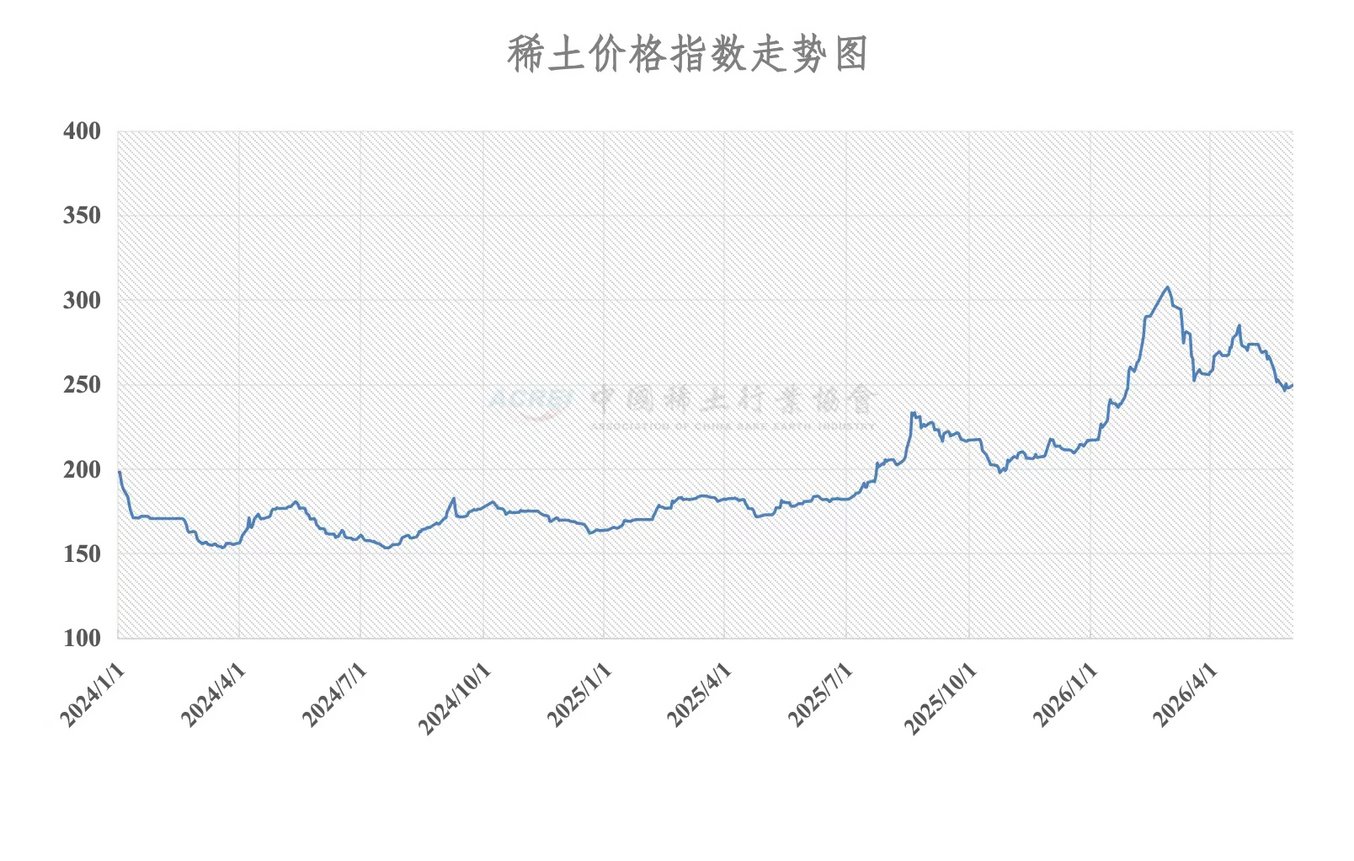
The Number Behind the Noise
CREIA says the index is calculated from average daily transaction data collected from domestic Chinese rare earth enterprises. That matters—but only with caution. This is not a transparent global commodity benchmark. It is a China-centered industry reference drawn from a market shaped by quotas, licensing rules, state industrial policy, export controls, and national security priorities.
Magnet Metals Stay Hot
Selected reported prices:
| Product | China price | Approx. USD/kg* | Trend |
|---|---|---|---|
| NdPr Oxide | ¥681.6–701.6/kg | $100.68–103.63 | Up |
| NdPr Metal | ¥832.4–852.4/kg | $122.95–125.91 | Up |
| Dysprosium Oxide | ¥1,215–1,255/kg | $179.47–185.38 | Flat |
| Terbium Oxide | ¥5,000–5,200/kg | $738.55–768.09 | Flat |
| Gadolinium Oxide | ¥193–235.5/kg | $28.51–34.79 | Flat |
*note prices in USA and ex-China can be many times higher
Approximate conversion using ¥6.77 = US$1.
NdPr metal inside China now sits near the $110/kg U.S. price floor created in the MP Materials–Department of Defense deal. But that floor applies to MP’s arrangement. It should not be assumed to govern the entire U.S. or ex-China market.
The Price Discovery Mirage
China’s prices are not pure market discovery. They are policy-infused signals from a state-directed supply chain.
The ex-China market has the opposite problem. With only a small share of global separation and refining outside China, most non-Chinese rare earth transactions remain bilateral, confidential, and highly customized. Price agencies see snapshots, not a deep global spot market.
Why This Matters
The real story is not one daily index print. It is the arrival of Great Powers Era 2.0 (a Rare Earth Exchanges™ thesis): rare earths are no longer ordinary commodities. They are industrial-security assets.
For investors, manufacturers, and policymakers, the question is no longer “What is the price?” The harder question is: who controls the supply, who sets the rules, and who can actually deliver material when geopolitics breaks the market?
Source Disclaimer: This pricing originates from the China Rare Earth Industry Association, operating within China’s state-directed rare earth ecosystem. Treat the data as indicative, not independently verified. Commercial decisions should be checked against producers, traders, buyers, contract terms, and non-China market intelligence.


0 Comments
No replies yet
Loading new replies...
Moderator
Join the full discussion at the Rare Earth Exchanges Forum →