
Highlights
- China's Rare Earth Price Index closed at 273.6 on May 6, with magnetic rare earths like terbium ($894-903/kg) and dysprosium ($198-204/kg) maintaining elevated levels due to supply discipline and strategic inventory management.
- China controls roughly 90% of global rare earth refining, creating a "split market structure" where domestic pricing is managed by state-backed enterprises while ex-China markets remain fragmented with limited price transparency.
- The persistent elevated pricing signals unresolved heavy rare earth scarcity and highlights the West's challenge: building independent midstream refining capacity and transparent pricing mechanisms to compete with China's vertically integrated industrial model.
China’s domestic rare earth pricing system remained elevated on May 6, with the official China Rare Earth Price Index closing at 273.6, according to the China Rare Earth Industry Association. The index, which uses 2010 transaction data as its base year (100), continues to reflect structurally higher pricing across key magnetic rare earth inputs compared to historical norms.
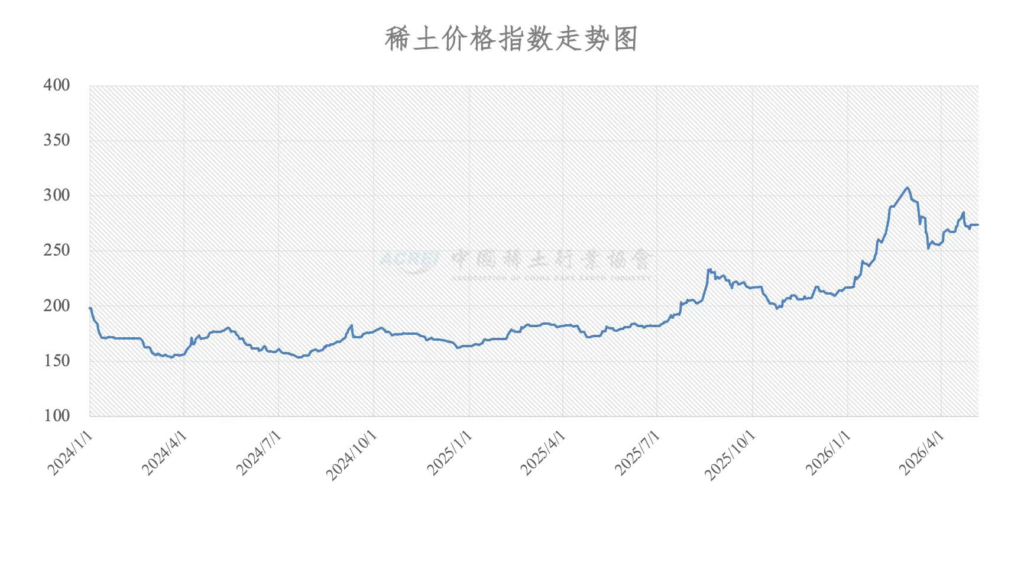
While daily moves across most products were officially labeled “flat,” the broader signal is more important: China’s rare earth complex remains priced at levels that suggest ongoing supply discipline, strategic inventory management, export-control friction, and persistent downstream demand tied to magnets, electrification, robotics, aerospace, and defense supply chains.
Market Snapshot: Key Rare Earth Prices
Using an approximate May 6 exchange rate of 1 RMB = $0.147 USD, the following domestic China reference prices were reported:
| Product | China Price (RMB/kg) | Approx. USD/kg | Trend |
|---|---|---|---|
| Neodymium Oxide | ¥839–859 | $123–126 | Flat |
| Pr-Nd Oxide | ¥540–560 | $79–82 | Flat |
| Dysprosium Oxide | ¥1,350–1,390 | $198–204 | Slightly Lower |
| Terbium Oxide | ¥6,085–6,145 | $894–903 | Flat |
| Terbium Metal | ¥7,525–7,625 | $1,106–1,121 | Flat |
| Gadolinium Oxide | ¥240–260 | $35–38 | Lower |
| Erbium Oxide | ¥5,000–5,200 | $735–764 | Flat |
The pricing data suggests continued resilience in high-value magnetic rare earths, particularly terbium and dysprosium, despite modest softness in select mid-tier heavy rare earth products.
The Real Story: Market Structure, Not Just Pricing
Investors should understand that neither the China domestic market nor the ex-China market currently represents a fully transparent free-market pricing system.
China’s domestic pricing environment remains heavily influenced by:
- state-backed enterprises,
- mining and separation quotas,
- export licensing,
- industrial policy priorities,
- and broader Chinese Communist Party strategic objectives.
At the same time, ex-China rare earth pricing remains immature and fragmented, not to mention highly dependent on bilateral contracts and some industrial policy. Roughly 90% of global refining and separation still occurs in China, while most ex-China transactions occur through:
- proprietary bilateral contracts,
- opaque negotiated pricing,
- limited spot liquidity,
- and the absence of meaningful futures-market discovery.
This creates what REEx has repeatedly described as a “split market structure”: China manages the dominant industrial pricing ecosystem internally, while the West still lacks a fully independent pricing architecture.
Strategic Implications for the West
The persistence of elevated pricing into 2026 matters because it reinforces several realities:
- Heavy rare earth scarcity remains unresolved,
- Western refining capacity remains insufficient,
- And pricing power still largely sits inside China’s industrial system.
- Pricing ex-China can be multiple times that of China, depending on the product
For U.S. and European policymakers, the challenge is no longer simply finding deposits. The challenge is building transparent midstream capacity, pricing mechanisms, metallization capability, and magnet ecosystems that can eventually compete with China’s vertically integrated model.
REEx Bottom Line
Today’s report is less about short-term volatility and more about structural leverage. China continues to control the dominant pricing ecosystem for rare earths—not simply because it mines material, but because it still controls most of the refining, separation, and industrial infrastructure behind the market itself.
Source & Disclaimer: This report is based on pricing data published by the China Rare Earth Industry Association, a state-aligned industry body operating within China’s industrial policy ecosystem. The association itself states the data is intended for reference only and does not constitute investment advice. All figures should be independently verified before use in investment, procurement, or strategic planning decisions.


0 Comments
No replies yet
Loading new replies...
Moderator
Join the full discussion at the Rare Earth Exchanges Forum →