
Highlights
- Researcher Payal Mehra found no statistically significant long-run or short-run financial link between REMX and the Magnificent Seven index using data from late 2022 through mid-2026.
- Financial decoupling may conceal physical concentration risk: a supply disruption in magnets or critical minerals could delay AI infrastructure even without stock-price correlation.
- REMX tracks mining company equities, not spot prices of NdPr, dysprosium, or terbium, making it a poor proxy for actual rare earth market conditions.
- The two series showed increasing alignment from 2024 onward, suggesting a relationship may be forming as investors recognize AI's physical mineral dependencies.
- Analysts call for future research using element-level pricing, export controls, and magnet production data rather than broad equity ETFs to detect true transmission risk.
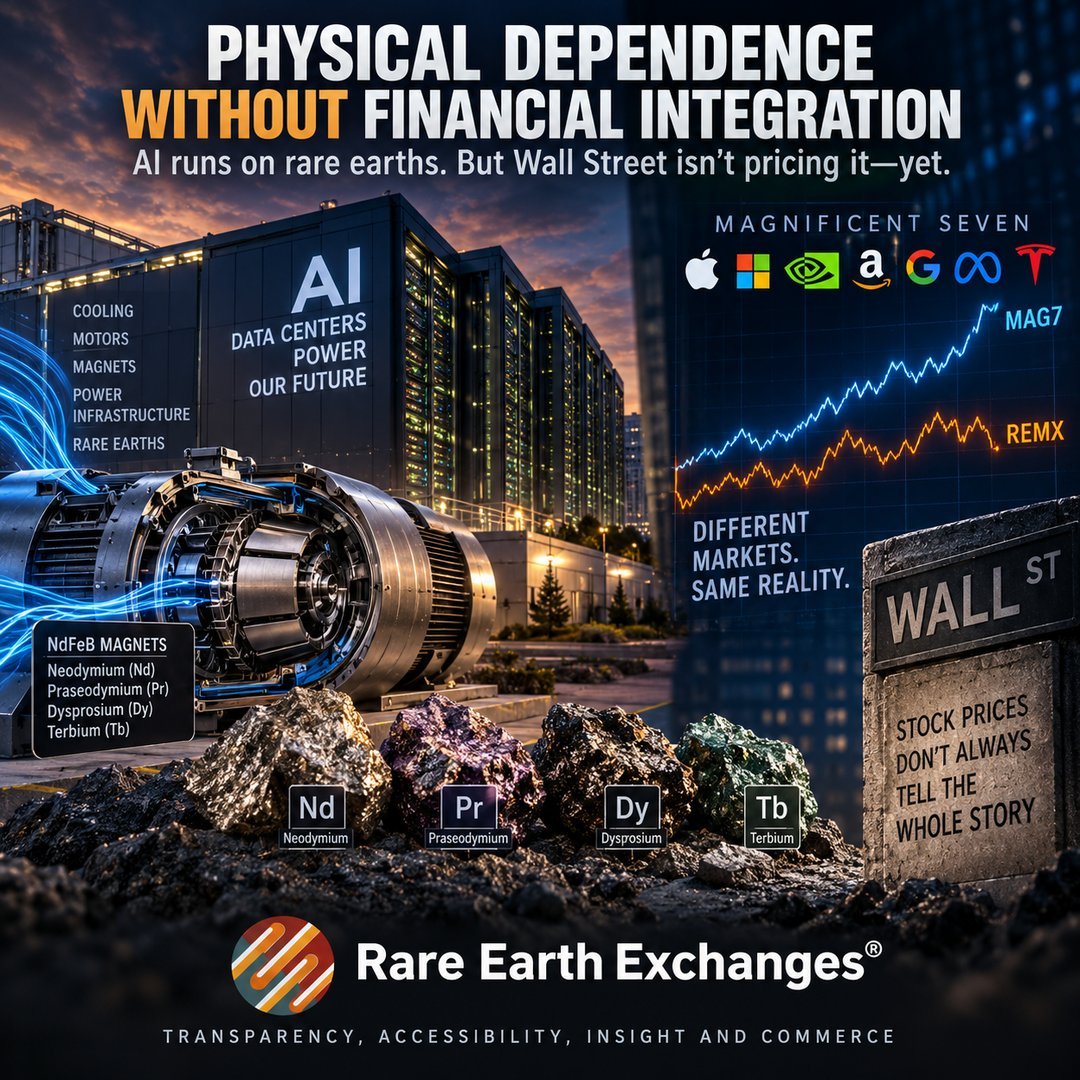
Artificial Intelligence (AI) can depend on rare earths physically without Wall Street pricing that dependence financially. That is the central finding of a new study (opens in a new tab) by Payal Mehra of Technological University Dublin (opens in a new tab), who examined whether rare earth-related equities move with the “Magnificent Seven”—Nvidia, Apple, Microsoft, Amazon, Alphabet, Meta, and Tesla. Using daily market data from November 2022 through June 2026, Mehra found no stable long-run relationship and no statistically significant short-run causal connection between the VanEck Rare Earth and Strategic Metals ETF (REMX) and the Solactive Magnificent Seven Index. The paradox: AI infrastructure increasingly requires physical equipment containing critical minerals, yet that dependency has not produced a detectable financial-market linkage.
REEx Insight: The Market May Be Pricing the Wrong Layer
The study highlights something potentially more important than correlation: there are three different markets hiding inside the AI–rare earth story—physical supply, commodity pricing, and public equities. They need not move together.
REMX (an ETF) measures shares of mining and materials companies—not the spot price, availability, or scarcity of individual magnet materials such as NdPr, dysprosium, or terbium. Meanwhile, Magnificent Seven valuations reflect everything from cloud revenue and advertising to margins, interest rates, and AI expectations. Finding little statistical connection between these two baskets therefore does not demonstrate that AI is insulated from rare-earth disruption.
That distinction creates the real REEx insight: financial decoupling may actually conceal physical concentration risk. A hyperscaler does not need rare earth prices to correlate with its stock price for a missing magnet, motor, or cooling component to delay infrastructure deployment.
REEx has separately documented how NdFeB magnets containing neodymium and praseodymium—and sometimes dysprosium and terbium—are used in high-efficiency motors supporting data-center cooling systems. REEx analysis of AI's hidden rare earth dependency
Study Methods and Findings
Mehra used Engle-Granger cointegration to ask whether REMX and MAG7 maintain a long-term financial relationship, and Granger-causality testing to determine whether past movements in one help predict the other. Neither test produced statistically significant evidence of linkage.
Yet the study contains an intriguing clue. The two series diverged through much of 2023 and early 2024, then became increasingly aligned from 2024 onward. The author suggests a relationship may still be forming as investors recognize the physical side of AI infrastructure—but importantly, the study did not formally test whether a structural break occurred.
Limitations, Controversy, and What Comes Next
The largest limitation is REMX itself: an equity ETF is not the physical rare-earth market. The sample is also short relative to the AI infrastructure cycle, and whole-period statistical tests could wash out a relationship emerging only after 2024. The author appropriately calls for longer datasets and structural-break or regime-switching analysis.
Future research should go one step further: test AI infrastructure spending against individual rare-earth oxide, metal, and magnet prices, physical availability, export restrictions, and processing capacity. That could reveal transmission that a diversified mining-equity ETF cannot.
The bigger question is therefore not whether AI stocks and rare-earth stocks move together today. It is whether financial markets will recognize the physical dependency before—or only after—a supply disruption forces them to.
REEx Assessment
The study is most valuable not as evidence that rare earths and AI are financially disconnected forever, but as evidence of a pricing gap worth investigating. Its negative result creates the research question: when does physical dependency become financially material? That is where a proprietary REEx dataset combining element-level pricing, separation capacity, magnet production, export controls, and AI infrastructure investment could add considerably more analytical value than broad equity proxies.
Citation: Mehra, P. (2026). The AI-Rare Earth Paradox: Physical Dependence without Financial Integration. Critical Letters in Economics & Finance, 3(2), Article 3. DOI: 10.21427/3hdq-h198.


0 Comments
No replies yet
Loading new replies...
Moderator
Join the full discussion at the Rare Earth Exchanges Forum →