
Highlights
- Leju Robotics opened Shenzhen's first pilot production line for humanoid robots, moving from lab development to manufacturing validation with 500-1,000 unit annual capacity targeting process refinement over volume.
- China's vertically integrated approach combines R&D in Shenzhen with manufacturing in Foshan, leveraging domestic rare earth dominance (90%+ global magnet production) to control the full supply chain from mining to robotics.
- The strategic alignment of AI, manufacturing infrastructure, and materials control (NdFeB magnets requiring neodymium, praseodymium, dysprosium) positions China to accelerate humanoid robot cost curves while exposing Western supply chain vulnerabilities.
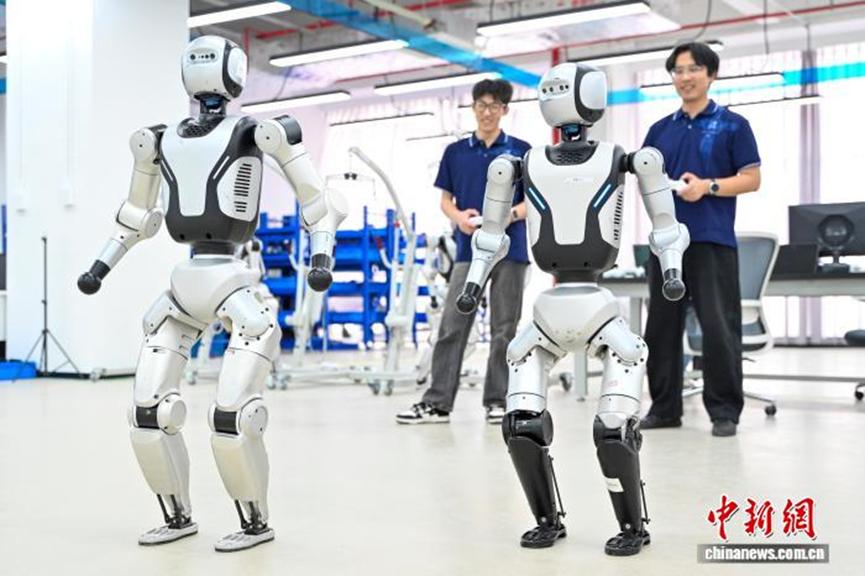
China is taking a tangible step toward industrializing humanoid robotics. On April 12, Shenzhen-based Leju Robotics (opens in a new tab) launched the city’s first pilot production line for humanoid robots—signaling a move from lab-scale engineering to early-stage manufacturing validation.
The Longhua-based facility is not designed for scale—yet. Its purpose is to tackle persistent industry constraints: unstable processes, high costs, and inconsistent quality, all of which have slowed global commercialization.
Building the “Closed Loop” Advantage
Leju’s model reflects a familiar Chinese industrial playbook: regional integration.
- Shenzhen → R&D and pilot production
- Foshan → manufacturing and eventual scale
This “closed loop” reduces the gap between design and production—an advantage China has repeatedly leveraged in EVs, batteries, and solar. The implication: faster iteration cycles and tighter quality control versus more fragmented Western supply chains.
From Trial Runs to Scalable Systems
The pilot line is currently producing small batches of the Roban2 humanoid robot, with pre-mass production testing across three vectors:
- Flexibility: Hybrid automation with human intervention for rapid iteration
- Standardization: Modular assembly with component-level validation
- Intelligence: MES-driven data capture enabling traceability and process replication
Notably, Roban2 has undergone 170+ process improvements, underscoring a focus on manufacturability—not just technical performance.
The Hidden Layer: Rare Earths and Magnet Demand
What’s not explicitly stated—but strategically critical—is the rare earth backbone behind humanoid robotics.
Humanoid systems rely heavily on high-performance permanent magnets (NdFeB and, in some cases, SmCo) for actuators, servo motors, and precision control systems. These magnets depend on rare earth elements such as:
- Neodymium (Nd) and Praseodymium (Pr) → core magnet materials
- Dysprosium (Dy) and Terbium (Tb) → high-temperature performance and stability
China’s dominance—roughly 90%+ of global magnet production and refining capacity—means developments like Leju’s are not isolated. They are vertically integrated into a domestic supply chain spanning:
Mining → Separation → Metal/alloy → Magnet manufacturing → End-use robotics
As humanoid robotics scales, incremental demand for NdPr and heavy rare earths could rise materially, especially if robots transition from pilot runs to industrial deployment.
Why This Matters: Scaling the Full Stack
The planned capacity—500 to 1,000 units annually—is less about volume and more about process validation. This is how China wins industries: de-risk production first, then scale rapidly.
Guangdong reinforces this trajectory:
- Targeting 200+ smart factories by 2026
- Supporting embodied AI and robotics testbeds
- Anchored by 160,000+ robotics-related firms
Implications for the West
The competitive landscape is shifting. While the U.S. and Europe retain strength in AI models and advanced design, China is aligning: AI + Manufacturing + Materials (rare earths + magnets)
If this integration holds, it could:
- Tighten China’s grip on downstream magnet demand growth
- Accelerate cost curves for humanoid robots globally
- Expose Western vulnerabilities in midstream processing and magnet supply
The real contest is no longer just intelligence—it’s industrialization at scale, powered by materials control.
Important Disclaimer: This report is based on information published by China News Network, a state-affiliated media outlet. The details should be independently verified, as state media may reflect strategic or policy-driven narratives.


0 Comments
No replies yet
Loading new replies...
Moderator
Join the full discussion at the Rare Earth Exchanges Forum →