
Highlights
- China's SICC holds 27.6% of global N-type SiC substrate share in 2025, surpassing Wolfspeed, while controlling ~85% of upstream silicon-metal capacity.
- The real chokepoint is manufacturing difficulty—crystal growth, wafer yield, and automotive qualification—not geological scarcity of raw materials.
- Western governments are investing billions: SK Siltron CSS in Michigan, Bosch's $1.9B Roseville conversion, and STMicroelectronics' €5B Catania campus.
- Wolfspeed's Chapter 11 filing illustrates the Transition Vulnerability Window: strategic importance does not guarantee economic viability against Chinese price pressure.
- The key metric for supply chain resilience is qualified yield at competitive cost, not announced capacity alone.
Silicon carbide (SiC) is two strategic industries sharing one chemical formula. Bulk SiC is an ultra-hard ceramic used in abrasives, refractories, metallurgy, and armor. Ultra-pure single-crystal SiC is a wide-bandgap semiconductor enabling EVs, charging infrastructure, grids, industrial power systems, and increasingly AI data centers to handle higher voltages, temperatures, and power densities more efficiently than conventional silicon. The distinction matters. China has about 45% of global abrasive-SiC production capacity, according to USGS, while its silicon-metal capacity—the upstream feedstock base—is roughly 85% of the world total. More consequentially, Chinese wafer producers are moving downstream. China's SICC Co., Ltd. (Shanghai: 688234 (opens in a new tab)), says Fuji Keizai (opens in a new tab) data put its share of global N-type SiC substrates at 27.6% in 2025, ahead of Wolfspeed. (opens in a new tab)
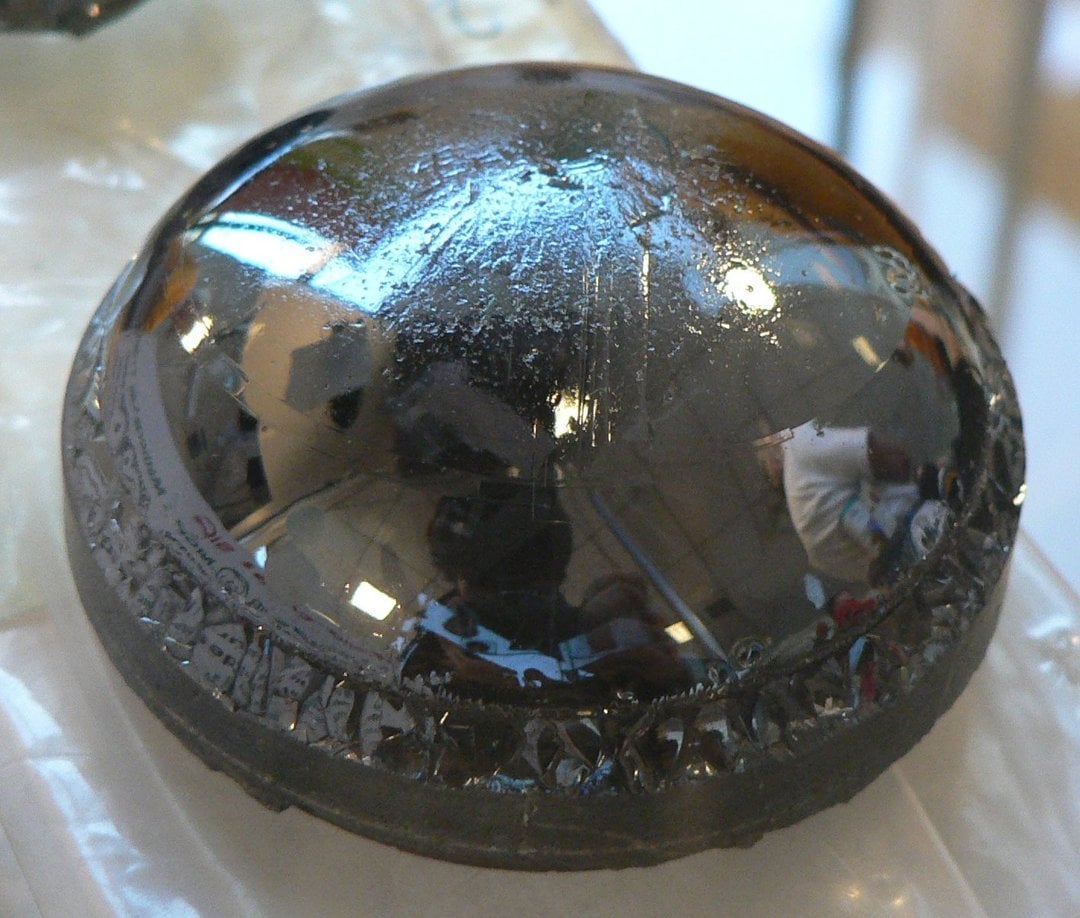
The Western problem is therefore not running out of sand. It is preserving economically viable capacity at the difficult stages where purity, crystal defects, wafer yield, and customer qualification determine who controls the power electronics supply chain.
REEx Insight: China Is Moving Up the Value Chain
Silicon carbide is not a mining story in the conventional critical-minerals sense. Quartz and carbon are abundant.
The chokepoint comes later. Industrial SiC is generally produced by electrically heating silica and carbon to extreme temperatures. Semiconductor SiC then travels through a far harder chain: high-purity feedstock → crystal growth → boule → wafer → polishing → epitaxy → device fabrication → qualification.
DOE notes that SiC boule growth is energy intensive, can take weeks, and suffers significant yield losses. That manufacturing difficulty—not geological scarcity—is the strategic barrier. China's leverage is increasingly layered. It combines enormous silicon-metal and industrial-SiC capacity with a rapidly expanding domestic crystal and wafer industry. SICC now produces 150mm and 200mm substrates, while Chinese competitors including TankeBlue are also scaling.
Yet China's position should not be overstated. Western, Japanese, and Korean companies retain important advantages in crystal growth, epitaxy, device intellectual property, and automotive qualification. The near-term threat may therefore be price rather than prohibition. Chinese overcapacity and lower production costs could compress wafer prices enough to undermine Western producers before an actual supply interruption occurs. That is classic Transition Vulnerability Window economics: governments need domestic capacity for resilience precisely when market economics can make that capacity hardest to sustain.
From Furnace to Power Chip
The U.S. already illustrates the split. DOE classifies SiC as an energy critical material. SK Siltron CSS is expanding wafer production in Michigan with a $544 million DOE loan, while Bosch plans a roughly $1.9 billion conversion of its Roseville, California facility for 200mm SiC devices. Commerce proposed up to $225 million in CHIPS funding for Bosch, although that announcement was preliminary rather than a final award.
Europe is pursuing the same missing middle. STMicroelectronics is building an integrated SiC campus in Catania covering material through finished devices. Italy is supporting the roughly €5 billion project with about €2 billion in state aid approved by the European Commission. Onsemi has separately proposed investing up to $2 billion in an integrated Czech SiC operation.
Meanwhile, Wolfspeed demonstrates the industry's paradox. The U.S. pioneer built enormous 200mm capacity, then entered Chapter 11 and emerged in September 2025 (opens in a new tab) after reducing debt by roughly 70%. Strategic importance does not guarantee attractive economics.
REEx Bottom Line
China controls 45% of global abrasive-SiC capacity and roughly 85% of silicon-metal capacity, but it does not yet control every high-value semiconductor step. That distinction may be temporary. The Great Powers Era 2.0 contest over SiC is moving from furnaces to wafers. Washington and Brussels are spending billions to build 200mm capacity just as Chinese suppliers are gaining scale and driving competition downstream.
For investors, the metric to watch is no longer announced capacity. It is qualified yield at competitive cost. That will determine whether the West has built a resilient silicon-carbide supply chain—or merely an expensive one.


0 Comments
No replies yet
Loading new replies...
Moderator
Join the full discussion at the Rare Earth Exchanges Forum →