
Highlights
- Washington is funding isolated projects while China builds integrated industrial ecosystems designed for long-term cost competitiveness.
- Private equity's short horizons and high return expectations are structurally mismatched with the decades-long investment cycles rare earth infrastructure requires.
- Price floor guarantees help launch first-of-a-kind facilities but risk permanently inflating input costs for downstream U.S. manufacturers.
- America's past infrastructure successes—highways, TVA, rural electrification—relied on patient public capital, not financial engineering, and rare earths demand the same approach.
- Rebuilding U.S. industrial competitiveness requires owner-operators focused on generational building, not compressed fund cycles or financial product innovation.
The United States has finally reached the point where strategy collides with economics. Automakers, defense contractors, robotics manufacturers, aerospace companies, and industrial equipment makers all agree on one point: America needs secure rare earth and critical mineral supply chains. But another reality is emerging just as quickly. Secure supply that is permanently more expensive is not a competitive strategy. China has spent decades building an integrated industrial ecosystem designed to lower costs while increasing resilience. The United States risks responding with exactly the opposite—a collection of high-cost projects financed one transaction at a time using some of the world's most expensive capital.
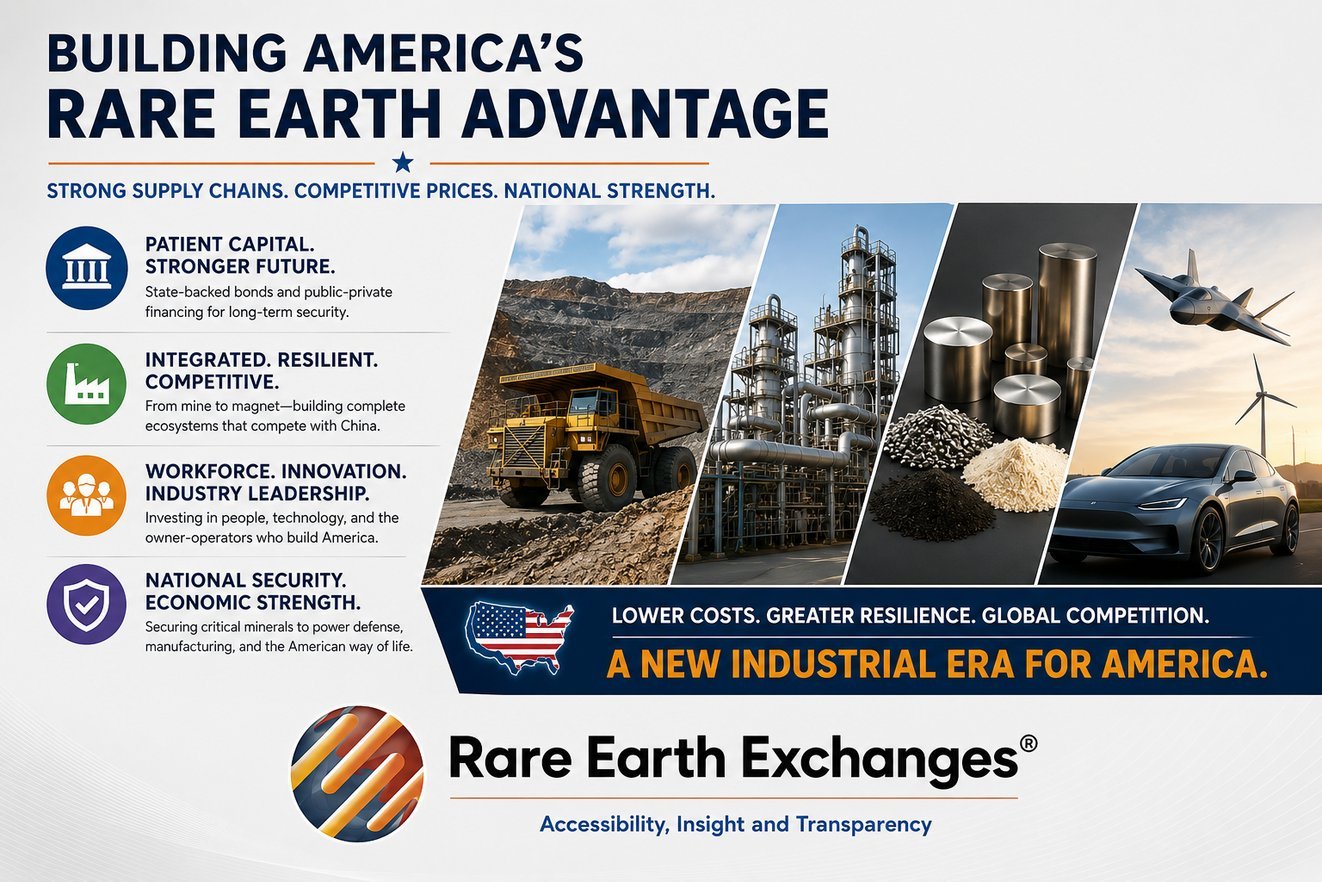
If America's mine-to-magnet strategy is built on expensive money, American manufacturers will eventually pay expensive prices. That may satisfy investors. It will not satisfy Detroit, defense manufacturers, or taxpayers. The real debate is no longer about mining. It is about the cost of capital.
Washington Is Financing Projects. China Is Financing Ecosystems.
Washington deserves credit for moving aggressively. The Department of Defense invested $400 million into MP Materials while providing additional loans, warrants, long-term offtake agreements, and price guarantees. The Department of Energy continues expanding demonstration funding. The Export-Import Bank, Development Finance Corporation, and Pentagon's Office of Strategic Capital are deploying billions toward domestic and allied supply chains. None of those programs are mistakes.
But collectively they reveal something larger. America does not suffer from a shortage of agencies.
It suffers from a shortage of orchestration. Every agency is pursuing its own mandate, often driven by players well versed in financialization based on illustrious Wall Street careers. Every transaction solves one company's financing problem. What remains missing is a national industrial architecture that coordinates those efforts toward one objective: producing globally competitive rare earth products at globally competitive prices. China did not build global dominance project by project.
It built an ecosystem.
Private Equity Isn't the Villain. It's the Wrong Tool
Rare Earth Exchanges® has been critical of the growing financialization of critical minerals, but the problem is frequently misunderstood. Private equity is not failing. Private equity is doing precisely what it was designed to do. Private funds seek relatively high annual returns, management fees, carried interest, liquidity events, and finite investment horizons. Those expectations are entirely appropriate for many industries. Mine-to-magnet manufacturing, along with several critical mineral supply chain challenges, is not one of them.
Rare earth separation plants, metallization facilities, magnet factories, industrial recycling systems, and workforce development require investment horizons measured in decades rather than fund cycles. America is asking high-return capital to build infrastructure that historically has always depended upon patient capital. That is an economic contradiction.
Price Floors Solve Today's Problem—and Create Tomorrow's
Recent government-backed agreements illustrate both the promise and the danger.
Price floors help finance first-of-a-kind facilities. They reduce risk and unlock construction financing that otherwise would never materialize. As transitional policy, they make sense. As permanent policy, they become dangerous.
Every guaranteed floor ultimately becomes somebody else's guaranteed input cost.
If every mine, separation facility, and magnet producer requires protected pricing to survive, downstream manufacturers inherit permanently higher production costs than competitors operating inside China's integrated industrial system. The objective cannot simply be supply security. The objective must be affordable supply security.
America Already Knows How to Build Systems Like This
The irony is that the United States already solved this problem generations ago.
- The Interstate Highway System.
- The Tennessee Valley Authority.
- The Rural Electrification Administration.
- The internet backbone itself via defense and later other vehicles
None were financed primarily through venture capital or private equity.
They were financed with patient public capital because policymakers understood these were national productivity investments rather than ordinary commercial ventures.
Rare earth and critical mineral supply chain infrastructure deserves similar treatment. The stakes for our society’s resilience are just too big. Industrial development bonds, revenue bonds, state infrastructure banks, development authorities, and specialized municipal financing already exist throughout America. Today they finance industrial parks, manufacturing facilities, logistics networks, water systems, workforce centers, and energy infrastructure.
They should become foundational financing tools for America's next-generation critical mineral ecosystem.
Not to replace private investment. To lower its cost.
From Financial Engineering to Industrial Engineering
The next American industrial strategy should resemble a layered capital stack. At the top sits a national industrial plan—not individual agency priorities. Importantly, this plan is shaped via a bottom-up feedback loop system.
Federal agencies such as EXIM, DFC, DOE, the Office of Strategic Capital, and national laboratories become coordinated financing and technical arms of that strategy rather than independent actors driving their own deals.
States, municipalities, industrial development authorities, and special districts finance shared infrastructure through long-duration municipal bonds—industrial parks, power, water, laboratories, workforce training, recycling facilities, characterization centers, logistics hubs, and permitting infrastructure.
Private capital then enters where it performs best: operating companies, technological innovation, expansion, acquisitions, and entrepreneurship. Government lowers systemic costs. Private industry creates competitive enterprises. Each performs its comparative advantage.
Where Are America's Industrial Builders?
Perhaps the most important question has nothing to do with bonds. Where are America's next industrial builders?
The United States once produced entrepreneurs who spent careers building steel mills, railroads, aerospace companies, semiconductor manufacturers, and industrial giants.
Today, too much talent migrates toward financial engineering rather than industrial engineering.
America does not simply need more capital. It needs more owner-operators willing to build businesses over generations instead of compressed investment cycles if we are to have a chance.
That culture—not merely financing—must return, or we face even more dire situations.
Great Powers Era 2.0 Requires a New Industrial Operating System
Rare Earth Exchanges has since our launch argued that rebuilding Western rare earth supply chains requires an integrated ecosystem rather than isolated, agency and private equity-based deal-driven projects. This article takes that conclusion one step further.
The United States should stop thinking primarily about financing mines, or even rethinking the deal-driven approach. It should begin financing an industrial civilization 2.0. The next generation of mine-to-magnet (as well as other critical mineral supply chains) infrastructure should resemble a public utility for national competitiveness—supported by patient public capital, disciplined private investment, world-class engineering, and owner-operated industrial companies competing on cost, quality, and innovation. This will be the only way to ensure competitive positioning with China as we enter Great Powers Era 2.0.
America did not become the Arsenal of Democracy through preferred equity or financial engineering. It became an industrial superpower by combining patient capital, entrepreneurial builders, skilled workers, and a coherent national purpose, which of course included massive public works efforts in the 1930s, a victorious World War 2, and massive economic growth thereafter. Since the 1980s, however, financial returns have too often eclipsed industrial investment, with shareholder primacy, short investment horizons, and the outsourcing of manufacturing contributing to the erosion of America's industrial base. Rebuilding it will require rediscovering the virtues of long-term industrial capitalism supported by the state—not simply creating new financial products.
Register today: REEx Marketplace™ (opens in a new tab)


0 Comments
No replies yet
Loading new replies...
Moderator
Join the full discussion at the Rare Earth Exchanges Forum →