
Highlights
- America's rare earth challenge isn't mining—it's the lack of industrial-scale separation capacity for critical magnetic elements like neodymium and dysprosium, where China maintains overwhelming dominance.
- Metasorbex is developing graphene-based separation technology to replace China's capital-intensive solvent extraction process with modular systems that could unlock secondary feedstocks like coal ash.
- The strategic battleground has shifted from upstream extraction to midstream processing—competition will be won by those who can separate rare earths most efficiently, not just extract them.
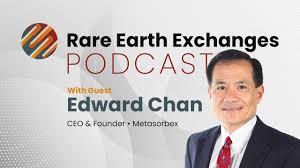
A discussion (opens in a new tab) with Metasorbex Corpoation (opens in a new tab) CEO Edward Chan (opens in a new tab) underscores a critical reality: the United States does not lack rare earth resources—it lacks the capacity to separate them at scale. As demand accelerates for magnetic elements such as neodymium (Nd), praseodymium (Pr), dysprosium (Dy), and terbium (Tb), the strategic battleground is shifting from mining to materials science. Emerging approaches, including graphene-based separation, aim to challenge a decades-old, China-dominated paradigm.
A Problem Misdiagnosed
In Washington, the instinct is familiar: find more mines, fund exploration, fast-track permits. But this is increasingly a category error.
Rare earths are not rare in the earth’s crust—they are rare in economically separable form.
The constraint—technical, capital-intensive, and largely invisible to policymakers—is separation. Isolating chemically similar elements such as Nd and Pr, and especially heavy rare earths like Dy and Tb, remains overwhelmingly concentrated in China.
As Chan notes, the bottleneck is not extraction—it is what comes after.
The Tyranny of Solvent Extraction
The incumbent technology, solvent extraction, is less innovative than industrial inertia. Developed in the late 20th century and scaled relentlessly in China, it relies on hundreds of sequential stages, large volumes of solvents, and extensive infrastructure.
It works—but at a cost: high capital intensity, operational complexity, and environmental burden. China’s advantage is not merely geological; it is systemic. Entire industrial ecosystems—from leaching to separation to magnet manufacturing—are optimized around this process. Replacing it would risk stranding billions in capital.
So the system endures.
A Materials Revolution—or Another False Dawn?
Metasorbex advances a different thesis: shift complexity from process engineering to material design. Rather than relying on multi-stage solvent systems, the company is developing graphene-based materials with tunable active sites to selectively bind rare earth ions. The ambition is clear—reduce stages, increase selectivity, and enable modular, distributed processing closer to feedstock sources such as coal ash and industrial residues.
The appeal is obvious: decentralized, plug-and-play systems converting waste into strategic supply. But reality intrudes. The technology remains at an early stage (laboratory scale), and history is littered with separation technologies that failed to scale. Meanwhile, solvent extraction—imperfect as it is—remains the only proven industrial method at scale.
Secondary Resources, Primary Opportunity
Where the thesis holds weight is in secondary feedstocks.
The United States possesses vast quantities of coal fly ash—running into the billions of tons—containing low concentrations of rare earth elements. While grades are modest, accessibility and permitting advantages make these materials strategically attractive.
If separation improves, these “wastes” become viable reserves.
This reframes the supply chain—from mine-centric to system-centric, where value is unlocked not by discovery, but by processing capability.
The Strategic Reality
The uncomfortable truth is this: America’s rare earth vulnerability is not upstream—it is midstream. Until the U.S. can separate at scale—particularly heavy rare earths critical for defense and advanced manufacturing—upstream gains will remain insufficient.
The next era of competition will not be won by those who dig the most, but by those who can divide the finest.


0 Comments
No replies yet
Loading new replies...
Moderator
Join the full discussion at the Rare Earth Exchanges Forum →