
Highlights
- A comprehensive review of 3,151 papers from 1984–2023 reveals that Nd-Fe-B magnet research has evolved from performance optimization to sustainability concerns, yet recycling rates remain at just 1% despite supply chain risks.
- China dominates both rare earth production and academic research, while the field has progressed through four phases: early development, performance optimization, supply risk awareness, and sustainability integration since the 2010s.
- The literature critically neglects social impacts of rare earth extraction—including labor conditions and community health—while environmental and economic dimensions receive growing but insufficient attention.
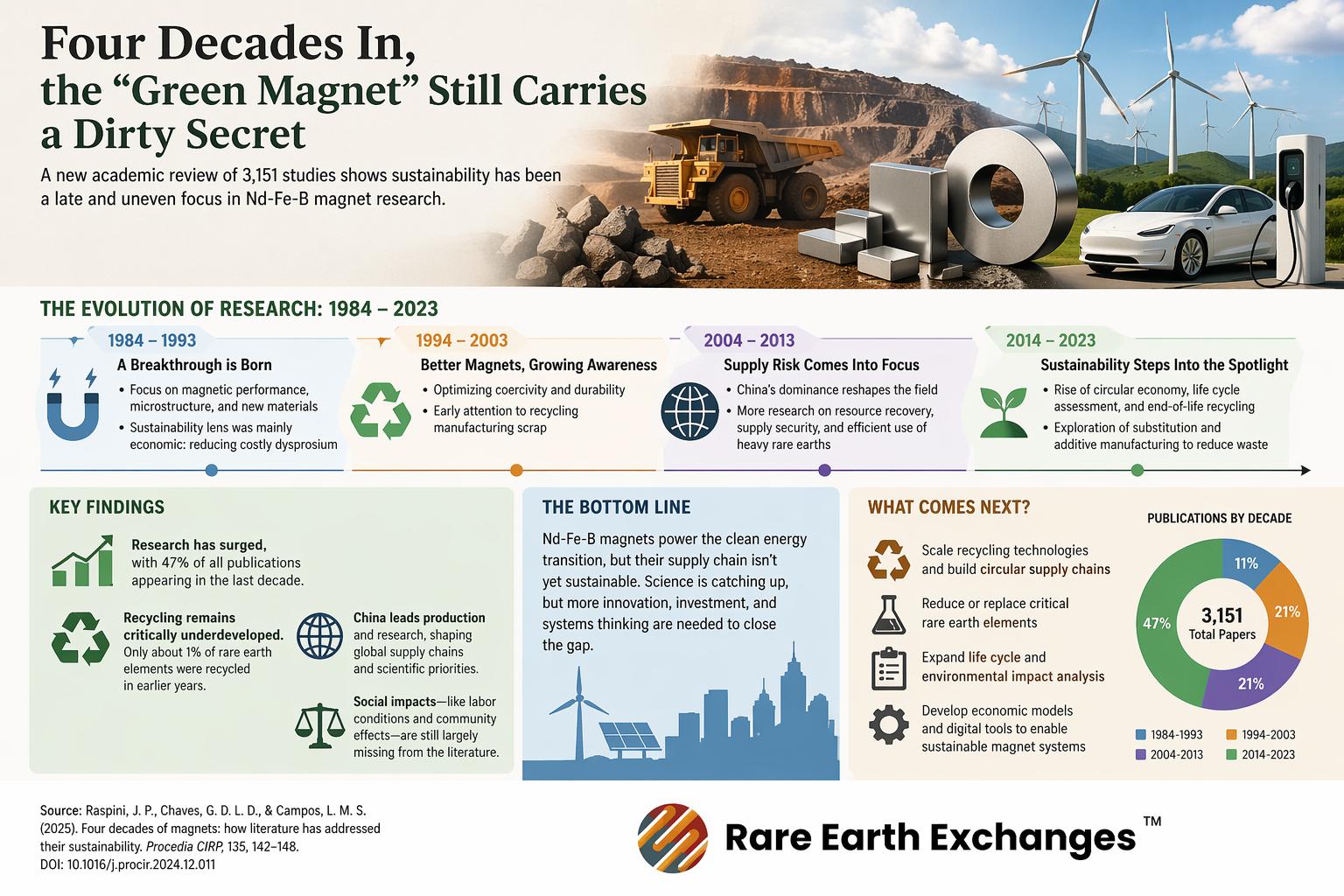
A sweeping academic review last year led by Jéssica Prats Raspini (opens in a new tab) and colleagues at the Federal University of Santa Catarina finds that while neodymium-iron-boron (Nd-Fe-B) magnets have become indispensable to electric vehicles and wind turbines, the science behind them has only recently begun to grapple seriously with sustainability. Drawing on an analysis of 3,151 papers published between 1984 and 2023, the study concludes that the field has evolved from a narrow focus on performance to a broader—though still incomplete—engagement with environmental and supply chain realities.
From Breakthrough Material to Strategic Dependency
Nd-Fe-B magnets, first commercialized in the early 1980s, revolutionized energy efficiency by enabling smaller, lighter, and more powerful motors. For decades, research has centered on improving magnetic strength and durability. Sustainability, when considered at all, was largely economic—how to reduce reliance on costly inputs like dysprosium.
Only later did a more complex picture emerge. The mining and processing of rare earth elements carry significant environmental burdens, and the global supply chain has become heavily concentrated. By the early 2010s, China accounted for the overwhelming majority of rare earth production, a dominance that reshaped both markets and research priorities.
The Rise of Recycling—and Its Limits
Then there was a gradual shift toward recycling and resource efficiency, particularly after 2004, when concerns over supply security intensified. Researchers began exploring ways to recover rare earths from manufacturing scrap and, eventually, from end-of-life products.
Yet progress has been uneven to say the least. Despite decades of study, recycling rates for rare earth elements have remained strikingly low, historically around 1 percent. Technical challenges, economic constraints, and fragmented supply chains have limited large-scale adoption.
Jéssica Prats Raspini

Source: ResearchGate
In recent years, the literature has expanded to include circular economy frameworks, life cycle assessments, and alternative manufacturing approaches such as additive manufacturing. Still, these efforts remain largely at the research stage, with few fully commercialized solutions.
A Field Expands—But Unevenly
There have been four phases in the evolution of Nd-Fe-B research: 1) early development (1980s), 2) performance optimization (1990s), 3) supply risk awareness (2000s), and sustainability integration (2010s onward). Notably, nearly half of all publications have appeared in the past decade, reflecting growing urgency around both demand and environmental impact.
China now leads not only in production but also in academic output, underscoring its central role in shaping the field’s direction, the research, and as Rare Earth Exchanges™ continues to caution policy makers in the West to own the future.
The Missing Dimension
Perhaps most striking is what remains underexplored. While environmental and economic dimensions of sustainability have gained traction, the social impacts of rare earth extraction—labor conditions, community health, and regional inequality—receive scant attention in the literature.
The Road Ahead
The study calls for a more holistic approach: improved recycling technologies, reduced reliance on critical materials, deeper life-cycle analysis, and stronger integration of economic and policy frameworks. Without such advances, the magnets powering the clean energy transition may continue to depend on supply chains that are anything but sustainable. In the end, the lesson is less about materials science than about systems.
The magnet may be efficient. The system that produces it, far less so.
Raspini, J. P., Chaves, G. D. L. D., & Campos, L. M. de S. (2025). Four decades of magnets: How literature has addressed their sustainability. Procedia CIRP, 135, 142–148. https://doi.org/10.1016/j.procir.2024.12.011 (opens in a new tab)


0 Comments
No replies yet
Loading new replies...
Moderator
Join the full discussion at the Rare Earth Exchanges Forum →