
Highlights
- A review of 1,180 scientific papers finds that selective thorium removal is one of the most significant unsolved challenges in rare earth processing.
- High thorium removal rates in lab settings often come at the cost of rare earth losses, radioactive waste generation, and poor scalability to industrial operations.
- Real-world processing conditions—competing ions, fluctuating pH, and suspended solids—frequently degrade the performance seen in simplified laboratory studies.
- Hybrid flowsheets combining multiple separation technologies are identified as the most promising path forward for managing thorium economically.
- Investors and policymakers are warned that a promising rare earth deposit can still fail commercially if thorium management is not economically and environmentally resolved.
A rare earth deposit can contain billions of dollars' worth of strategic minerals. It can sit atop favorable geology, enjoy political support, and attract eager investors. Yet a single element—thorium—can quietly turn a promising project into an environmental, regulatory, and economic headache. In a sweeping 2026 review (opens in a new tab), Antonio Clareti Pereira (opens in a new tab), a chemical engineer affiliated with São Paulo University (opens in a new tab) (USP), Brazil, examined more than a thousand scientific papers and reached a sobering conclusion: despite years of research and impressive laboratory results, selective thorium removal remains one of the most significant unresolved challenges in rare earth processing. The review finds that while researchers can often remove 95–99% of thorium under controlled conditions, those same methods frequently lose valuable rare earths, generate radioactive waste, or fail to scale economically. For Western nations seeking to build secure, non-Chinese rare earth supply chains, the message is unmistakable: the future may depend as much on managing thorium as on mining rare earths.
The Element Lurking Inside the Supply Chain
Rare earth elements power modern civilization. They are found in permanent magnets used in electric vehicles, wind turbines, advanced robotics, missile guidance systems, fighter aircraft, and increasingly, artificial intelligence infrastructure.
But many rare earth deposits—particularly monazite-rich resources—contain thorium, a naturally occurring radioactive element. During processing, thorium can dissolve into chemical circuits alongside valuable rare earths. Once that happens, operators face a difficult balancing act: remove the radioactive contaminant without sacrificing the valuable product.
That sounds straightforward. It is not.
Thorium behaves differently from rare earth elements chemically, but not differently enough to make separation easy. Every mistake can mean lower recoveries, higher costs, additional waste handling requirements, and greater regulatory scrutiny.
What the Review Examined
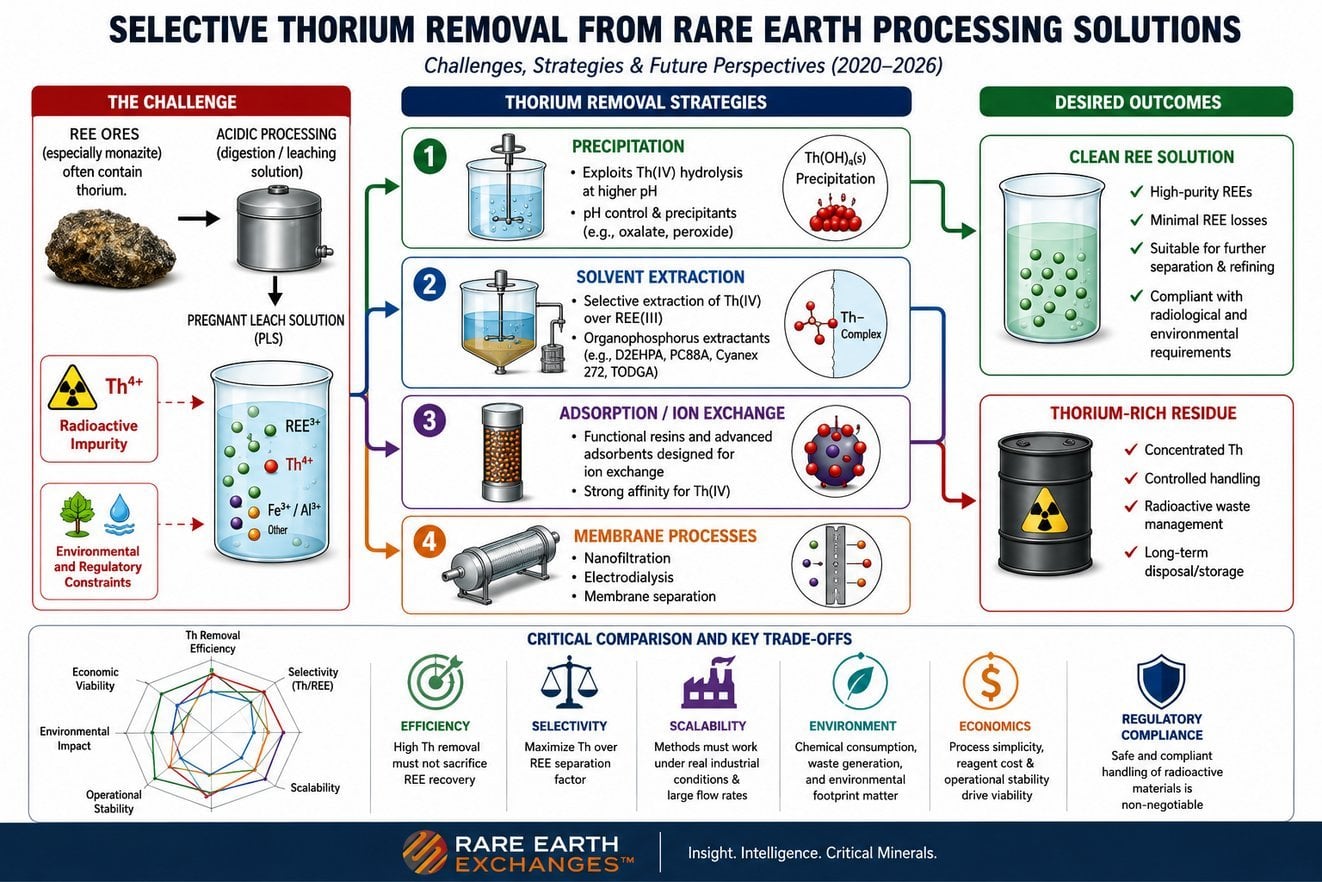
Pereira conducted a PRISMA-informed review of approximately 1,180 publications published between 2020 and 2026. The analysis evaluated the major technologies currently proposed for thorium removal, including:
- Chemical precipitation
- Solvent extraction
- Ion exchange
- Adsorption technologies
- Membrane separation
- Electrosorption
- Hybrid integrated flowsheets
Importantly, the study did not simply ask which method removes the most thorium. It examined selectivity, rare earth losses, scalability, environmental impact, radioactive waste generation, and industrial practicality.
That distinction matters.
The Central Finding: Removing Thorium Is Easier Than Managing It
The review repeatedly arrives at a conclusion that many investors and policymakers overlook: high thorium removal efficiency does not automatically translate into a viable industrial process. Laboratory studies routinely report impressive removal rates. Yet many are conducted using simplified synthetic solutions rather than the chemically complex liquids found in commercial rare earth plants. Real-world operations contain competing ions, sulfates, phosphates, suspended solids, fluctuating pH conditions, and countless operational variables that can degrade performance.
The result is a recurring pattern throughout the literature:
- Higher thorium removal often increases rare earth losses.
- Membranes foul.
- Extractants degrade.
- Reagent consumption rises.
- Radioactive residues accumulate.
- Process stability becomes harder to maintain.
In short, the engineering challenge extends far beyond separating one element from another.
The Most Important Insight for Investors
Perhaps the review's most valuable contribution is its warning against technological optimism.
Many emerging separation technologies demonstrate extraordinary laboratory performance. Yet relatively few have undergone meaningful pilot-scale validation. According to Pereira, critical issues such as long-term operating stability, residue management, equipment durability, and commercial economics remain insufficiently studied.
This creates a gap between scientific promise and industrial reality.
For investors evaluating rare earth projects, that gap matters. A company can possess an attractive resource and still struggle if it cannot economically manage radioactive impurities.
What Comes Next?
The review identifies hybrid processing flowsheets—systems combining multiple separation technologies—as the most promising path forward. Rather than relying on a single "silver bullet," future plants may require integrated solutions that balance thorium removal, rare earth recovery, environmental stewardship, and economic performance simultaneously.
The author also calls for significantly more pilot-scale testing and greater focus on radioactive residue stabilization and long-term waste management.
The REEx Take
Rare earth investors often focus on grades, tonnage, magnet demand, and geopolitical headlines. Those factors matter. But this review highlights a less visible reality: the race to build resilient Western rare earth supply chains may ultimately be won or lost inside the processing plant. The industry already knows how to find rare earths. The harder challenge is separating, purifying, and responsibly managing what comes with them. Thorium may not generate the excitement of neodymium or dysprosium. Yet as this review makes clear, it remains one of the most consequential variables in the entire rare earth value chain.
Citation: Pereira, A.C. (2026). Selective Thorium Separation from Rare Earth Leach Solutions: Hydrometallurgical Strategies, Process Limitations, and Future Perspectives. Vol. 1, Issue 5, pp. 1–55. DOI: 10.66104/2syq3w92.
Register today: REEx Marketplace™ (opens in a new tab)


3 Comments
3 replies
Loading new replies...
Active member
Administrator
New member
Join the full discussion at the Rare Earth Exchanges Forum →