
Highlights
- Tsinghua University students visited Shenghe Resources in Liangshan as part of China's strategic program to align elite academic talent with rare earth industries, reinforcing vertical integration from mining to downstream processing.
- China systematically integrates provincial industrial clustering, technical institutes, and workforce development into national rare earth strategy, while Western efforts lack coordinated federal-to-local implementation frameworks.
- The talent pipeline initiative signals China's institutional advantage in rare earths extends beyond geology to educational systems, regional government coordination, and strategic human capital mobilization.
In a move underscoring China’s long-term focus on rare earth dominance, graduate students from Tsinghua University (opens in a new tab) visited Shenghe Resources (opens in a new tab) (Dechang) as part of a government-backed talent and industrial development initiative in Liangshan Prefecture, Sichuan. Organized by the Liangshan Development and Reform Commission, the visit is part of the “Thousand Talents · Intelligence Converges in Liangshan” program, designed to connect elite academic talent with regional strategic industries—chief among them rare earths.
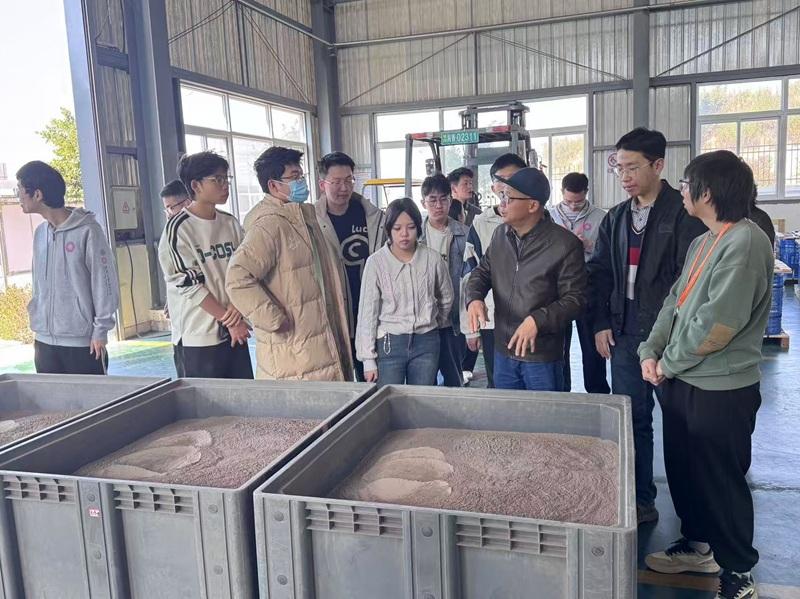
At the Dechang facility, students toured rare earth metal production lines and received briefings from company leadership on applications, manufacturing processes, and the broader supply chain. Executives outlined Liangshan’s fully integrated rare earth ecosystem—from ore mining and beneficiation to metallurgical separation and downstream metal processing—positioning the region as a key node in China’s vertically integrated rare earth infrastructure.
The message was clear: rare earths are not just industrial inputs but strategic national assets. Company representatives emphasized China’s unique position in the global supply chain, describing rare earths as the “vitamins of modern industry” and reinforcing the country’s advantage in processing, refinement, and downstream value capture.
Why This Matters for U.S. and Western Audiences
While framed as a talent exchange, the visit highlights several strategic developments:
- Vertical Integration Reinforced: Liangshan ispresented as possessing a complete industrial chain—an enduringadvantage over Western efforts still struggling to build large-scale separation capacity.
- Talent Pipeline Mobilization: China is actively aligning elite technical talent with domestic rare earth development, strengthening human capital in advanced materials, environmental controls, and digital industrial upgrades.
- Strategic Signaling: The narrative reinforces China’s view of rare earths as a geopolitical lever and core industrial asset—especially relevant as the U.S. and EU attempt to de-risk supply chains.
There are no announced technical breakthroughs in this report. However, the coordinated alignment of academia, regional government, and industry signals continued consolidation of China’s rare earth advantage—particularly in downstream metals and functional materials.
For Western policymakers and investors, this serves as a reminder: China’s competitive edge is not just geological—it is institutional, educational, and vertically integrated.
For example, a critical gap in emerging U.S. and European industrial policy is the lack of a systematic framework that integrates national rare-earth and critical-mineral strategies with state, county, and municipal economic development systems. While federal governments announce stockpiles, tax credits, and strategic partnerships (among several independent agencies), there is no structured mechanism that aligns local permitting authorities, regional workforce boards, four-year universities, community colleges and technical schools, land-use planners, infrastructure funding, and municipal bond markets into a coordinated minerals ecosystem.
In practice, rare earth strategy remains top-down and federal—relatively haphazard and fragmented at this level, while implementation barriers—zoning, water rights, grid interconnection, vocational training pipelines, local tax incentives, and environmental review capacity—are hyper-local. Without a formal vertical integration model linking federal objectives to state incentive packages, county-level industrial parks, and municipal talent development programs, Western critical mineral policy risks fragmentation, delay, and capital flight.
China’s model, on the other hand, integrates province-level industrial clustering, financing vehicles, technical institutes, and workforce mobilization directly into national strategy.
By contrast, the U.S. and Europe lack a codified “federal-to-local minerals alignment architecture” that synchronizes policy, permitting velocity, infrastructure buildout, and human capital formation into a singleoperational framework. Until that structural layer is built, national strategy (which, again, is far from sufficient) will continue to outpace on-the-ground execution.


0 Comments
No replies yet
Loading new replies...
Moderator
Join the full discussion at the Rare Earth Exchanges Forum →