
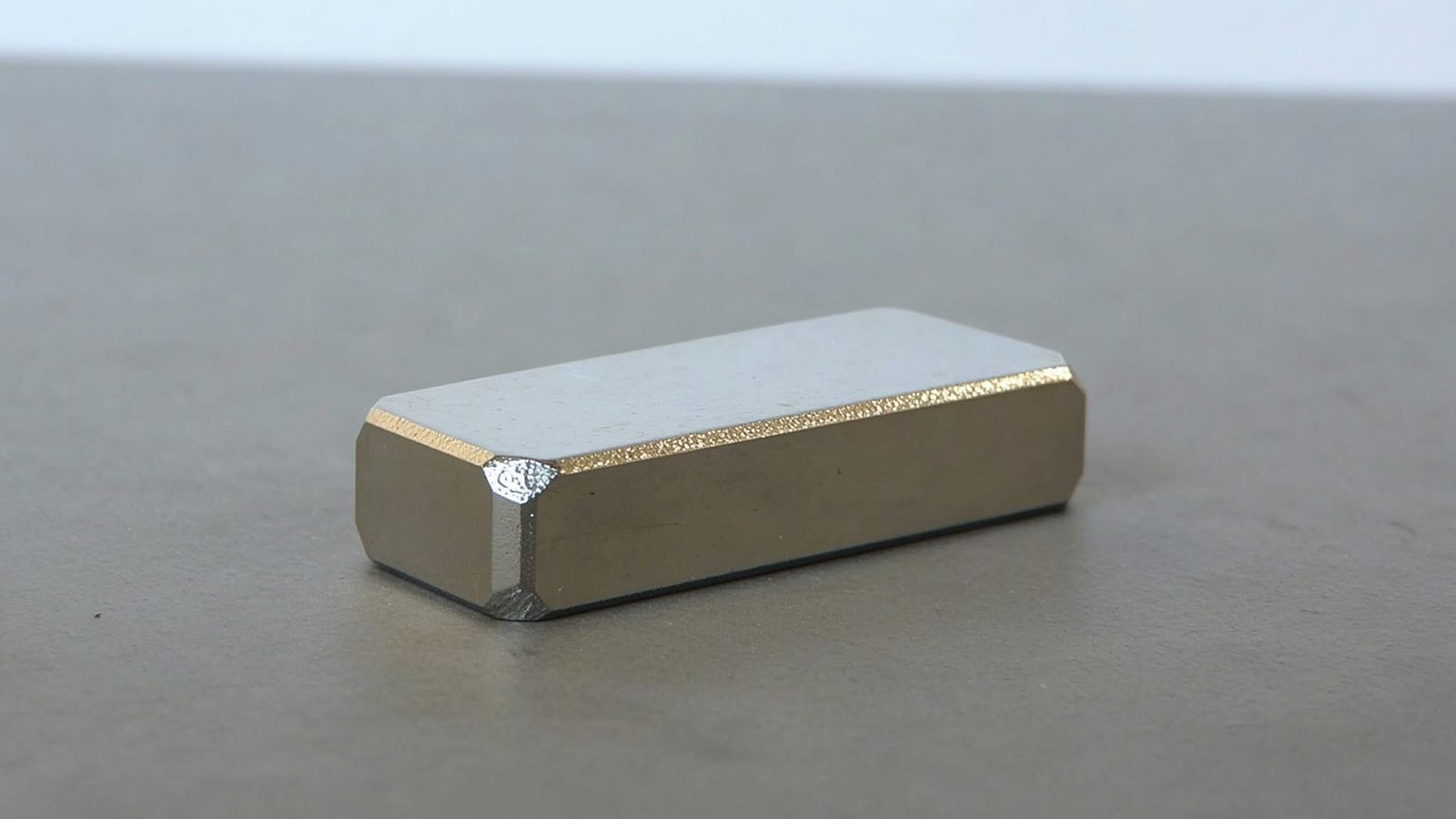
What is a rare earth magnet? It is a strong permanent magnet made from alloys of rare earth elements. There are two types, neodymium and samarium cobalt, and the U.S. Department of Energy calls rare earth magnets the strongest magnets commercially available.
Table of Contents
What is a rare earth magnet?
A rare earth magnet is a strong permanent magnet made from alloys of rare earth elements. The first type is neodymium iron boron, written NdFeB, an alloy of neodymium, iron and boron that forms the Nd2Fe14B tetragonal crystalline structure. The second is samarium cobalt, written SmCo. Samarium-cobalt magnets were developed in the 1960s, based on work by Karl Strnat. Neodymium magnets came later, developed independently by General Motors and Sumitomo Special Metals in 1984.
The two main types
Samarium-cobalt magnets come in two series. SmCo5 has one samarium atom for every five cobalt atoms and energy products of 16 to 25 MGOe, while Sm2Co17 reaches maximum energy products of 20 to 32 MGOe. Neodymium magnets have a remanent magnetization of typically 1.3 teslas, and commercial grades run from N28 up to N55, with a theoretical maximum at N64.
Why rare earths are not actually rare
Even the two least abundant rare earth elements, thulium and lutetium, are nearly 200 times more common than gold, according to the USGS rare earth elements fact sheet (opens in a new tab).
How rare earth magnet strength compares with ferrite and alnico
The gap between these magnets and ferrite and alnico magnets shows in both field strength and maximum energy product.
Field strength
Rare-earth magnets typically produce magnetic fields that can exceed 1.2 teslas, while ferrite or ceramic magnets typically produce 0.5 to 1 tesla.
Maximum energy product
Sintered NdFeB magnets have a maximum energy product of 200 to 440 kJ/m3, compared with 120 to 200 kJ/m3 for sintered SmCo5. By comparison, sintered alnico ranges from 10 to 88 kJ/m3 and sintered strontium ferrite from 10 to 40 kJ/m3.
Neodymium vs samarium-cobalt magnets
The two types compare differently on strength and heat.
Strength
Neodymium has the higher energy product range of the two, as the figures above show, and the Neodymium magnet article on Wikipedia calls neodymium magnets the strongest type of permanent magnet available commercially. To see how the metal becomes a finished magnet, read how neodymium magnets are made.
Heat resistance
Samarium cobalt tolerates more heat. The Curie temperature of Nd2Fe14B is 310 to 400°C, compared with 720°C for SmCo5 and 800°C for Sm(Co,Fe,Cu,Zr)7, and samarium-cobalt magnets have maximum use temperatures from 250°C to 550°C. K&J Magnetics specifications give standard N-grade neodymium magnets a maximum operating temperature of 80°C (176°F), with higher-temperature grades going up to 220°C (428°F) for the NAH grade. Dysprosium or terbium is added to neodymium magnets to curb the fall in performance as temperature changes.
Corrosion and brittleness
Sintered Nd2Fe14B tends to be vulnerable to corrosion, especially along grain boundaries, and nickel, nickel-copper-nickel and zinc platings are the standard methods of protection. Rare-earth magnets are also extremely brittle and vulnerable to corrosion, so they are usually plated or coated to protect them from breaking, chipping or crumbling.
What rare earth magnets are used for
These magnets are key components of wind turbine generators and of traction motors in battery and hybrid electric vehicles, according to the U.S. Department of Energy supply chain fact sheet (opens in a new tab). They are also used in computer hard disk drives, loudspeakers and headphones, MRI scanners and cordless tool motors.
Electric vehicles and wind turbines
For more on the rare earths used in these motors, see rare earths in electric motors.
Who makes rare earth magnets
China controlled 58% of rare earth mining and 92% of magnet manufacturing in 2020, according to the same Department of Energy fact sheet. Buyers comparing magnet suppliers can browse listings on the REEx Marketplace.
Handling rare earth magnets safely
Rare-earth magnets larger than a few centimeters are strong enough to injure body parts pinched between two magnets, and magnets that snap together can chip and shatter.
Browse rare earth magnet suppliers on the REEx Marketplace (opens in a new tab)
Frequently asked questions
What is the strongest type of rare earth magnet?
Neodymium iron boron. Sintered NdFeB magnets have a maximum energy product of 200 to 440 kJ/m3, compared with 120 to 200 kJ/m3 for sintered SmCo5, and neodymium magnets have a remanent magnetization of typically 1.3 teslas. Samarium cobalt has the lower energy product range but much higher Curie temperatures and a maximum use range of 250°C to 550°C.
Are rare earth magnets actually rare?
Not in terms of how common they are in the earth's crust. Even the two least abundant rare earth elements, thulium and lutetium, are nearly 200 times more common than gold, according to the USGS. The magnets themselves are made from alloys of rare earth elements, such as neodymium in NdFeB magnets and samarium in SmCo magnets.
Why do neodymium magnets need a coating?
Sintered neodymium magnets tend to be vulnerable to corrosion, especially along grain boundaries, and rare-earth magnets are extremely brittle. They are usually plated or coated to protect them from breaking, chipping or crumbling. Nickel, nickel-copper-nickel and zinc platings are the standard methods of protection for sintered neodymium magnets.
What are rare earth magnets used for?
They are key components of wind turbine generators and of traction motors in battery and hybrid electric vehicles, according to the U.S. Department of Energy. They are also used in computer hard disk drives, loudspeakers and headphones, MRI scanners and cordless tool motors.
Which magnet handles high temperatures better?
Samarium cobalt. Its Curie temperature is 720°C for SmCo5 and 800°C for Sm(Co,Fe,Cu,Zr)7, compared with 310 to 400°C for Nd2Fe14B, and samarium-cobalt magnets have maximum use temperatures from 250°C to 550°C. In K&J Magnetics specifications, standard N-grade neodymium magnets are rated to 80°C and the NAH grade to 220°C.
Who makes most of the world's rare earth magnets?
China. It controlled 58% of rare earth mining and 92% of magnet manufacturing in 2020, according to a U.S. Department of Energy supply chain fact sheet, which describes the global supply chain for rare earth metals and magnets as almost completely dominated by China. Buyers comparing magnet suppliers can browse listings on the REEx Marketplace.
Key figures
| Item | Value | Source | As of |
|---|---|---|---|
| Rare earth magnet definition | Permanent magnet made from rare-earth alloys | Wikipedia - Rare-earth magnet (opens in a new tab) | 2026-11-09 |
| Number of types | 2 types: NdFeB and SmCo | First4magnets - Rare Earth Magnets (opens in a new tab) | 2026-11-09 |
| Samarium-cobalt developed | Early 1960s (Karl Strnat) | Wikipedia - Samarium-cobalt magnet (opens in a new tab) | 2026-11-09 |
| Neodymium developed | 1984 (General Motors and Sumitomo Special Metals) | Wikipedia - Neodymium magnet (opens in a new tab) | 2026-11-09 |
| Field strength comparison | Over 1.2 T vs 0.5-1 T (ferrite/ceramic) | Wikipedia - Rare-earth magnet (opens in a new tab) | 2026-11-09 |
| Energy product, rare earth | NdFeB 200-440 kJ/m3; SmCo5 120-200 kJ/m3 | Wikipedia - Rare-earth magnet (opens in a new tab) | 2026-11-09 |
| Energy product, older magnets | Alnico 10-88 kJ/m3; Sr-ferrite 10-40 kJ/m3 | Wikipedia - Rare-earth magnet (opens in a new tab) | 2026-11-09 |
| Neodymium remanence and grades | Typically 1.3 T; grades N28-N55 (theoretical N64) | Wikipedia - Neodymium magnet (opens in a new tab) | 2026-11-09 |
| Neodymium structure | Nd2Fe14B tetragonal | Wikipedia - Neodymium magnet (opens in a new tab) | 2026-11-09 |
| Samarium-cobalt series | SmCo5 16-25 MGOe; Sm2Co17 20-32 MGOe | Wikipedia - Samarium-cobalt magnet (opens in a new tab) | 2026-11-09 |
| Curie temperatures | NdFeB 310-400 C; SmCo5 720 C; Sm2Co17-type 800 C | Wikipedia - Rare-earth magnet (opens in a new tab) | 2026-11-09 |
| Samarium-cobalt max use temp | 250-550 C | Wikipedia - Samarium-cobalt magnet (opens in a new tab) | 2026-11-09 |
| Neodymium max operating temp | N 80 C (176 F); NAH 220 C (428 F) | K&J Magnetics - Neodymium Magnet Specifications (opens in a new tab) | 2026-11-09 |
| Heat performance additive | Dysprosium or terbium added | Wikipedia - Neodymium magnet (opens in a new tab) | 2026-11-09 |
| Corrosion protection | Ni, Ni-Cu-Ni, zinc plating | Wikipedia - Neodymium magnet (opens in a new tab) | 2026-11-09 |
| China supply share (2020) | 58% of mining, 92% of magnet manufacturing | U.S. Department of Energy - Rare Earth Permanent Magnets Supply Chain Fact Sheet (opens in a new tab) | 2022-02-24 |
| Abundance vs gold | Least abundant REE nearly 200x more common than gold | USGS - Rare Earth Elements Fact Sheet (opens in a new tab) | 2002-12-01 |
