
Highlights
- Samarium-cobalt magnets now outperform heat-resistant Nd-Fe-B magnets above 140°C and have entered commercial use in railway traction motors and generators.
- Advances in samarium-iron systems show magnetic properties approaching Nd-Fe-B benchmarks, but most remain pre-commercial or limited to laboratory-scale demonstrations.
- Shifting magnet chemistry away from dysprosium and terbium reduces one supply vulnerability, yet samarium itself still requires midstream processing where China holds major advantages.
- The review reflects Japan's magnet research community and gives less coverage to competing programs in China, Europe, and the United States.
- Investors should note the real competitive frontier is building better magnets and resilient industrial ecosystems, not just finding new rare earth deposits.
Researchers argue samarium-based permanent magnets could reduce dependence on scarce heavy rare earth elements while expanding options for electric vehicles, robotics, aerospace, and defense. The research is encouraging—but it does not eliminate the West's larger dependence on China's rare earth industrial ecosystem.
Shinya Sakurada, PhD
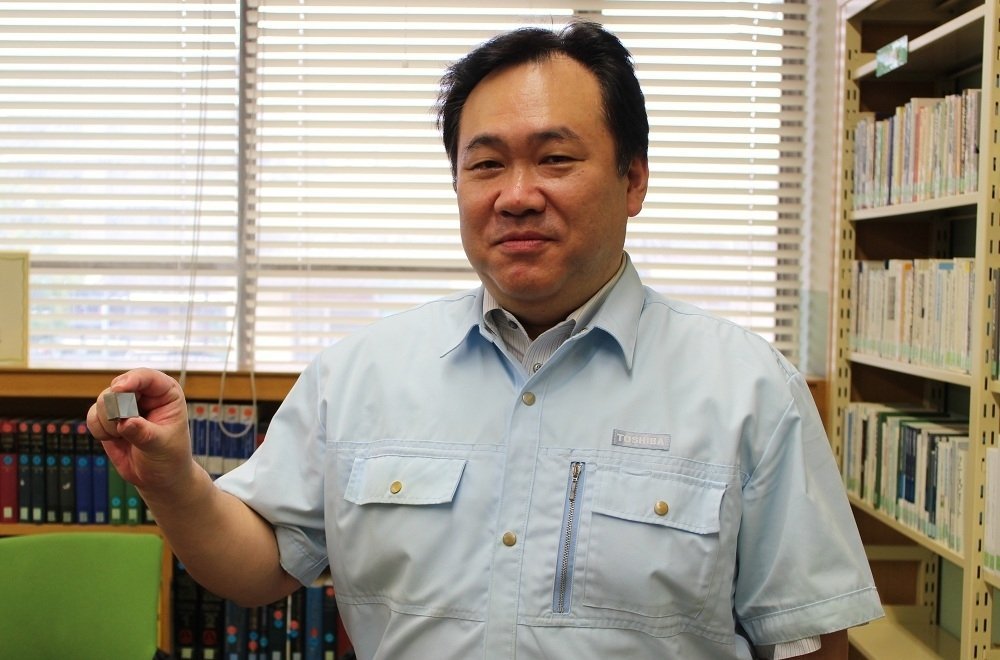
A comprehensive review (opens in a new tab) late last year by Dr. Shinya Sakurada, Senior Fellow at Toshiba Corporation's Materials & Frontier Research Center (opens in a new tab), synthesizes decades of research into samarium (Sm)-based permanent magnets and concludes these materials are becoming increasingly attractive alternatives for applications where conventional neodymium-iron-boron (Nd-Fe-B) magnets require heavy rare earth additions to withstand high temperatures. Drawing on research from Toshiba, Japan's National Institute for Materials Science (NIMS), Daido Steel, Sumitomo Metal Mining, Nichia, and numerous academic collaborators, the review concludes that advances in samarium-cobalt (Sm-Co) and samarium-iron (Sm-Fe) magnets could strengthen supply-chain resilience by reducing dependence on dysprosium (Dy) and terbium (Tb)—two heavy rare earth elements that have become increasingly strategic amid China's tightening export controls and dominant position in global processing.
Why This Matters
Permanent magnets are the quiet engines of the modern economy. They enable electric vehicles, industrial robots, wind turbines, smartphones, aircraft, satellites, precision manufacturing, and many advanced defense systems. Today's highest-performance Nd-Fe-B magnets often require additions of dysprosium or terbium to maintain magnetic strength at elevated operating temperatures.
Those heavy rare earths remain among the world's most supply-constrained critical materials.
How the Review Was Conducted
Rather than reporting a single experiment, Sakurada's paper is a comprehensive tutorial review that evaluates decades of published research across multiple samarium-based magnet systems. It compares magnetic performance, manufacturing approaches, commercialization progress, and remaining scientific obstacles while highlighting advances from both academia and industry.
What Researchers Found
The review documents substantial progress across several samarium magnet technologies.
High-iron Sm-Co magnets now achieve record magnetic performance while outperforming heat-resistant Nd-Fe-B magnets in operating environments above roughly 140°C. Toshiba reports these magnets have already entered commercial service in railway traction motors and electrical generators.
The review also highlights rapid advances in several Sm-Fe systems—including Sm₂Fe₁₇N₃, ThMn₁₂, and TbCu₇ crystal structures. Some laboratory materials now exhibit magnetic properties approaching—or in specific metrics exceeding—conventional Nd-Fe-B magnets. However, many of these advances remain confined to thin films, bonded magnets, or laboratory-scale demonstrations and have yet to achieve large-scale commercial production.
The REEx Perspective: A Chemistry Race Inside the Great Powers Era 2.0™
For Rare Earth Exchanges®, the review illustrates something much larger than incremental materials science.
The global rare earth industry is no longer simply searching for new deposits. It is redesigning permanent magnet chemistry itself to reduce exposure to the scarcest and most geopolitically vulnerable materials. Alternative magnet technologies could materially reduce future demand for dysprosium and terbium, easing one of the West's greatest strategic vulnerabilities.
Yet investors should avoid an overly optimistic conclusion. Samarium is itself a rare earth element. Producing competitive samarium magnets still requires sophisticated separation, metallurgical processing, alloy production, magnet manufacturing, and advanced engineering—precisely the industrial midstream where China continues to maintain substantial advantages.
In other words, changing magnet chemistry alone does not eliminate supply-chain dependence.
Important Limitations
This paper is a review article rather than a new experimental investigation. Many of the most promising Sm-Fe technologies remain pre-commercial, while several record-setting magnetic properties have been demonstrated only in thin films, bonded magnets, or laboratory specimens—not high-volume sintered magnets suitable for mass-market automotive production. Questions surrounding manufacturing cost, scalability, qualification by automotive and defense customers, and long-term commercial economics remain unresolved.
The review also reflects the perspective of Japan's magnet research community and naturally emphasizes technologies developed by Toshiba and its collaborators. It gives comparatively less attention to competing research programs underway in China, Europe, and the United States.
Bottom Line
The review demonstrates that samarium-based magnets are evolving from scientific curiosity into commercially relevant technologies for selected high-performance applications. They may significantly reduce future dependence on dysprosium and terbium—but they are unlikely to replace Nd-Fe-B magnets across the broader market anytime soon. For investors, the larger lesson is that the next competitive frontier is not simply discovering more rare earths. It is developing better magnets, more resilient supply chains, and stronger industrial ecosystems. That is precisely the contest defining the Great Powers Era 2.0™.
Citation: Sakurada S. New developments in samarium-based permanent magnets. JSAP Review. 2026;260208. Materials & Frontier Research Center, Toshiba Corporation.


0 Comments
No replies yet
Loading new replies...
Moderator
Join the full discussion at the Rare Earth Exchanges Forum →