
Highlights
- China's Rare Earth Price Index reached 263.6 on August 6, 2026, with NdPr oxide at $109–112/kg domestically versus $120–140+/kg ex-China.
- Heavy rare earth price gaps are extreme: dysprosium trades at $205–211/kg in China but $575–2,500+/kg ex-China, while terbium reaches $2,050–5,000+/kg outside China.
- U.S. government contracts with MP Materials, Serra Verde, and USA Rare Earth reveal an emerging security premium embedded in non-China rare earth supply agreements.
- Yttrium oxide illustrates extreme supply dislocation risk, with ex-China indications potentially exceeding $1,600/kg during severe scarcity events.
- For strategic buyers, the critical question is no longer the published price but whether qualified material from an acceptable origin can be obtained at all.
China’s Rare Earth Price Index equaled 263.6 on August 6, 2026, against a 2010 base of 100. Domestic Chinese references placed magnet-critical NdPr mixed oxide at RMB 725.4–745.4/kg (US$108.81–111.81), dysprosium oxide at RMB 1,365–1,405/kg (US$204.75–210.75) and terbium oxide at RMB 6,630–6,690/kg (US$994.50–1,003.50), using ¥1 = US$0.15. But those numbers increasingly describe China as promulgated by the China Rare Earth Industry Association (CREIA)—not necessarily the price available to a Western buyer.
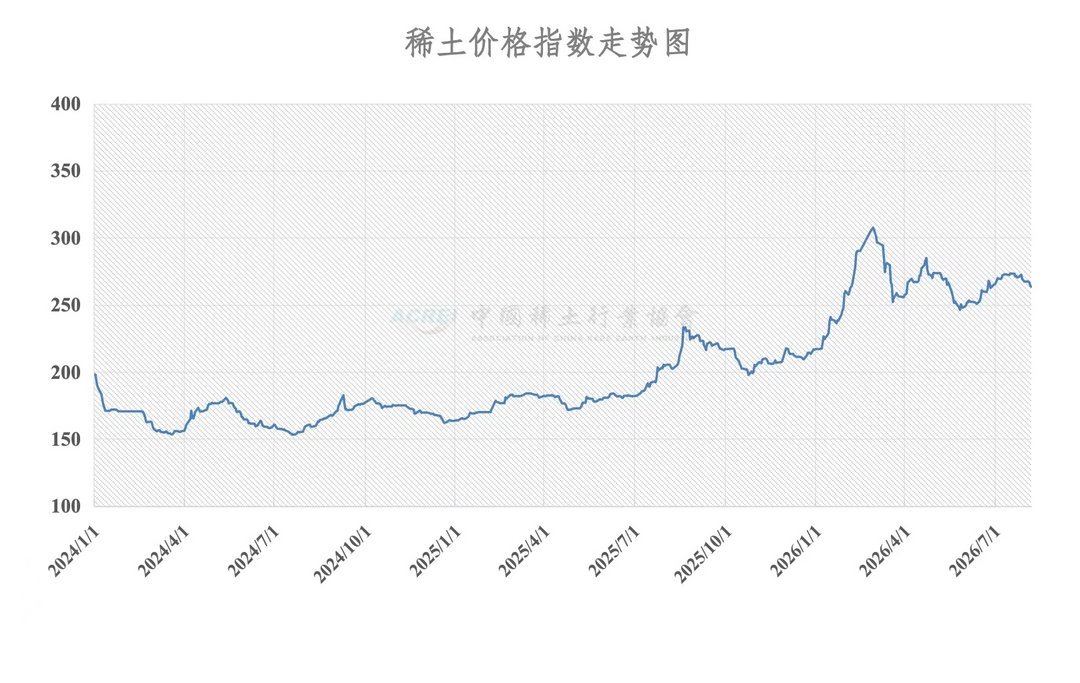
REEx Insight | Two Markets, Neither Truly Transparent
China's rare earth prices should not be confused with conventional free-market price discovery. Production controls, export licensing, state industrial policy, and national-security priorities influence the system. CREIA itself calculates its index from transaction information collected from domestic enterprises.
The ex-China market has the opposite problem: too little liquidity. Most transactions remain confidential, bilateral, and specification-dependent. With limited non-Chinese separation capacity, a Western so-called "spot price" can sometimes be little more than a snapshot of several traders or transactions. REEx therefore treats ex-China values as indicative transaction ranges—not exchange-cleared prices.
The Price Gap
| Magnet-Critical Product | China Reference | Indicative Ex-China Range* |
|---|---|---|
| NdPr Oxide | $109–112/kg | $120–140+/kg |
| Dysprosium Oxide | $205–211/kg | $575–2,500+/kg (can be higher) |
| Terbium Oxide | $995–1,004/kg | $2,050–5,000+/kg (can be far higher) |
| Yttrium Oxide | $8.81–9.41/kg | ~$90–320+/kg in stressed markets (ex-China scarcity and massive hikes can equal over $1,600 per kg) |
*REEx indicative ranges—not universal market prices or guaranteed executable quotes. Product form, purity, quantity, origin, qualification, delivery date, and contract structure can radically change the transaction price. REEx has previously documented yttrium oxide indications reaching roughly $120–320+/kg during severe supply dislocations.
The public contracts reveal the emerging security premium. The U.S. government's agreement with MP Materials provides MP a $110/kg NdPr price floor for ten years; it should not automatically be interpreted as an industry-wide American floor. Serra Verde's separate 15-year arrangement establishes floors of $575/kg for Dy and $2,050/kg for Tb, while USA Rare Earth's presentation showed non-China reference values near $1,100/kg Dy and $4,000/kg Tb.
REEx Insight | With HREEs, Availability Can Trump Price
This is the central lesson for investors. NdPr remains the volume engine of NdFeB magnets, but dysprosium and terbium are the strategic choke points for high-coercivity, high-temperature magnets. Yttrium illustrates an even stranger market: under supply stress, buyers may struggle to obtain qualified material regardless of the published Chinese price.
In Great Powers Era 2.0™, the question is increasingly not "What is the rare earth price?" It is "At what price can you actually obtain qualified material, from an acceptable origin, when you need it?" That is an entirely different market.


0 Comments
No replies yet
Loading new replies...
Moderator
Join the full discussion at the Rare Earth Exchanges Forum →