
Highlights
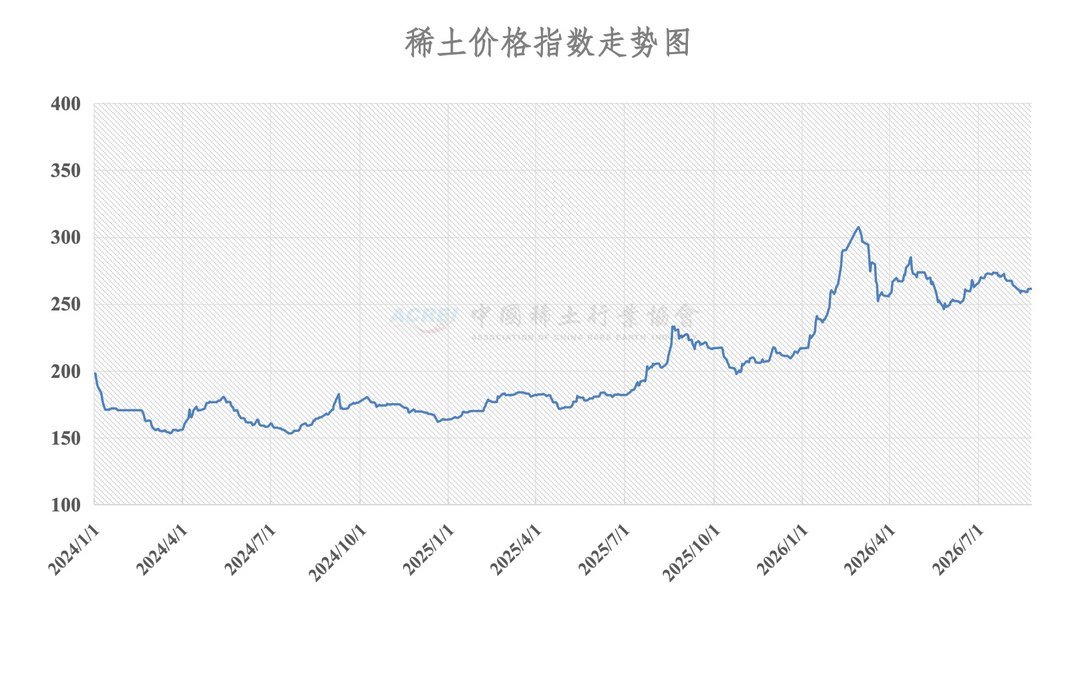
- CREIA's August 24 index hit 261.3, with terbium oxide strengthening to ¥6,650–6,710/kg (~$998–1,007) inside China.
- Ex-China prices for dysprosium and terbium are dramatically higher—up to $4,000+/kg for terbium—when material can be sourced at all.
- China has shipped no dysprosium oxide to Japan for nine months and no terbium oxide for eight, signaling supply denial as policy.
- Pentagon contracts with MP Materials and Serra Verde reveal a growing security premium embedded in Western rare earth procurement.
- Rare earth pricing is increasingly a function of origin and geopolitical access, not just market supply and demand.
Rare earths increasingly have two prices—and sometimes only one place where the material can actually be bought. The China Rare Earth Industry Association (CREIA) reported its August 24 price index at 261.3, versus a 2010 base of 100. Domestic references included NdPr oxide at ¥715.4–735.4/kg (US$107–110), dysprosium oxide at ¥1,400–1,440 ($210–216) and terbium oxide at ¥6,650–6,710 ($998–1,007). Most products were flat; terbium strengthened. Ex-China represents an increasingly difficult and, in some cases, scarcer world.
REEx Insight: Price Is Becoming Geography
The real story is not 261.3. It is the widening separation between a Chinese reference price and the cost—and sometimes impossibility—of obtaining qualified material outside China. China is not a conventional commodity market. Production controls, export licensing, industrial policy and national-security objectives coexist with commercial trading. CREIA's index itself draws on domestic enterprise transaction data. Outside China, the opposite problem prevails: too little liquidity for robust price discovery. Transactions are bespoke, bilateral and frequently confidential.
The result is extraordinary geographic arbitrage:
| Product | China ¥/kg | China US$/kg* | Indicative ex-China US$/kg |
|---|---|---|---|
| NdPr oxide | 715–735 | $107–110 | ~$120–140 |
| Dy oxide | 1,400–1,440 | $210–216 | ~$1,100 reference |
| Tb oxide | 6,650–6,710 | $998–1,007 | ~$2,500 to $4,000+ reference |
| Y oxide | 57.8–61.8 | $8.67–9.27 | Highly illiquid/scarce |
*Using ¥1 = US$0.15. Ex-China figures are indicative reference points, not executable universal spot prices.
When Availability Beats Price
This is most acute for Dy, Tb and Y. China has shipped no Dy oxide to Japan for nine months and no Tb oxide for eight; even U.S. yttrium supply has depended heavily on Chinese export approvals. Government-backed contracts reveal the emerging security premium. The Pentagon guarantees MP Materials a $110/kg NdPr floor for 10 years—a company-specific arrangement, not necessarily an American industry floor. Serra Verde's separate offtake establishes floors of $575/kg Dy and $2,050/kg Tb.
REEx conclusion: rare-earth pricing is becoming a measure not merely of value, but of origin, access and geopolitical permission. A cheap Chinese quotation means little to a Western factory if the material cannot cross the border.
Source disclaimer: CREIA operates within China's state-directed industrial system. Its figures are reference data, not independently exchange-discovered prices, and should be independently verified before investment or procurement decisions.


0 Comments
No replies yet
Loading new replies...
Moderator
Join the full discussion at the Rare Earth Exchanges Forum →