
Highlights
- Myanmar's Karen State has documented antimony, lead, zinc, and tin-tungsten deposits, but no substantiated commercial rare earth deposits have been confirmed.
- Active mining near Three Pagodas Pass involves Chinese and Thai operators paying taxes to the Karen National Union, yet production data and ownership records remain scarce.
- Thailand imported 68,919 tonnes of Myanmar antimony ore in 2025, highlighting a functioning cross-border mineral supply chain that gives Karen State strategic industrial proximity.
- Karen's geology along the Sibumasu Block warrants REE exploration, but geological analogy alone does not constitute a resource without drilling, assays, and resource definition.
Karen State may be one of Southeast Asia's least understood critical-mineral districts. Myanmar government geological work documents antimony, lead, zinc, and tin-tungsten in Karen—officially Kayin—State, while mining near the Thai border is not theoretical: antimony has been mined in KNU-controlled territory, and lead mines around Makkatha and Thebyu near Three Pagodas Pass were reportedly operating in 2026 with Chinese and Thai participation.
Karen State, Myanmar
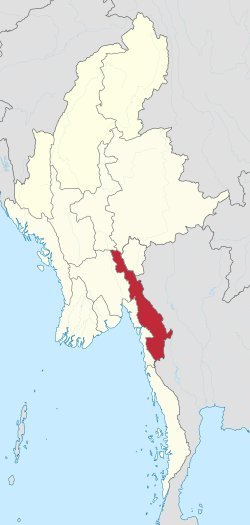
But one distinction is essential: Rare Earth Exchanges® found no substantiated commercial rare-earth deposit, resource estimate, or operating rare earth mines in Karen State.
That separates Karen sharply from Kachin State, source of much of Myanmar's dysprosium-terbium-rich ionic-clay production. Karen is also not Kayah/Karenni State, where the famous Mawchi tin-tungsten mine is located.
The Geology Is Real. The REE Thesis Is Not Yet Proven.
Myanmar's Department of Geological Survey and Mineral Exploration (DGSE) recorded 22 mineral commodities in Kayin State, identifying antimony, tin-tungsten, and zinc among its important minerals.
At Lebyin in Kyarinnseikgyi Township, DGSE geologists documented stibnite-bearing quartz veins associated with barite, feldspar, and mica in Paleozoic sedimentary rocks near a Mesozoic granite intrusion. Regional geological research places Karen along the Sibumasu Block, within the broader Southeast Asian metallogenic architecture responsible for important tin-tungsten and polymetallic mineralization.
This makes further exploration compelling. Granitic systems elsewhere in Thailand and Southeast Asia can contain monazite, xenotime, and other REE minerals, while deeply weathered granites are increasingly being investigated for ion-adsorption REEs. But geological analogy is not a resource.
No apparent evidence currently establishes Karen as another Kachin-style ionic-clay REE province. Investors should not assign mineable REE tonnes until drilling, assays, mineralogy, metallurgy, and resource definition demonstrate otherwise.
Mining Is Already Happening
Karen's strongest documented critical-mineral story is antimony. At Maw Lu Taung in Papun Township, Myint Myat San and Htut Khaung operated antimony mines with Karen National Union permission beginning in 2006. The KNU later moved to withdraw permission following complaints about water pollution, plantation damage, and livestock deaths.
Farther south, the Makkatha-Thebyu mining district near Three Pagodas Pass developed significant lead and antimony activity. Historical reporting identifies Nawarat Company, described as a Thai-Chinese joint venture, as its largest operator and says it constructed a local refinery before pollution problems forced its closure.
Mining apparently continues. Local reporting in 2026 described lead mines under KNU Brigade 6 control, mine owners paying taxes to the KNU, and Chinese and Thai companies operating in the district. Yet public reserve estimates, production figures, grades, and beneficial-ownership records remain remarkably scarce.
That opacity may be Karen's biggest investment risk.
Thailand Changes the Equation
Karen's strategic advantage is its border with an established industrial economy. Thailand was the leading destination for Myanmar antimony in 2024, according to USGS. Thai statistics subsequently recorded 68,919 tonnes of antimony-ore imports worth ฿8.44 billion in 2025. Mae Sot Customs separately reported a dramatic increase in imports from Myanmar, driven principally by antimony ore.
Those statistics do not prove the material originated in Karen. Myanmar has other antimony districts. But they demonstrate something strategically important: a functioning Myanmar-to-Thailand mineral supply chain already exists.
The Myawaddy–Mae Sot and Three Pagodas Pass–Kanchanaburi corridors put Karen mineralization beside Thai roads, processors, manufacturers, capital, and customers. Historic reporting also describes informal cross-border mineral sales, making actual Karen production difficult to reconstruct from customs statistics.
As REEx recently reported, Thailand is making investments to become a rare earth processing center as well.
Why REEx Is Watching Karen
Rare Earth Exchanges has repeatedly examined Myanmar's larger critical-mineral problem in "Study Identifies Myanmar as the Hidden Bottleneck Behind China's Rare Earth Power," "Myanmar's Heavy Rare Earth Reality Check," "Heavy Rare Earth Black Swans," "Myanmar's Rare Earth Boom Powers the So-called Green Economy—but Who Pays the Price?," "China-Backed Militia Secures New Rare Earth Mines in Myanmar," and "Poisoned Upstream."
Those six REEx investigations principally illuminate Kachin, Shan, and the broader Myanmar supply chain—not evidence of a Karen REE deposit. Their relevance is the pattern they expose: mineral resources intersecting ethnic governance, Chinese capital, informal trade, environmental risk, and neighboring-country processing.
Karen already has many of those ingredients, and Karen has strategic proximity to Thailand and the prospect of a mineral corridor between the two.
In Karen State, unless REE deposits can be found, antimony, lead, tin-tungsten, and potentially zinc—not proven dysprosium-terbium clays—currently define the opportunity.
So an unanswered question becomes consequently geological: How extensive are Karen's Sn-W and zinc systems? Are Makkatha-Thebyu ores polymetallic? Do its granitoids, weathered profiles, or placers contain economically recoverable monazite, xenotime, or ion-adsorbed REEs? Karen is not the next Kachin on today's evidence. It may instead be something equally worth investigating: an underexplored critical-mineral province sitting directly beside Thailand's industrial supply chain.


0 Comments
No replies yet
Loading new replies...
Moderator
Join the full discussion at the Rare Earth Exchanges Forum →