
Highlights
- China inaugurated the National Quality Standards Laboratory for Rare-Earth New Materials in Ganzhou, Jiangxi Province on August 14, uniting research, industry, and standards under one roof.
- The lab targets four priorities: enabling technologies, analytical testing, standards formulation, and supply-chain quality improvement, with a commercialization path from science to standard to factory.
- Ganzhou's advanced rare-earth materials cluster generated nearly RMB 60 billion in revenue in 2024, and the new lab adds a critical metrology layer to an already dense industrial ecosystem.
- Western competitors lack a parallel metrology-and-standards ecosystem; mine-to-magnet independence remains incomplete without reference materials, certification labs, and standards development capacity.
- China explicitly aims to use the laboratory to expand its international influence over rare-earth performance definitions and technical specifications.
China is strengthening an overlooked layer of its rare-earth advantage: the infrastructure that determines whether advanced materials meet increasingly demanding specifications. On August 14, China inaugurated the National Quality Standards Laboratory for Rare-Earth New Materials in Ganzhou, Jiangxi Province. It combines the Jiangxi Tungsten and Rare Earth Quality Inspection Center, China Rare Earth Group, Jiangxi University of Science and Technology, and GRINM Group to develop testing technologies, evaluation methods, quality processes, and standards for advanced rare-earth materials. It is Jiangxi's only approved National Quality Standards Laboratory.
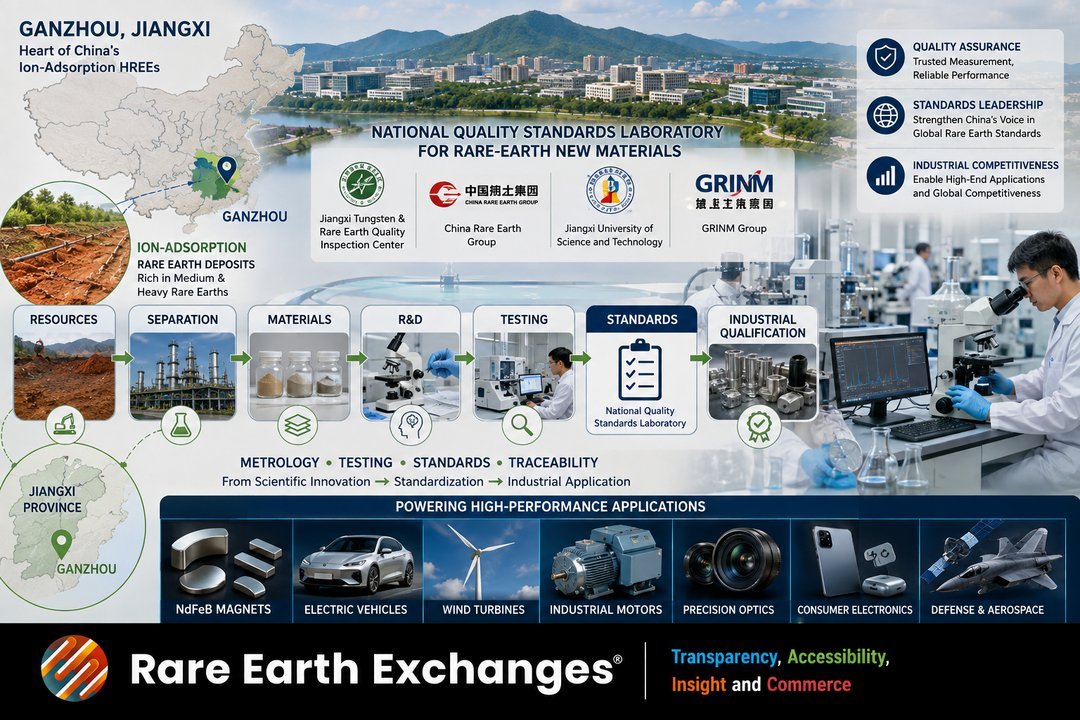
No new production capacity or singular technological breakthrough was announced. The significance is deeper: China is connecting research, measurement, standards, and industrial deployment inside one of its most strategically important rare-earth clusters.
REEx Insight: Ganzhou Is the Point
Location transforms this from a laboratory announcement into something strategically more interesting.
Ganzhou is historically synonymous with China's ion-adsorption rare earths, including strategically important medium and heavy rare earths. Academic research plus industry networks describe Jiangxi—and particularly Ganzhou—as a major HREE center. China reinforced that position in 2021 by locating the headquarters of state-owned China Rare Earth Group in Ganzhou.
The city has subsequently evolved beyond extraction. Ganzhou hosts the National Rare Earth Functional Materials Innovation Center, designed around R&D, pilot-scale validation, testing, and commercialization of magnetic, luminescent, alloy, and recycled rare-earth materials. Its advanced rare-earth materials and applications cluster generated nearly RMB60 billion in revenue from above-designated-size enterprises in 2024, according to the municipal government.
Now add a national quality-and-standards laboratory.
The strategic architecture becomes clearer: resources → separation → materials → R&D → testing → standards → industrial qualification → downstream applications. This matters because advanced rare-earth competition ultimately depends upon repeatability. Producing one high-purity oxide or high-performance magnet is insufficient; manufacturers must reproduce specifications across thousands of batches and prove it through trusted measurement.
Standards can also become a form of industrial leverage. If China's enormous domestic manufacturing base generates the data, testing protocols, and technical specifications around which new materials mature, Chinese institutions gain greater ability to influence how performance gets defined. The laboratory itself explicitly targets improving China's international voice in rare-earth standards.
For Washington and Brussels, the lesson is uncomfortable: mine-to-magnet independence is still incomplete without a parallel metrology-and-standards ecosystem. The West needs reference materials, analytical laboratories, round-robin testing, certification capability, and standards development operating alongside new processing and magnet capacity. Ganzhou is building these layers in the same place.
From Science to Standard to Factory
The laboratory identifies four priorities: common enabling technologies; analytical testing and performance evaluation; standards verification and formulation; and supply-chain quality improvement. Its stated commercialization pathway is particularly revealing: "scientific innovation → standardization → industrial application."
But investors should distinguish infrastructure from accomplishment. No budget, new standard, detection-performance metric, commercial qualification, or implementation timetable was disclosed. This is institutional capacity-building—not evidence that a particular technical bottleneck has already been eliminated.
REEx Reflection
The bigger REEx takeaway: Baotou and Ganzhou increasingly look like complementary poles of China's rare-earth industrial architecture rather than merely two mining centers. Baotou grew around Bayan Obo and the light-rare-earth economy; Ganzhou grew around southern ion-adsorption deposits and medium/heavy rare earths. Both are now being layered with research, standards, talent, advanced materials, and downstream manufacturing. That geographic specialization—and the institutional density built around it—is arguably one of the hardest parts of China's advantage for the West to replicate.
REEx Connect
| Organization | Strategic Role |
|---|---|
| National Quality Standards Laboratory for Rare-Earth New Materials | Testing, quality, and standards development |
| China Rare Earth Group | State-owned integrated rare-earth producer headquartered in Ganzhou |
| Jiangxi Tungsten & Rare Earth Quality Inspection Center | Testing and metrology |
| Jiangxi University of Science and Technology | Rare-earth research and talent |
| GRINM Group | Materials science and industrial R&D |
| National Rare Earth Functional Materials Innovation Center | R&D, pilot validation, and commercialization |
| Ganzhou | Historic ion-adsorption and medium/heavy rare-earth industrial center |
Source disclaimer: The underlying announcement originates from a Chinese government-affiliated quality-inspection institution and concerns organizations including state-owned enterprises. Claims concerning capabilities, progress, and future outcomes should be independently verified before being relied upon for investment or commercial decisions.


0 Comments
No replies yet
Loading new replies...
Moderator
Join the full discussion at the Rare Earth Exchanges Forum →