
Highlights
- USGS ranks lutetium third among 84 minerals by U.S. supply-disruption risk, with a $2.059 billion annual GDP impact model
- China placed gadolinium, lutetium, and yttrium under export licensing in April 2025, creating functional leverage over downstream industries
- Separation of adjacent lanthanides—differing by only ~0.01 angstrom in ionic radius—is the true technical and strategic moat
- DoD and CHIPS Act funding is backing MP Materials and USA Rare Earth to build domestic heavy rare earth separation capacity
- Obscure HREEs like erbium, thulium, and holmium underpin fiber optics, nuclear control rods, and medical imaging despite tiny market volumes
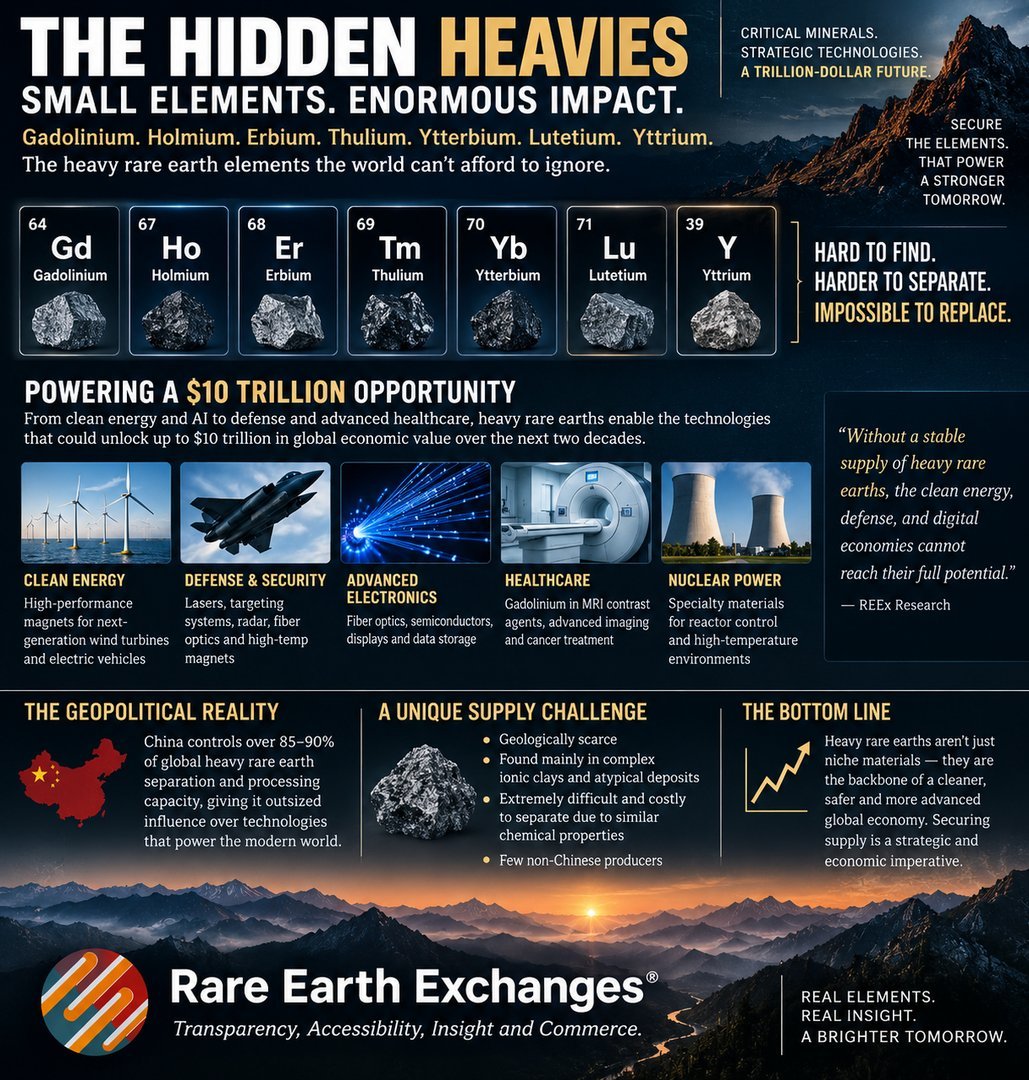
The rare-earth conversation usually stops at neodymium-praseodymium, dysprosium and terbium. That misses a quieter vulnerability. Gadolinium, holmium, erbium, thulium, ytterbium, lutetium and yttrium sit inside medical imaging, telecom fiber, lasers, nuclear systems, specialty alloys and electronics. All seven appear on the U.S. 2025 Critical Minerals List. The real choke point is not simply finding them—it is separating chemically near-identical elements into products industry can actually use.
REEx Insight | Tiny Markets, Giant Industrial Shadows
Lutetium is the element investors should study. USGS ranks it third among 84 minerals by modeled U.S. supply-disruption risk, with a probability-weighted annual GDP impact of $2.059 billion. Gadolinium follows at $758 million, yttrium at $295 million and thulium at $180 million. China put gadolinium, lutetium and yttrium—alongside terbium and dysprosium—under export licensing in April 2025. This is functional leverage: tiny tonnage can sit underneath enormous downstream value. Commodity-market size is therefore a poor measure of strategic importance.
The Forgotten Seven Power the Invisible Layer
Gadolinium supports medical imaging, magnets and steel; holmium, lasers and nuclear control rods; erbium, fiber-optic amplifiers; thulium, lasers and X-ray devices; ytterbium, lasers and metallurgy; lutetium, medical imaging and some cancer therapies; yttrium, displays and high-performance alloys.
The geology also deserves nuance. Ion-adsorption clays have historically been major HREE sources, but HREEs are not exclusive to them. USGS identifies carbonatites, alkaline igneous systems, mineral sands and regolith-hosted clays as commercial rare-earth deposit families.
Separation Is the Moat
Adjacent lanthanides differ in ionic radius by only about 0.01 angstrom on average. That chemical sameness makes separation brutally difficult. A “HREE-rich” drill result therefore proves little. REEx wants element-by-element distribution, recovery, separation factors, oxide purity, reagent and waste intensity, metallization routes and qualified customers. China accounted for about 90% of global rare-earth processing in 2025, including all reported dysprosium and terbium HRE processing. America is finally building: DoD financed heavy-rare-earth separation at MP Materials, while CHIPS committed up to $1.6 billion to USA Rare Earth’s Round Top-to-magnet chain, explicitly covering the obscure heavies.
What’s the Downstream Risk?
Some make declarations of up to $10 trillion in economic loss from these heavy rare earth elements should they be disrupted. Trillions of dollars in downstream activity may be exposed, but exposure is not loss. USGS says all mineral-reliant U.S. industries generated $4.09 trillion in value in 2025; its HREE disruption estimates are much narrower.
That does not make the threat small. It makes the thesis sharper: obscure heavy rare earths are low-volume inputs with disproportionate industrial leverage—and China controls the hardest part of the chain.


0 Comments
No replies yet
Loading new replies...
Moderator
Join the full discussion at the Rare Earth Exchanges Forum →