
Highlights
- China halted U.S. yttrium shipments after April 2025 controls, then approved intermittent flows of 60 tonnes in March and 29 tonnes in July 2026.
- Yttrium prices spiked 6,900% in twelve months while direct Chinese shipments to the U.S. collapsed 95% in the eight months following export controls.
- REEx identifies the 'Missing Molecules Problem': small upstream yttrium volumes can disrupt enormous downstream aerospace and defense asset values.
- China is running a two-speed supply chain—rebounding permanent-magnet exports while keeping heavy rare-earth compounds constrained for overseas competitors.
- The Pentagon sought new yttrium supply proposals, underscoring that stockpiles buy time but only qualified industrial ecosystems create lasting security.
A few tonnes of an obscure element can hold up industries worth billions. Reuters documents how China is rationing yttrium exports to the United States while flows to Japan have nearly disappeared, turning a small rare-earth market into geopolitical leverage. Yttrium is essential to thermal-barrier coatings protecting jet engines and turbines and serves semiconductor, laser, and advanced-electronics applications. Reuters certainly gets the immediate story right: China controls the tap. Yet Rare Earth Exchanges® (REEx) sees the deeper problem—the West does not yet control enough of the industrial plumbing behind it.
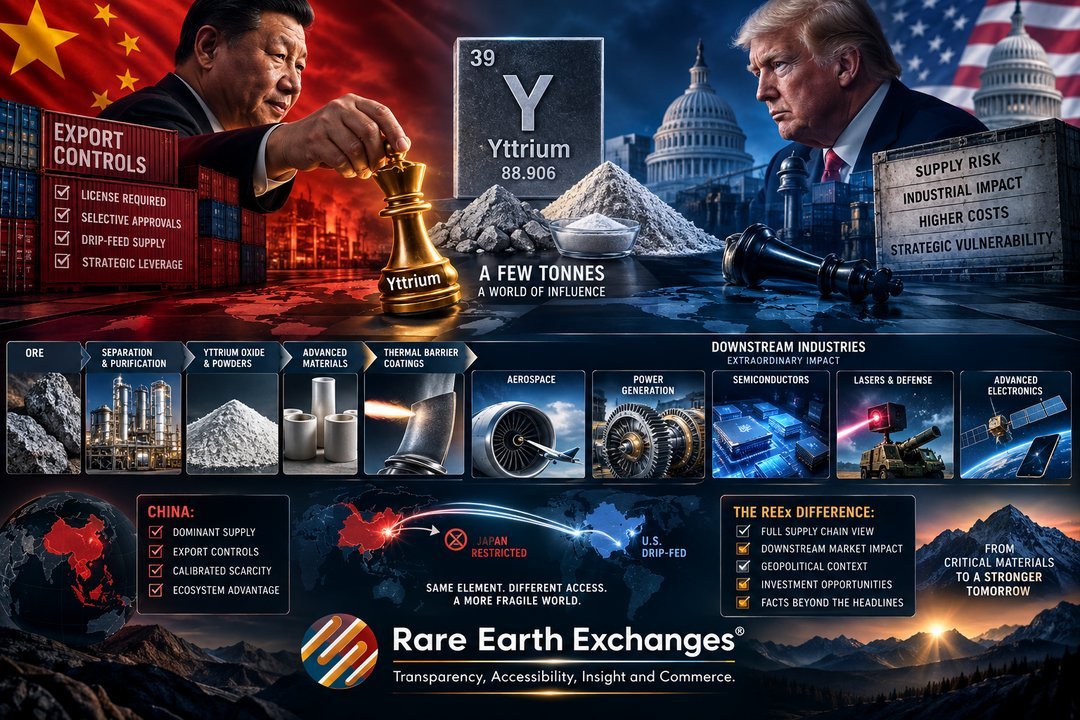
REEx Insight — The Missing Molecules Problem Becomes a Weapon
Yttrium may be the clearest demonstration yet of REEx’s Missing Molecules Problem: strategic importance bears little relationship to tonnage. REEx previously found that U.S. aerospace vulnerability extends beyond acquiring yttrium oxide. The material must move through purification, specialized powders, coating chemistry, qualified manufacturing processes, and ultimately certified engine components. Alternative ore in the ground does little for an aircraft manufacturer today if those downstream steps cannot satisfy aerospace qualification.
That makes China’s leverage unusually asymmetric: small upstream volumes can influence enormous downstream asset values. Reuters describes Beijing “drip-feeding” supply. REEx would go further. This resembles calibrated scarcity—enough material can move to prevent complete decoupling while licensing preserves uncertainty, inventory costs, and political leverage. REEx identified the pattern in August when 29 tonnes of yttrium reached America while Japan remained severely constrained.
There is an even more revealing wrinkle. Silverado Policy Accelerator data analyzed by REEx showed Chinese permanent-magnet exports rebounding while controlled heavy-rare-earth compounds remained constrained—a two-speed supply chain. China can potentially protect exports of higher-value Chinese manufactured goods while making access to selected upstream ingredients harder for overseas competitors.
That is Great Powers Era 2.0™: not simply mine versus mine, but ecosystem versus ecosystem. China’s strategic advantage resides across processing, purification, manufacturing knowledge, and commercial scale.
The 60-Tonne Warning
Reuters reports that China stopped U.S. yttrium shipments after imposing April 2025 controls, later approving intermittent flows—including 60 tonnes in March and 29 tonnes in July 2026. Japan has experienced even sharper restrictions. REEx earlier documented a 6,900% twelve-month price spike through February and a 95% collapse in direct Chinese shipments during the eight months following the controls. The Pentagon subsequently sought new yttrium supply proposals.
The investment lesson is stark: stockpiles buy time; mines create optionality; qualified industrial ecosystems create security.
REEx Bottom Line: Reuters sees a metal becoming a diplomatic weapon. REEx sees something more consequential: China demonstrating how control over the right molecules can transmit power through somebody else’s factories, engines, and defense systems.
Reuters original analysis (opens in a new tab) | REEx: The Yttrium Chokepoint in Aerospace and Defense | REEx: China Loosens the Rare Earth Noose | REEx: The Two-Speed Supply Chain


0 Comments
No replies yet
Loading new replies...
Moderator
Join the full discussion at the Rare Earth Exchanges Forum →