
Highlights
- GRINM and Baogang issued complementary directives linking Communist Party leadership to rare earth R&D, mining, and advanced manufacturing strategy.
- Baogang's September 18 meeting called for 'full-element, full-chain' development of light, medium, and heavy rare earths centered on the world's largest known deposit at Bayan Obo.
- China's integrated approach spans resources, research, separation, IP, manufacturing, and commercialization—far beyond what a single Western mine can counter.
- Bayan Obo mining capacity is slated to rise from 10 to 15 million tonnes annually, while Baogang pushes downstream into rare-earth steel and advanced materials.
- The announcements come as Western aerospace firms test rare-earth substitutes and Washington and Beijing discuss supply ahead of a potential Trump-Xi summit.
China's state-owned GRINM Group (opens in a new tab) and Baogang Group (opens in a new tab) have separately issued unusually complementary directives tying Communist Party leadership and national strategy to technology, critical-materials development, and industrial competitiveness. GRINM's September 20 meeting ordered Party leadership to permeate corporate governance and help transform political and organizational advantages into competitive advantages. Two days earlier, Baogang went considerably further operationally: management called for intensified basic research, breakthroughs in "key core technologies," stronger patents and standards, advanced manufacturing, and development of light, medium, and heavy rare earths across the full value chain centered on the giant Bayan Obo resource. Together, the announcements provide a revealing snapshot of how Beijing's state-owned industrial ecosystem is being organized for its next phase.
REEx Insight — This Is What the West Is Actually Competing Against
The significance is not Communist Party meetings themselves. It is the alignment appearing between governance, geology, research, intellectual property, manufacturing, and national strategy. GRINM supplies part of the technology and advanced-materials architecture. Baogang sits over Bayan Obo, the world's largest known rare-earth deposit, and is now being instructed to improve resource utilization while pushing further downstream. Bayan Obo mining capacity is separately slated to rise from 10 million to 15 million tonnes annually, although that expansion is principally for iron ore and does not itself change China's rare-earth production quotas.
Most important is Baogang's language. It calls for "full-element, full-chain" development of light, medium, and heavy rare earths, deeper industry-university-research collaboration, and faster pathways toward industrialization. It also specifically identifies rare-earth steel and rare-earth new materials while demanding greater supply-chain "independence and controllability."
That suggests China's strategy is not simply to protect today's separation and magnet dominance. It is trying to compound the advantage—extract more value from existing resources, generate intellectual property, connect laboratories to factories, move into higher-value materials, and create new downstream demand. For the U.S. and Europe, this exposes the scale of the challenge. Building another mine addresses only one link. China is reinforcing an industrial operating system spanning resources → research → separation/materials → IP → manufacturing → commercialization. That matters now. Western aerospace companies are already testing rare-earth substitutes as Chinese supply restrictions continue, while Washington and Beijing are discussing rare earths ahead of the September 24 Trump-Xi summit.
Bayan Obo Moves Beyond "Dig and Ship"
Baogang's September 18 meeting ordered greater "protective development" and higher-value utilization of Bayan Obo, alongside greener mining, digitization, and closer cooperation with research teams.
The crucial phrase is explore pathways to industrialization. This is not merely about producing additional concentrate. Baogang wants discoveries converted into commercially useful processes and products. Its ambition is explicit: accelerate advanced manufacturing, upgrade traditional industries, and build an advanced-materials enterprise "led by rare earths."
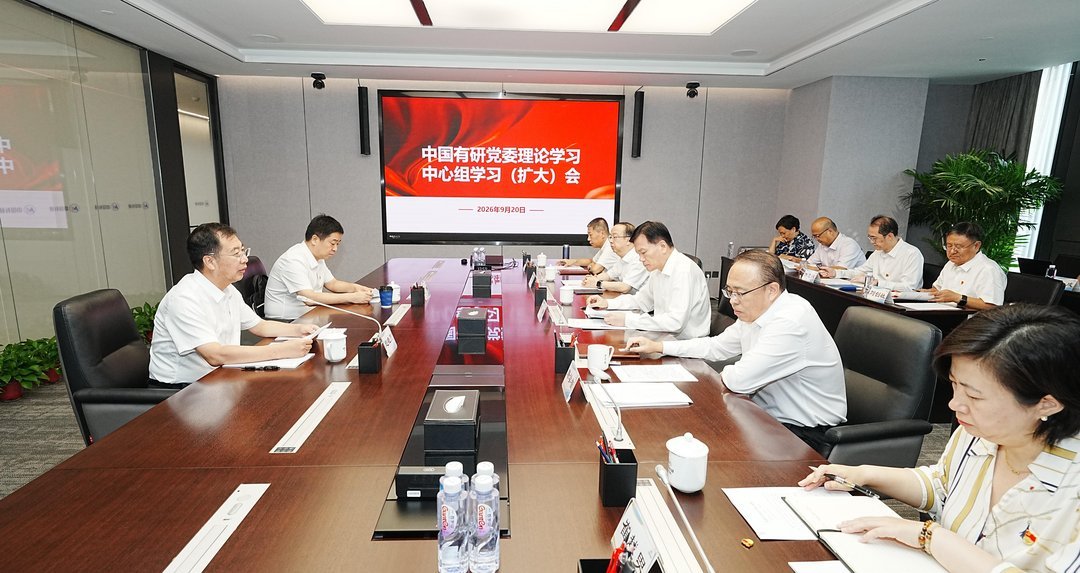
China GRINM Group Party Committee Theoretical Study Center Group Expanded Meeting
GRINM Provides the Other Half of the Picture
GRINM's announcement contained no production milestone, but declared the centrally controlled advanced-materials group a national industrial champion and instructed management to connect Party leadership with corporate competitiveness and national objectives. Read beside Baogang, the strategic architecture becomes clearer: state governance establishes direction; research organizations develop capability; resource champions secure feedstock; industrial groups commercialize technologies; patents and standards reinforce the resulting ecosystem.
While no breakthrough technology was announced by either company, the development worth watching is potentially larger: China appears intent on making an already integrated rare-earth system yet more integrated still.
REEx Connect
| Organization / Contact | Role | Why REEx Is Watching |
|---|---|---|
| Baogang Group | State-owned industrial group | Bayan Obo resources, steel, rare earths, and advanced materials |
| Meng Fanying | Party Secretary & Chair, Baogang | Senior strategic leadership |
| Li Xiao | Deputy Party Secretary & General Manager, Baogang | Corporate execution |
| Bayan Obo Mine | Strategic mineral complex | Rare earths, iron, niobium, scandium, and other resources |
| China Northern Rare Earth | Baogang-controlled rare-earth enterprise | Major Chinese rare-earth processing and materials platform |
| GRINM Group | Central state-owned technology group | Nonferrous metals, advanced materials, and R&D |
| Zhao Xiaochen | Party Secretary & Chair, GRINM | Senior corporate and Party leadership |
| Tang Xuezhi | GRINM Discipline Inspection Secretary | Governance and internal supervision |
| SASAC | Central SOE regulator | Oversees China's centrally administered state enterprises |
| Inner Mongolia government | Regional government | Bayan Obo and Baotou rare-earth industrial policy |
Source Disclaimer: The underlying GRINM and Baogang reports originate from the media channels of Chinese state-owned enterprises and primarily describe internal Communist Party meetings and management directives. They should be treated as primary-source statements of institutional priorities—not independent reporting. Material operational, technological, and commercial claims should be independently verified.


0 Comments
No replies yet
Loading new replies...
Moderator
Join the full discussion at the Rare Earth Exchanges Forum →