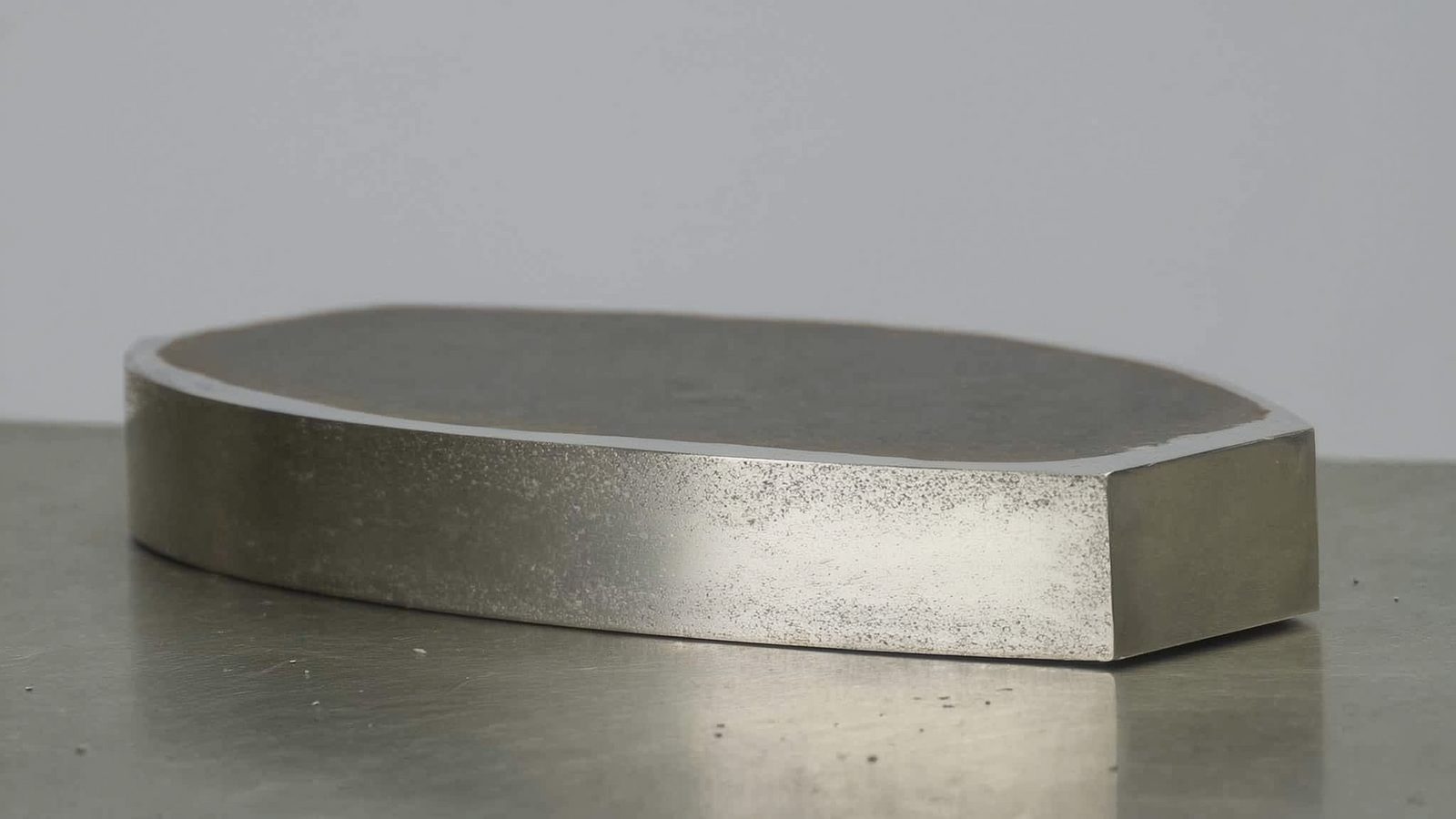
NdFeB composition testing tells a buyer what is actually inside a neodymium magnet rather than what the grade label implies. A grade name like N42SH names a magnetic class and a temperature rating. It does not lock the chemistry. Two magnets with the same grade can carry different rare earth splits, different boron, and very different oxygen. A laboratory settles the question by measuring each element group and gas that sets performance, on a sample prepared so the numbers describe the alloy. If you want the step before the lab, see how neodymium magnets are made.
Key takeaways
- A magnet grade sets magnetic minimums and a temperature rating, but the chemistry behind that grade can vary from part to part, so a grade name cannot serve as a composition specification.
- Plasma optical emission is the workhorse for magnet chemistry because it reports trace additives and main elements in one run, though iron and the rare earths produce thousands of emission lines that need spectral correction.
- Oxygen and carbon are measured on a separate instrument and need their own line on the certificate, and they bear directly on whether scrap can go back into magnets.
- Grain boundary diffusion concentrates heavy rare earth near the surface, so where a sample is cut changes the result.
- A defensible certificate names the method, the detection limits, the uncertainty, and the accredited scope for each test.
What does NdFeB composition testing measure, and why do buyers order it?
NdFeB composition testing confirms the light rare earths, the heavy rare earth additions, the iron and boron balance, the minor transition-metal additions, the interstitial gases, and the coating metal. Each of these changes how a magnet performs, and the same grade name can hide different chemistry. The U.S. Department of Energy's Rare Earth Permanent Magnets supply chain assessment (opens in a new tab) lists the materials in these magnets as the light rare earths neodymium and praseodymium, the heavy rare earths dysprosium and sometimes terbium, plus iron and boron, with additional elements such as copper, cobalt, niobium and cerium sometimes included.
Buyers order the test to confirm what they were sold. As John Konopka of Thermo Fisher Scientific writes in Application Note 52769 on SEM/EDS techniques for NdFeB magnets, "As part of incoming inspection, automobile companies need to confirm that the correct grade of material was supplied or whether the supplied material satisfied the requirements of the grade." A buyer who asks only for neodymium content can accept a magnet whose heavy rare earth, boron, or oxygen levels do not match the grade. That mismatch shows up later as demagnetization or corrosion in service. State which of these groups must appear on the certificate before the sample ships.
The major elements: neodymium, praseodymium, iron and boron
The total rare earth fraction of a sintered NdFeB magnet is about 30 percent, with the balance iron and boron, according to the DOE assessment. Neodymium and praseodymium make up most of that rare earth share. PerkinElmer's note on analyzing a neodymium-iron-boron magnet alloy states that magnetic performance depends heavily on precise control of both major and additive elements, particularly boron.
The additives that set the grade: dysprosium, terbium, cobalt and the rest
Small additions of dysprosium or terbium, from 0.5 to 11 percent, improve high-temperature resistance to demagnetization, the DOE assessment reports, along with cobalt, aluminum and other transition metals. Miss them and you cannot tell whether a magnet will hold its field at its rated operating temperature. Analytik Jena's method for permanent magnet alloys notes that magnet properties depend on the contents and ratios of rare earth additives.
Gases and coatings: the results to request separately
Oxygen, carbon, nitrogen and hydrogen do not appear in a rare earth split. They come from a different instrument and have to be requested by name. Analytik Jena reports that nickel or nickel-copper protective coatings are electroplated on neodymium magnets, and that layer thickness is a direct measure of corrosion resistance. The DOE assessment describes that nickel film at 5 to 10 microns applied before magnetizing. A buyer who needs corrosion performance should ask for the coating metal and thickness as a separate line.
How magnet grades map to chemistry in NdFeB composition testing
A grade name carries an energy product and a temperature suffix, and buyers often read chemistry out of it. The DOE assessment's grade table gives approximate dysprosium contents by suffix: below 0.5 wt% with no suffix at a maximum operating temperature of 80 C, 1.4% for M at 100 C, 2.8% for H at 120 C, 4.2% for SH at 150 C, 6.5% for UH at 180 C, and 8.5% to 11% for EH at 200 C and AH at 220 C. The Nd+Pr column runs from 29.5% down to 19% to 21.5%. The author of that table calculated those figures assuming 30% total rare earth content. It is an approximation, and it does not match every magnet.
The reason the table fails as a specification is process. Grain boundary diffusion and the dual alloy process, which pairs NdPr metal with ferro-dysprosium, can cut dysprosium below the table levels for a given grade, the DOE assessment states. So a magnet can hit the same suffix with less heavy rare earth than the table shows.
The rare earth share and the iron-boron balance
Sintered NdFeB grades typically range between 35 and 52 MGOe, named by energy product preceded by N, such as N35 or N42, followed by a temperature suffix. The iron and boron balance fills the rest of the mass. A measured rare earth total that lands well off 30 percent is a signal that the grade claim deserves a second look. For context on how rare earth totals are reported in an assay, see what TREO means on a rare earth assay.
Temperature suffixes and heavy rare earth content
The suffix names the maximum operating temperature, and the approximate heavy rare earth content climbs with each step. A buyer specifying an SH or UH part is buying coercivity at temperature, and that coercivity depends on the dysprosium or terbium actually present. The suffix is a target rather than a measurement.
Why grain boundary diffusion breaks the old grade-to-chemistry table
Diffusion does not spread heavy rare earth evenly. It concentrates near the surface and along the grain boundaries, so chemistry and properties change with depth. Researchers who coated commercial N48 magnets with a terbium compound and diffused them at 950 C for 10 hours cut 7 mm cubes into 7 slices along the diffusion direction and mapped them by EPMA. As reported in a study of microstructure gradients after grain boundary diffusion (opens in a new tab), terbium became rarer in the main phase as depth increased, and coercivity differed by as much as 307 kA/m between surface and center. A single surface reading on a diffused part will overstate the average terbium.
International specifications do not close this gap. IEC 60404-8-1 specifies minimum magnetic properties and dimensional tolerances for permanent magnet materials and provides chemical composition ranges for information purposes only, with rare earth-iron-boron alloys coded R7, per the IEC 60404-8-1 listing on the IEC Webstore; the current edition is IEC 60404-8-1:2023. A draft ISO/TC 298 project, ISO/AWI 26023, would add a classification and labeling system for sintered NdFeB magnets with criteria including major alloying elements. Until a scheme like that exists, the DOE assessment's own words apply: "Not all magnets have the same chemistry, even for the same grade of magnet, and it is difficult to know the composition of a magnet acquired at end-of-life."
Sample preparation: from a coated magnet to something a lab can measure
Most disputes over an NdFeB composition testing result trace back to what was sampled and how it was dissolved, not to the instrument. The coating has to come off or be reported separately. A magnet must be demagnetized before microscopy. For a diffused part, where the sample is cut decides the answer.
Demagnetizing, sectioning and removing the coating
Thermo Fisher's note states that SEM/EDS characterizes phases on a polished, demagnetized sample. Removing the nickel or nickel-copper film matters too, since a bulk digest that includes the coating will report nickel and copper that belong to the plating rather than the alloy. ISO 24544 notes that large sintered magnets from end-of-life products can be reused as raw material after removing the coating.
Acid digestion for plasma methods
Two instrument-maker methods show the common route. Analytik Jena weighs about 0.2 g of sample into a 50 mL tube with 4 mL deionized water and 4 mL nitric acid, heats at 90 C for 2 hours, makes up to 50 mL, and analyzes directly, running cerium, iron, gadolinium, neodymium and praseodymium at a 100-fold dilution against matrix-matched standards. A Horiba study dissolved NdFeB in nitric acid, 5 mL for 0.5 g of sample, at 10 g/L and ran it by high-resolution ICP-OES using standard addition rather than external calibration. Ask which calibration route the lab used.
Pellets, fused beads and polished sections
For X-ray fluorescence, Thermo Fisher describes homogenizing the sample by milling and pressing it into a pellet, or dissolving it in a flux to form a fused disk. For electron microscopy, the sample is a polished, demagnetized section.
Swarf and sludge: oxidized, oily and mixed
It arrives oxidized, oily, and often mixed across grades. ISO 24544 states that machining sludge is recycled by calcium thermal reduction or into rare earth compounds depending on its oxidation and main phase structure. Before any rare earth number means much, swarf and sludge need drying, oil removal, and gas analysis. A recycling study of sludge found centerless grinding sludge mixing neodymium, praseodymium, gadolinium, dysprosium and holmium because various grades are processed on the same machine, reported in an efficient process for recycling Nd-Fe-B sludge (opens in a new tab). A single lot number on a drum of sludge does not mean a single chemistry inside.
Choosing the method: ICP-OES, ICP-MS, XRF, GD-MS and electron microscopy
Ordering the wrong technique either misses the heavy rare earth content a grade depends on or spends ultra-trace effort on a routine grade check. Plasma optical emission is the workhorse for magnet chemistry.
| Method | Range it covers | Best suited material |
|---|---|---|
| ICP-OES | Trace to main elements in one run | Digested magnet alloy, majors and additives |
| GD-MS | Ultra-trace to percent levels | Solid samples, ultra-trace purity |
| XRF | Bulk averages | Homogenized pellet or fused disk |
| SEM/EDS | Phases down to sub-micron | Polished, demagnetized section |
Plasma optical emission for majors and additives in one run
The Horiba instrument measured elements from the part-per-million level up to 65% in a single run, with a barium stability test giving RSD below 1.5% over 50 minutes. That range is why plasma emission suits NdFeB composition testing: trace additives and main elements come off the same digest. The cost is spectral complexity. Analytik Jena reports that high contents of iron, neodymium, dysprosium and terbium produce thousands of emission lines, and that even at high resolution the sensitive lines of dysprosium, gallium and lanthanum could not be separated in the magnet matrix and needed correction with clean-interferent spectra. With those corrections, the method reached limits of detection in the sub mg/kg range, spike recoveries of 95% to 110% for 1 mg/L spikes, and duplicate precision below 3% RSD.
A worked case shows why this matters for a grade claim. Analytik Jena digested about 0.2 g of a neodymium magnet and ran it by high-resolution ICP-OES. The sample came back at roughly 66.9% iron, 12.99% neodymium, 4.05% praseodymium, 10.29% cerium, 3.76% gadolinium, 0.97% boron and 0.86% aluminum, with dysprosium below the detection limit of 0.24 mg/kg. A check that measured only neodymium would not have shown the cerium, the gadolinium or the missing dysprosium. ASTM E1479-24 describes the components of an ICP atomic emission spectrometer (opens in a new tab) and identifies critical factors affecting accuracy, precision and sensitivity, but it sets no performance criteria, so the instrument description does not guarantee a result.
Trace impurities and the mass spectrometry options
For ultra-trace purity work, glow discharge mass spectrometry runs on the solid. NRC Canada describes GD-MS as sputtering solid samples (opens in a new tab) in a low-pressure argon discharge, avoiding dissolution, measuring from sub-ppb to percent levels in one run across 60 to 70 elements, with detection limits below 1 ppb in the solid.
X-ray fluorescence for fast bulk checks
XRF gives an average composition after homogenizing. Thermo Fisher notes that the average composition of a magnet is typically obtained by XRF or ICP-MS after the sample is milled and pressed into a pellet or dissolved in a flux to form a disk, and that these results lack structure information. A draft borate-fusion method, ISO/AWI 24890, covers XRF of praseodymium-neodymium compounds over Pr6O11 10 to 40% and Nd2O3 60 to 90%, but it is written for oxide feedstock, not alloy, and it is not applicable to materials containing elements for which matrix corrections were not calculated. Cite it only as work in progress.
Microscopy for phases, inclusions and failures
SEM/EDS on a polished, demagnetized sample characterizes phases and inclusions down to sub-micron size, Thermo Fisher reports. That is failure and structure work, and it does not yield average composition.
Oxygen, carbon, nitrogen and hydrogen: the gas results buyers forget
Oxygen and carbon bear on magnet quality and scrap value, so they need their own line on the certificate. They are not part of a rare earth split and do not come off the plasma run.
Inert gas fusion and combustion analysis
Oxygen, nitrogen and hydrogen are measured by melting the sample under inert gas. Carbon is measured by combustion. A study of Nd-Pr-Fe-B machining wastes measured oxygen by inert gas fusion on a LECO ONH836 and carbon by combustion with infrared detection on a LECO CS 300, reported in a characterization of magnet machining wastes (opens in a new tab).
What oxygen and carbon tell you about a magnet or a scrap lot
The scale across material states is wide. In that machining-waste study, XRF put grinding residue at 30.71% total rare earth and diamond-cut residue at 40.96%, while inert gas fusion measured 4.7% and 6.3% oxygen and combustion measured 0.4% and 1.3% carbon. The authors concluded that because carbon and oxygen are deleterious to magnetic properties, the sludge cannot go straight back into sintered magnet production. A grinding sludge can run far higher: the sludge recycling study found 21.8 wt% oxygen in centerless grinding sludge, and its recycled powder ended at 0.08 wt% carbon, 0.22 wt% hydrogen and 0.42 wt% oxygen after reduction. The oxygen result bears directly on whether scrap can go back into magnets.
Borrowed steel methods and their limits
The common standard for these gases was not written for rare earth alloys. ASTM E1019-24 covers carbon, sulfur, nitrogen and oxygen in steel, iron, nickel and cobalt alloys (opens in a new tab) within stated limits, by combustion and inert gas fusion. A magnet is about one-third rare earth by mass, outside that scope. Labs use the same combustion and inert gas fusion techniques on NdFeB, but a certificate citing this standard for a magnet means the lab adapted it. Ask how the method was validated for the rare earth matrix.
Standards, accreditation and what the certificate should show
A certificate that names no method, no uncertainty and no accreditation scope gives a buyer nothing to defend in a dispute with the supplier. The standards that touch magnet testing fall into three groups, and only one of them governs how a result is produced.
Which standards apply to NdFeB composition testing and which do not
ISO/IEC 17025:2017 (opens in a new tab) sets the general requirements for the competence, impartiality and consistent operation of laboratories, and covers how results are reported under clause 7.8. It applies to any lab issuing NdFeB composition results, whatever the method. It sets no composition limit for a magnet. IEC 60404-8-1 is the magnet specification: its magnetic minimums are binding, its chemistry ranges are informative only, so chemistry limits belong in the purchase specification instead of the IEC grade. ISO 24544:2024 applies to trading recyclable NdFeB scrap, swarf, sludge and end-of-life magnets, classifying those resources and setting acceptance conditions. It does not apply to specifying new magnets.
Accreditation scope, traceability and uncertainty
Accreditation under ISO/IEC 17025 is granted per site and per method. It means something for a magnet result only when the specific method is on the lab's accredited scope. NRC Canada reports that its GD-MS lab holds ISO/IEC 17025 accreditation from the Standards Council of Canada and reports results with stated uncertainties traceable to the SI. The factors behind a testing budget are covered in what drives the cost of rare earth testing.
A certificate checklist for magnet buyers
A usable certificate should show these items:
- Sample identity and where it was cut, which matters most for diffused parts
- How the coating was handled, removed or reported separately
- The digestion or preparation route used
- The method for each element group, including the gases
- Detection limits and the stated uncertainty
- Oxygen and carbon results on their own line
- The accreditation scope that covers each test
For how these results travel in a transaction, see how a certificate of analysis works in rare earth trade and the background on what rare earth minerals are and who controls the 17 elements.
Before a sample ships for NdFeB composition testing, write down which element groups must appear on the certificate and name the method and accreditation scope required for each.
Request NdFeB Magnet Testing or Independent Laboratory Verification Through REEx
Rare Earth Exchanges connects participants across the rare earth and critical minerals supply chain.
Whether you need elemental analysis, concentrate characterization, mineralogical testing, or independent laboratory verification, clearly defining your testing requirements is the first step toward identifying an appropriate provider.
When submitting an inquiry, include your material description, expected composition, sample quantity, required measurements, and intended use of the results.
Need NdFeB Magnet testing? Submit NdFeB Magnet Testing Request (opens in a new tab)