
Highlights
- Africa has 64 known REE deposits across 12 key countries, with exploration spending up 112% to $34.8 million in 2024.
- China extended zero tariffs to all 53 African diplomatic partners effective May 2026, deepening its economic pull on African mineral exports.
- Competing infrastructure corridors—the U.S.-backed Lobito and China-linked TAZARA—represent rival industrial operating systems, not just transport routes.
- REEx identifies five investor questions: who finances, processes, moves, receives, and qualifies the final product—revealing where real strategic value lies.
- Africa can leverage great-power competition to demand processing, jobs, and technology transfer rather than repeating an extraction-only model.
Reuters columnist Andy Home argues (opens in a new tab) Africa could use the critical-minerals race to capture more value through processing, infrastructure, and better integration of artisanal mining. REEx agrees—but the race is not starting at zero. China enters Great Powers Era 2.0™ with decades of infrastructure, processing capacity, commercial relationships, and political engagement already in place. Beijing's new zero-tariff access for 53 African partners widens that advantage. For investors, Africa's opportunity is real—but so is China's formidable head start.
Development Corridors and Mineral Facilities Sub-Saharan Africa
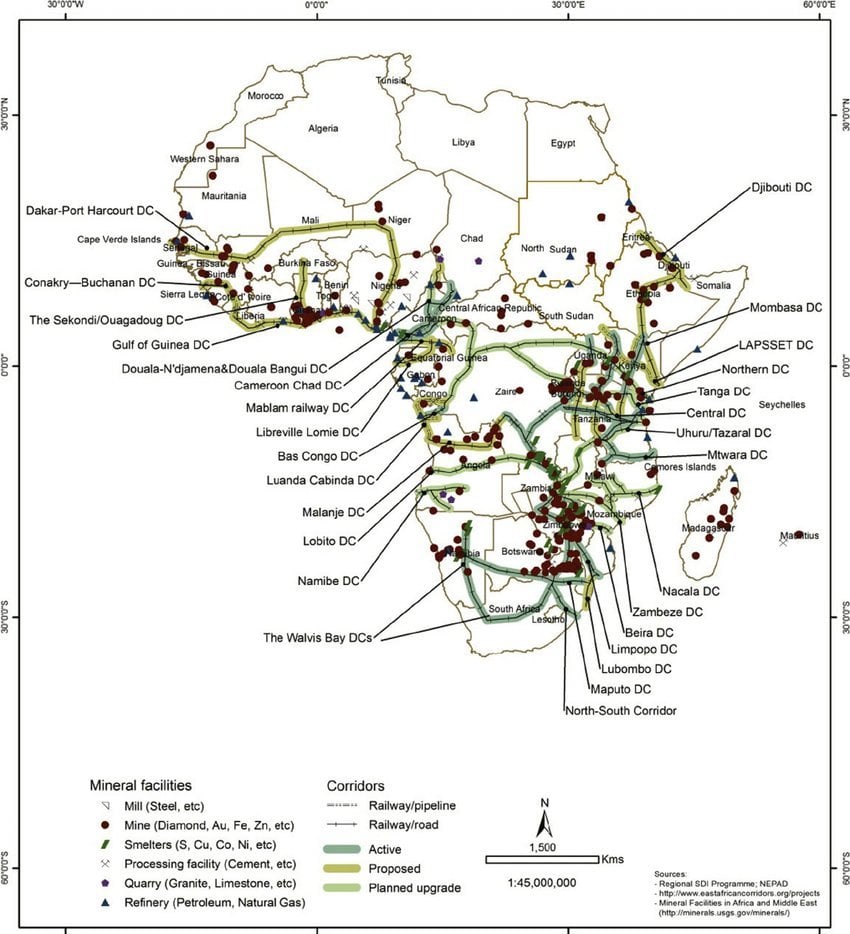
Source: ResearchGate: Paul H G M Dirks (opens in a new tab)
Rare Earth Elements in Africa
Africa may become an important new source of rare earth elements (REEs)—the metals used in powerful magnets, electric vehicles, wind turbines, electronics, and defense systems. A 2025 scientific review (opens in a new tab) identified 64 known REE deposits across Africa, although 43 were still in the exploration stage. The largest known resources are concentrated in 12 countries, including Tanzania, Angola, South Africa, Malawi, Namibia, and Madagascar. Tanzania has the largest reported REE resources in the study. Africa also has several different kinds of deposits, including hard-rock carbonatites and clay-like ion-adsorption deposits, which can be important sources of harder-to-find heavy rare earths.
The opportunity is large, but of course finding rare earths is not the same as producing them. Most African projects still need mines, roads, electricity, financing, and plants capable of separating rare earths into usable materials. Investment is rising: the study estimates African REE exploration spending reached about $34.8 million in 2024, up 112% from 2023. China is especially important to this story. The study itself was led largely by researchers from the China Geological Survey and notes Chinese commercial interest in projects such as Tanzania's Ngualla deposit. Africa therefore has the geology to become an important REE supplier—but who finances, processes, and ultimately buys those minerals may determine where the real economic value goes.
REEx Insight — China Is Already Several Laps Around the Track
Back to Reuters' Andy Home—he is right that Africa has become a front line in the contest for critical minerals. But describing the West as simply "vying with China" understates the starting positions. China built an ecosystem. The West is now trying to build an alternative.
China's advantage reaches beyond ownership of mines. It includes financing, infrastructure, trading relationships, processing expertise, industrial customers, and logistics networks accumulated over decades.
REEx has repeatedly argued that this conversion layer—turning mined material into usable industrial products—is where much of China's strategic power resides. Beijing is now adding market access. Effective May 1, 2026, China extended zero tariffs across 100% of tariff lines to all 53 African countries with which it has diplomatic relations; 33 least-developed African countries already had that treatment, while 20 additional countries received preferential zero tariffs for two years.
That matters. Tariff policy, railways, ports, financing, and processing should not be analyzed separately. Together they create economic gravity: African producers gain another reason to trade into a Chinese-centered ecosystem.
The REEx Investor Test
For an African mineral project, investors should increasingly ask five questions:
1) Who finances it → 2) who processes it → 3) which corridor moves it → 4) which market receives it → 5) who qualifies the final product? Follow that chain and you often discover who possesses the real strategic asset.
Rails Are Becoming Geopolitical Plumbing
Home's strongest evidence is infrastructure. The U.S.- and Europe-backed Lobito Corridor gives Congo and Zambia a westbound alternative to the Chinese-linked TAZARA railway. China responded with a $1.4 billion commitment to revamp TAZARA.
Reuters sees competing transportation corridors. REEx sees competing industrial operating systems.
That is Great Powers Era 2.0: states increasingly competing through mines, tariffs, financing, ports, processing plants, technology, and supply chains—not simply military power.
Africa Holds More Cards Than the Map Suggests
This does not mean China automatically wins. Africa's leverage is increasing precisely because China, the United States, Europe, and others need its resources. Governments can demand processing, infrastructure, employment, and technology transfer rather than simply exporting ore. The danger is replacing one extraction model with another.
The opportunity is larger: use great-power competition to build African industrial capacity. For investors, therefore, geology is only the opening chapter. In Great Powers Era 2.0, the investable moat increasingly sits between the mine and the customer.
Related REEx Intelligence
The Missing Chapter: Great Powers Era 2.0 Rewrites the Supply Chain — REEx explains how China built dominance across processing while the West effectively outsourced the industrial middle. Great Powers Era 2.0: The Industrial Alliances That Will Decide the Rare Earth Race — REEx argues that competing with China's accumulated scale requires allied industrial networks rather than isolated national supply chains.
Great Powers Era 2.0 Accelerates the Erosion of China's Rare-Earth Monopoly: China Won the Old Game. The Board Is Moving. — REEx examines why China's accumulated infrastructure, workforce, and expertise provide a durable advantage even as new supply networks emerge.
Great Powers Era 2.0: Infrastructure, Supply Chains, and the New Contest for Industrial Power — REEx examines ports, railways, processing plants, and logistics corridors as strategic infrastructure rather than ordinary s


0 Comments
No replies yet
Loading new replies...
Moderator
Join the full discussion at the Rare Earth Exchanges Forum →