
Highlights
- Africa holds $29.5 trillion in mineral wealth (20% global total) with $8.6 trillion undeveloped, but AFC argues the bottleneck is infrastructure conversion—not geology—requiring power, logistics, and regional demand clusters to unlock value.
- The Compendium rejects blanket beneficiation, advocating processing only where regional demand exists through electrification, agriculture, and digitalization while mapping mines to power hubs, railways, and ports as value gatekeepers.
- AFC positions Africa as a supply-chain diversification partner amid China's dominance in rare earth and critical mineral refining, while proposing gold reserve accumulation as a liquidity tool despite governance and execution risks.
Africa Finance Corporation’s (opens in a new tab) 2026 Compendium of Africa’s Strategic Minerals (opens in a new tab) reframes the continent’s mineral wealth as a systems challenge, not a geological one. The core thesis is blunt: Africa’s estimated $29.5 trillion in mine-site mineral value, roughly 20% of the global total, will remain inert unless embedded in power, logistics, industrial zones, and regional demand clusters.
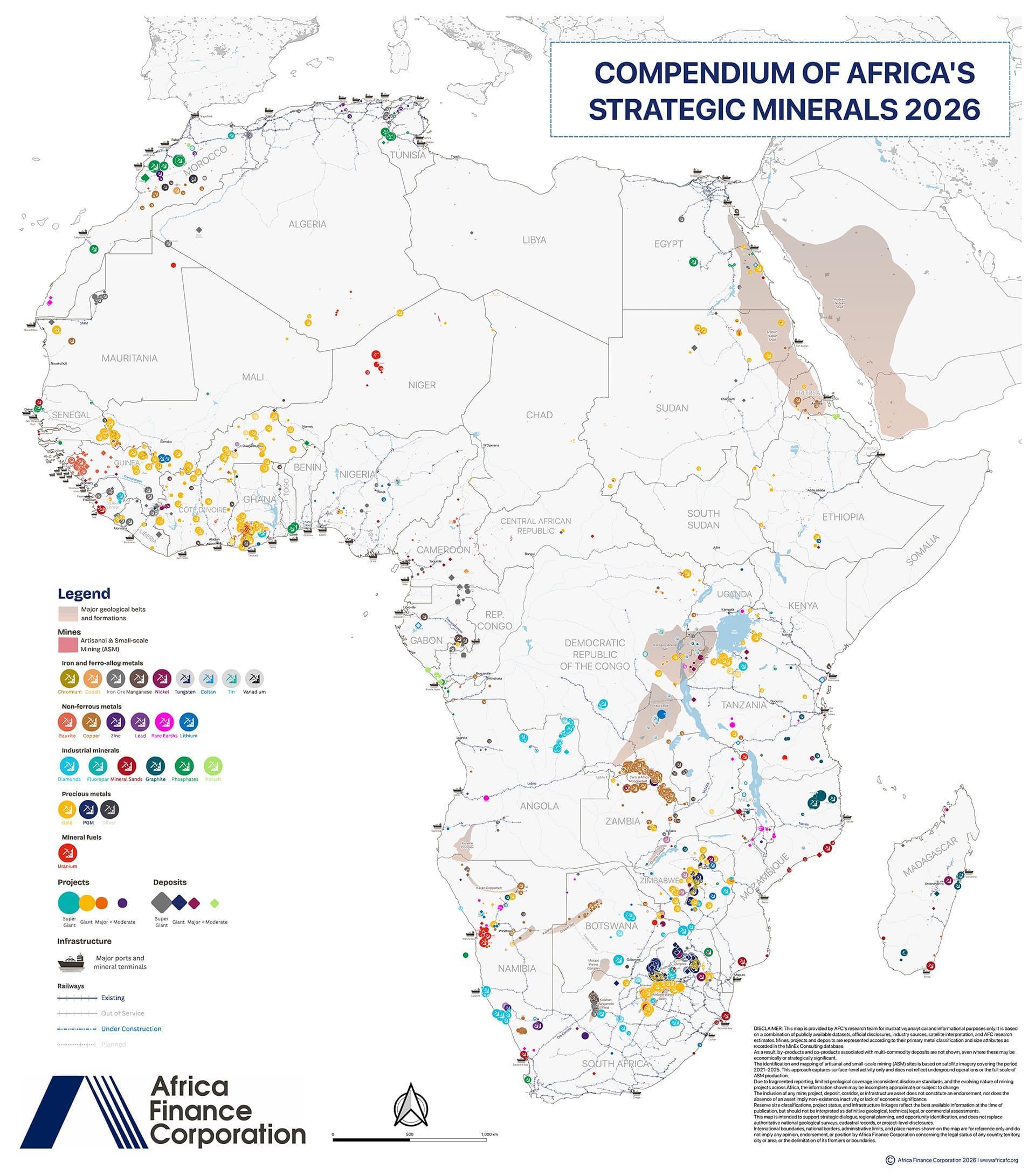
Of that, $8.6 trillion remains undeveloped, equivalent to roughly 2.5 times Africa’s annual GDP. AFC argues the bottleneck is not scarcity, but conversion—turning in-situ value into infrastructure, processing, and regional value chains. The media entry serves a clear purpose: position the AFC as a catalytic investor and policy partner in Africa’s industrialization push amid global supply-chain realignment.
Data Poverty, Not Resource Poverty
AFC contends Africa is “structurally under-explored.” Poor geological data increases perceived risk and inflates capital costs. The corporation calls for a deeper “geological data ecosystem” to derisk investments.
This is a defensible claim. Exploration data gaps do suppress valuations and raise financing hurdles. However, readers should note that mine-site values are gross in-situ estimates, calculated before processing, logistics, taxes, and operating costs. These headline figures can overstate realizable value. That is not misinformation—but it requires context.
The bias here is subtle but present: high aggregate valuations strengthen the argument for accelerated capital deployment.
Beneficiation: Only Where Demand Exists
AFC rejects blanket calls for “local beneficiation.” It argues that processing works only when regional demand anchors it. Steel, ferro-alloys, fertilizers, batteries, and digital devices must be driven by real infrastructure growth.
The logic is economically sound. Processing without demand becomes stranded capacity. Africa’s growth in electrification, agriculture, and digitalization could indeed create mineral-intensive demand clusters.
The risk? Demand projections remain aspirational. The press release does not quantify timelines, financing gaps, or governance constraints.
Infrastructure Is the Gatekeeper
As shown above, the Compendium introduces a continent-wide map linking mines topower hubs, railways, and ports. The message is clear: power reliabilityand logistics capacity set the ceiling on value capture.
This aligns with global evidence. Smelting, refining, and battery precursor processing are power-intensive. Without baseload electricity and efficient transport, beneficiation economics collapse.
No obvious misinformation appears here. The framing is industrially pragmatic.
Geopolitics: Opportunity or Narrative Tailwind?
AFC highlights concentration risks in global supply chains—China’s dominance in rare earth refining (~90), graphite processing, and manganese refining. It positions Africa as a diversification partner amid trade tensions. These facts are broadly consistent with industry data. However, the press release implies Africa’s “non-aligned positioning” is a strategic advantage. That assumption may underestimate political risk, regulatory volatility, and capital constraints across jurisdictions.
A strategic opportunity exists. Execution risk remains high.
Gold: The Quiet Reserve Play
AFC proposes gold as a tool for reserve accumulation. Africa hosts over $5 trillion in mine-site gold value but holds only about $70 billion in gold reserves, roughly 15% of total FX reserves.
The argument is pragmatic: gold offers liquidity and rapid monetization. Yet scaling reserve accumulation depends on governance, transparency, and central bank discipline—factors not addressed in depth.
REEx Assessment
The Compendium presents a coherent systems thesis: minerals alone do not transform economies—infrastructure, demand aggregation, and regional integration do. AFC promotes its own investing and advisory role as the connective tissue. That is expected in a corporate press release/report for external consumption. Key numbers require contextual understanding. Ambition exceeds operational detail. The real test is not geology. It is governance, capital discipline, and power reliability.
Profile
The Africa Finance Corporation is a premier pan-African multilateral development financial institution established in 2007 to bridge Africa's infrastructure deficit through debt and equity investment, project development, and advisory services. With over US$18.5 billion invested in 36 countries, it focuses on high-impact projects in power, transport, logistics, natural resources, and telecommunications.
Citation: Africa Finance Corporation. Compendium of Africa’s Strategic Minerals 2026 (Press Release). 2026.


0 Comments
No replies yet
Loading new replies...
Moderator
Join the full discussion at the Rare Earth Exchanges Forum →