
Highlights
- China launched the Anhui Rare Earth Industry Alliance at the 2026 China Rare Earth Permanent Magnet Forum in Hefei on September 11, 2026.
- A five-party strategic cooperation agreement connects rare-earth research, a national magnet laboratory, local government and Anhui's EV sector.
- Ministry of Commerce officials attended alongside academicians and downstream manufacturers, signaling deep government coordination.
- Presentations covered permanent-magnet motors, rail traction motors and rare-earth use in multilayer ceramic capacitors across major Chinese industries.
- Analysts warn Western nations risk building isolated mining assets rather than integrated rare-earth-to-motor ecosystems.
China is tightening the connection between rare-earth science, permanent magnets and downstream manufacturing. At the 2026 China Rare Earth Permanent Magnet Forum in Hefei, industry and government organizations launched the Anhui Rare Earth Industry Alliance and signed a five-party strategic cooperation agreement linking rare-earth organizations, a national magnet laboratory, local government and Anhui’s EV sector. The announcement disclosed no investment amount or new production capacity, but the organizational architecture is strategically significant.
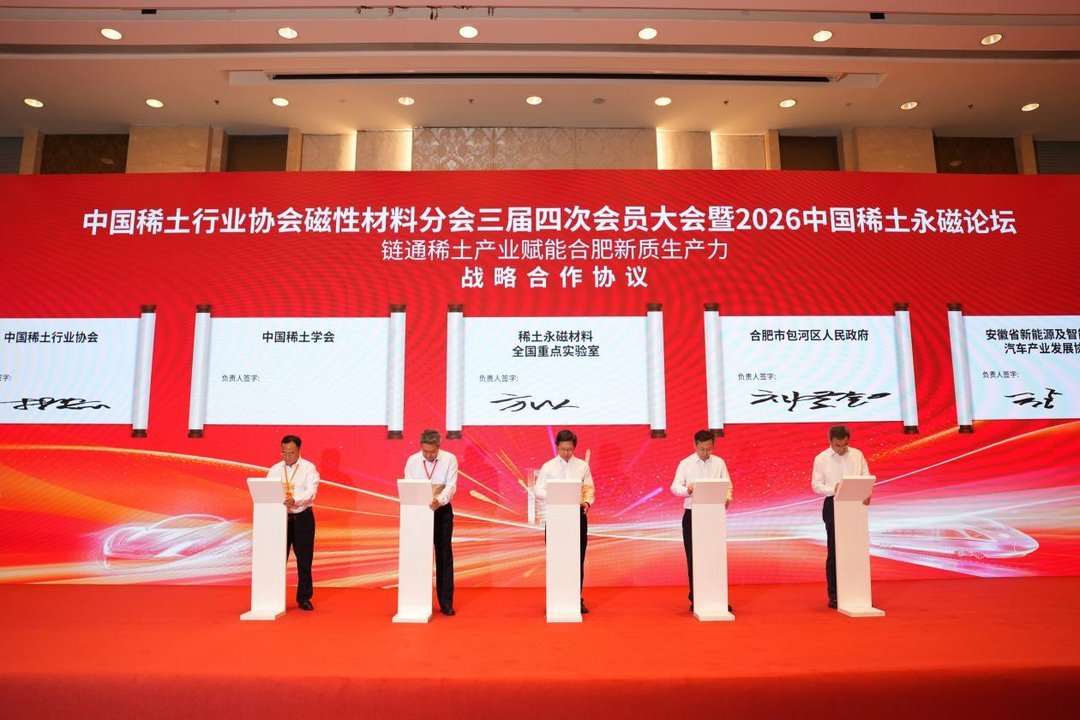
China Connects Rare Earths to the Downstream Economy: Representatives of five Chinese industry, research and government organizations sign a strategic cooperation agreement at the 2026 China Rare Earth Permanent Magnet Forum in Hefei on September 11, 2026. The agreement links the China Rare Earth Industry Association, Chinese Society of Rare Earths, National Key Laboratory of Rare Earth Permanent Magnet Materials, Hefei’s Baohe District government and Anhui’s new-energy and intelligent-vehicle industry—an example of China’s coordinated effort to connect rare-earth technology, permanent magnets and downstream advanced manufacturing.
REEx Insight — China Is Organizing Demand, Not Just Supply
The breakthrough here is institutional rather than technological. China is connecting the chain from rare-earth research and permanent magnets to motors, rail traction, energy equipment, electronics and intelligent vehicles. Presentations covered permanent-magnet motors at China Huadian, traction motors at CRRC Zhuzhou Institute, industrial motors and rare-earth applications in multilayer ceramic capacitors. More revealing was who attended: representatives of China’s Ministry of Commerce Bureau of Industrial Security and Import and Export Control appeared alongside academicians, laboratories, industry associations, local government and downstream manufacturers.
In the Great Powers Era 2.0™, that matters. China is not treating rare earths as an isolated mining industry. It is coordinating technology + materials + manufacturing + downstream demand + government policy as an ecosystem. Other Chinese industry forums this year similarly emphasize supply-chain security, export controls and emerging demand from robotics and advanced manufacturing.
For Washington and Brussels, the lesson is uncomfortable: building mines without simultaneously connecting separation, metals, magnets, motors and customers risks creating isolated assets rather than an ecosystem.
Hefei Builds a Rare-Earth-to-EV Bridge
The September 11 forum was organized by the China Rare Earth Industry Association’s Magnetic Materials Branch, with the National Key Laboratory of Rare Earth Permanent Magnet Materials and Baotou INST Magnetic New Materials as co-organizers. Five parties then signed a strategic cooperation agreement: the China Rare Earth Industry Association, Chinese Society of Rare Earths, National Key Laboratory, Baohe District government and Anhui New Energy and Intelligent Connected Vehicle Industry Development Association.
That makes Hefei's downstream position particularly noteworthy: rare-earth industrial coordination is being explicitly connected with a major Chinese automotive and advanced-manufacturing cluster.
No specific commercialization milestone, capacity addition or financing commitment was announced. Western readers should therefore interpret this as ecosystem formation—not yet a production breakthrough.
REEx Connect
| Organization / Individual | Strategic relevance |
|---|---|
| China Rare Earth Industry Association / Li Wei | Association president; forum chair |
| Gan Yong | CAE academician; honorary association president |
| Shen Baogen | CAS academician; Institute of Physics |
| Suzhou Laboratory / Jiang Chengbao | Permanent-magnet industry development |
| Hefei Government / Li Mingshan | Executive vice mayor |
| Anhui NEV & Intelligent Connected Vehicle Association / Deng Xiangyang | Alliance co-launch participant |
| China Huadian Electric Power Research Institute / Zhang Yanpeng | Permanent-magnet motor deployment |
| CRRC Zhuzhou Institute / Yao Rui | Rail traction-motor applications |
Source caution: This news originated with the China Rare Earth Industry Association, an industry body operating within China’s state-directed industrial environment. Claims about achievements, cooperation and outcomes should be independently verified before being relied upon for investment or strategic decisions.


0 Comments
No replies yet
Loading new replies...
Moderator
Join the full discussion at the Rare Earth Exchanges Forum →