
Highlights
- New regulations effective September 15 allow China to bar citizens from leaving if export-control or technology-transfer violations threaten national industrial security.
- China's rare-earth export volumes rose 19% between 2023 and 2025 while export value fell 19%, illustrating the gap between volume leadership and economic value creation.
- The China Rare Earth Industry Association acknowledged magnet overcapacity alongside shortages of some high-end specialty materials, exposing contradictions in state-directed scale.
- Beijing's anti-involution campaign recognizes that excessive subsidized investment and brutal price competition can destroy returns even while expanding output.
- Analysts warn that retaining talent through administrative control rather than opportunity creates very different long-term incentives for innovators and investors.
China faces a paradox of its own success. Beijing commands the world's deepest rare-earth and advanced-manufacturing ecosystem, yet it is simultaneously confronting industrial overcapacity, weak domestic demand, and destructive price competition while expanding state authority over technology, capital and, in defined circumstances, people's ability to leave the country. New exit-entry regulations effective September 15 allow authorities to prohibit Chinese citizens from leaving when violations of export-control or technology-transfer rules may endanger national industrial or technological security. Beijing says the broader regulations protect lawful rights while safeguarding national security and development interests.
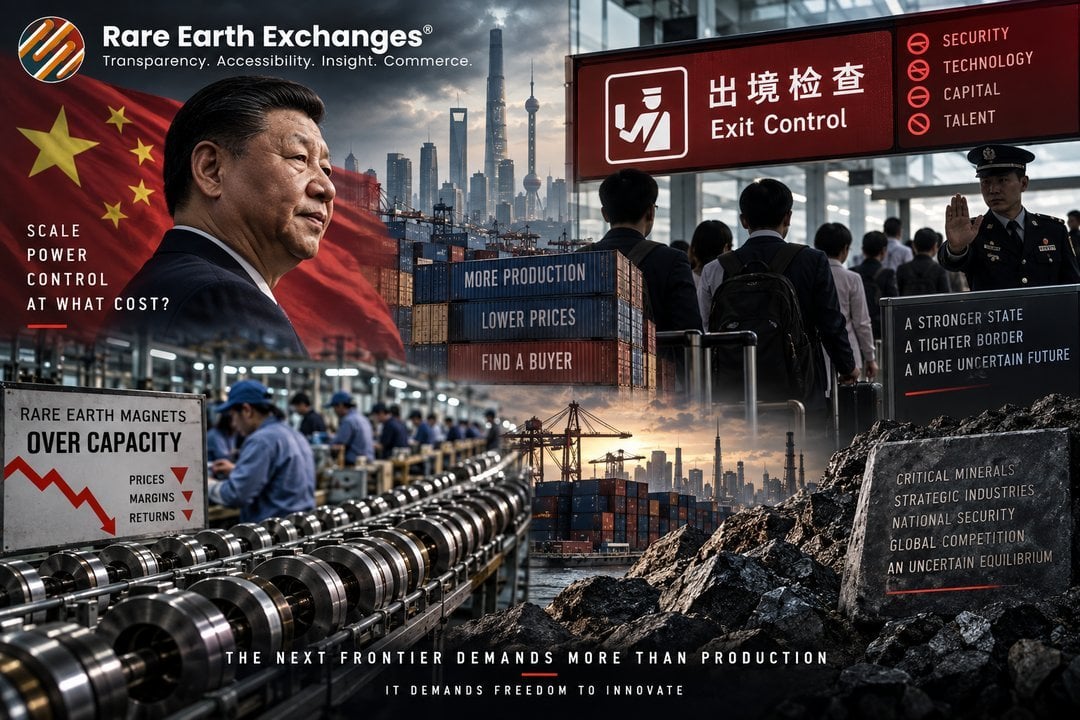
For rare-earth investors, the deeper question is uncomfortable: can the state-directed system that helped build China's industrial dominance eventually constrain its renewal? That’s the unfolding dialectic.
REEx Insight — When Scale Starts Fighting the Market
China's rare-earth supremacy was not accidental. Patient capital, infrastructure, industrial policy, engineering talent, enormous manufacturing clusters, and relentless downstream integration created an ecosystem competitors still cannot easily reproduce. It worked spectacularly. But scale has produced contradictions.
The China Rare Earth Industry Association recently acknowledged magnet overcapacity alongside shortages of some high-end specialty materials. China can simultaneously possess too much commodity-level capacity and insufficient capability at parts of the technological frontier. (Rare Earth Exchanges®)
Beijing's broader “anti-involution” campaign recognizes a related problem: excessive investment and brutal price competition can destroy returns even while increasing output. IMF research similarly finds that industrial subsidies can expand strategic-sector exports while creating distortions and negative spillovers.
Here is the longer-term REEx point. Markets need failure. Prices must communicate scarcity and excess. Capital must be allowed to abandon weak businesses. Entrepreneurs must be able to challenge the planner.
When cheap capital and strategic objectives repeatedly override commercial signals, factories risk producing capacity faster than profitable demand develops. And when the state simultaneously tightens control over technology, information, capital, and certain movements of technical personnel, another potential cost appears: the entrepreneurial experimentation required for the next technological leap may become harder to sustain.
That is a thesis, not a prediction of Chinese decline. China's engineering base, infrastructure, manufacturing density, and domestic market remain formidable advantages.
The Factory Still Needs a Customer
REEx has described China's wider contradiction as strong supply meeting insufficient demand. Rare earths offer a useful microcosm: REEx calculated that Chinese rare-earth export volumes increased 19% between 2023 and 2025 while export value declined 19%, implying sharply lower average export value per tonne. (Rare Earth Exchanges) That does not prove market failure—product mix and pricing cycles matter. But combined with acknowledged magnet overcapacity, it illustrates why volume leadership and economic value creation are not synonymous.
Western policymakers should notice the distinction. Replicating China's factories without sustainable demand, qualified customers, and rational returns would reproduce China's emerging problem rather than solve Western dependence.
The Border Becomes an Industrial-Policy Tool
The new rules do not impose a blanket exit ban on China's wealthy, entrepreneurs, or engineers. That distinction matters. They do, however, explicitly connect export-control and technology-transfer compliance with the ability of Chinese citizens to leave the country. CNBC reports (opens in a new tab) that advisers see the broader regulatory environment as increasing pressure on mobile capital and specialized talent.
From a Great Powers Era 2.0™ thesis perspective, Beijing's strategic logic is understandable. Rare-earth processing, batteries, semiconductors, and advanced manufacturing increasingly embody national-security knowledge. China has spent decades accumulating that expertise and does not want competitors acquiring it cheaply.
Yet there is a profound economic distinction between retaining talent because opportunity attracts it and retaining strategic knowledge through administrative control. Over time, those approaches can produce very different incentives for innovators and investors.
Great Powers Era 2.0 — A Formidable Moat, Not an Eternal One
None of this means China's rare-earth dominance is about to collapse. That would be wishful Western analysis.
China retains metallurgical knowledge, supplier networks, trained labor, infrastructure, and scale accumulated over decades. REEx has repeatedly argued that rebuilding those capabilities elsewhere will take years.
But Great Powers Era 2.0 is changing the competitive environment. America, Europe, Japan, Australia, and others are subsidizing alternative chokepoints; customers increasingly care about provenance and geopolitical exposure; and resource nations increasingly want processing conducted closer to their mines.
China therefore faces competition on two fronts: new industrial ecosystems abroad and potential rigidity at home.
Xi Jinping's centralized model has demonstrated extraordinary capacity to mobilize capital and industrial resources. The unanswered question is whether progressively greater political control eventually reduces the price discovery, capital discipline, and entrepreneurial freedom required to keep that ecosystem at the technological frontier.
For investors, watch capacity utilization, industry margins, private investment, business formation, and whether capital continues flowing toward politically favored production after commercial returns deteriorate.
China built one of history's great industrial machines. The next test is whether Beijing can let the market tell it when the machine is producing too much.
Recent REEx China Analysis
“China Rare Earth Industry Association Flags Magnet Overcapacity and High-End Supply Gaps” — September 13, 2026. (Rare Earth Exchanges)
“China's Rare Earth Warning Shot: Beijing's Scientists Confront the Costs of Great Powers Era 2.0 Race” — June 19, 2026. (Rare Earth Exchanges)
“China Drafts Cross-Border Corruption Law—Critical-Mineral Supply Chains Face a New Compliance Fault Line” — September 13, 2026.


0 Comments
No replies yet
Loading new replies...
Moderator
Join the full discussion at the Rare Earth Exchanges Forum →