
Highlights
- China's CREIA Rare Earth Price Index reached 264.9 on June 29, 2026, with heavy rare earths including dysprosium and terbium showing upward price movement.
- Dysprosium oxide was priced at approximately US$119–123/kg and terbium oxide at US$210–216/kg, reflecting continued strategic material tightness.
- China's rare earth prices are shaped by state quotas, export controls, and industrial policy—not free-market discovery—making them unreliable benchmarks for Western buyers.
- Outside China, heavy rare earth oxides and metals like dysprosium and terbium may be nearly impossible to procure, with qualified material sometimes unavailable at any price.
- The U.S. MP Materials government-backed NdPr floor near US$110/kg remains unclear in broader application, leaving Western buyers exposed to opaque bilateral contract terms.
China’s Rare Earth Industry Association (CREIA) reported its Rare Earth Price Index at 264.9 on June 29, 2026, with several strategic materials—including dysprosium oxide, dysprosium metal, terbium oxide, gadolinium oxide, and NdPr products—showing upward movement. Most other listed products were flat. Rare Earth Exchanges® view: These Chinese prices are useful signals, but they are not true free-market discovery. China’s rare earth market is shaped by state policy, quotas, export controls, security priorities, and industrial planning. Outside China, pricing is also opaque because most rare earth contracts are confidential, bilateral, and over-the-counter.
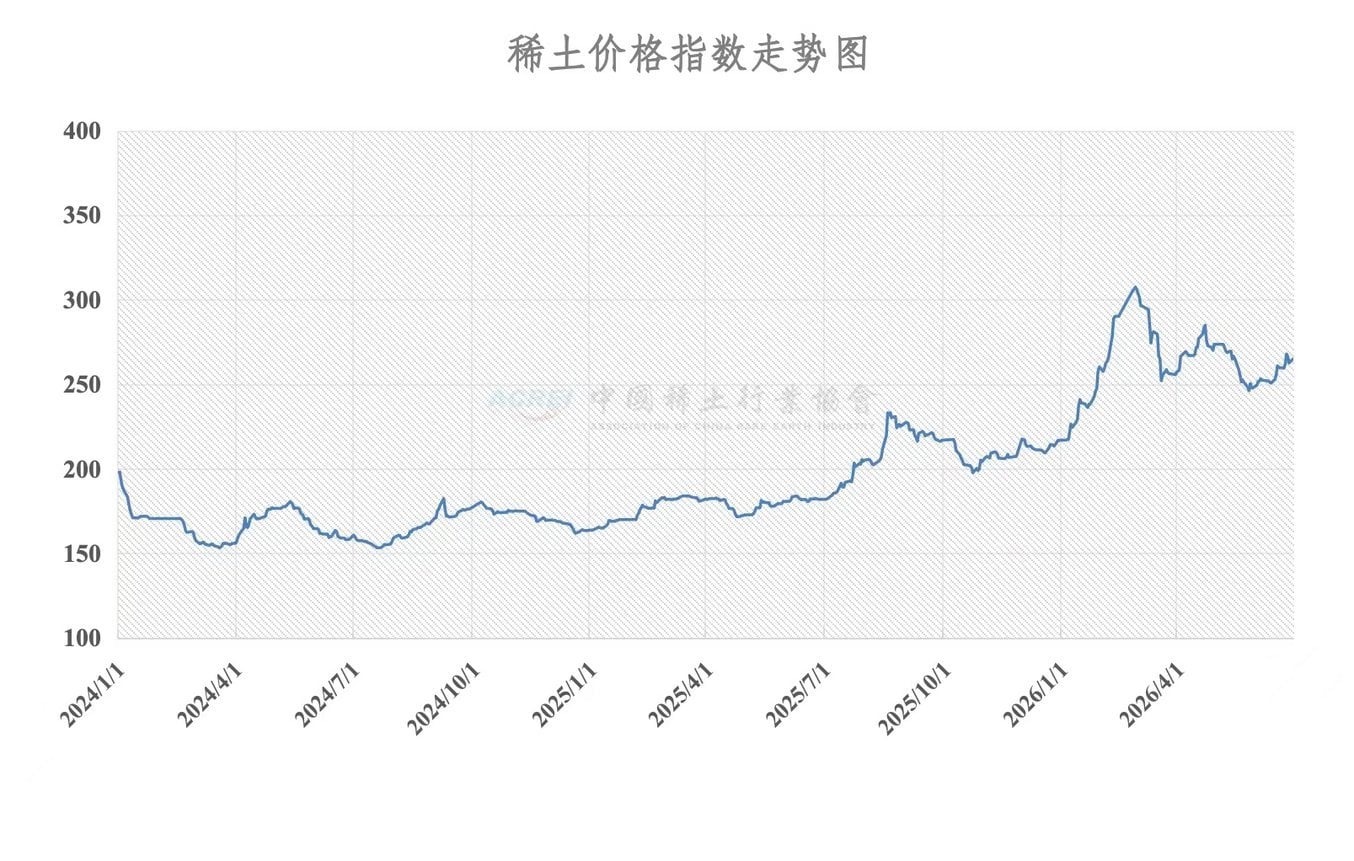
China’s Index Holds at Elevated Levels
CREIA reported the June 29 Rare Earth Price Index at 264.9, using 2010 as the base year of 100. The index is calculated from daily transaction data collected from domestic Chinese rare earth enterprises and processed through CREIA’s rare earth index model.
The broader chart shows a market that has moved materially higher from 2024 and early 2025 levels, with the index rising sharply in 2026 before settling back from its recent peak.
Heavy Rare Earths and Magnet Materials Move Higher
Several strategically important materials rose on the day. Again for China, dysprosium oxide was listed at ¥797.1–817.1/kg, or approximately US$119.57–122.57/kg. Dysprosium metal was ¥978.5–998.5/kg, or US$146.78–149.78/kg. Terbium oxide stood at ¥1,400–1,440/kg, or US$210–216/kg. Gadolinium oxide was ¥167–187/kg, or US$25.05–28.05/kg.
Magnet-linked NdPr products also strengthened. NdPr oxide was reported at ¥728–748/kg, or US$109.20–112.20/kg, while NdPr alloy was ¥888.8–908.8/kg, or US$133.32–136.32/kg. Conversion uses the requested rate of US$0.15 per Chinese yuan.
The Price Is Not the Market
Investors should be careful. China’s rare earth prices do not represent clean market-clearing signals. They are produced inside a hybrid state-capitalist system shaped by quotas, state-owned champions, export licensing, environmental policy, industrial security planning, and strategic stockpiling. The influence of the Communist Party remains ubiquitous.
The ex-China market is not much cleaner. With only a minority of rare earth separation outside China, true spot liquidity is thin. Most deals are confidential bilateral contracts with bespoke terms. Pricing agencies often rely on limited trader input, which can skew reported levels. Corporate buyers can overpay for imperfect benchmarks. Buyer beware, as we now have multiple accounts of traders making money hand over fist.
The U.S. government-backed MP Materials agreement established a reported floor near US$110/kg for certain separated NdPr products, but it remains unclear whether that floor applies broadly across the industry.
The West’s Heavy Rare Earth Problem
The deeper issue is not daily pricing. It is physical availability, as we have elaborated on with more frequency. Outside China, heavy rare earth oxides and metals—including dysprosium, terbium, lutetium, and sometimes yttrium—can be extremely difficult to procure. In certain cases, qualified material may not be available at any price.
That is the real strategic warning. A quoted price suggests a functioning market. For many heavy rare earths, the market barely exists outside China. And as we have conveyed with concern, November 10th is right around the corner. What kind of arrangement will America have with China for access to rare earth elements at that point?
Disclaimer: This report is based on pricing data published by the China Rare Earth Industry Association, which states that the information is collected from industry enterprises for reference only and does not constitute investment advice. CREIA operates within China’s state-directed rare earth industrial system. The information should be independently verified before commercial or investment use.
Register today: REEx Marketplace™ (opens in a new tab)


0 Comments
No replies yet
Loading new replies...
Moderator
Join the full discussion at the Rare Earth Exchanges Forum →