
Highlights
- Malaysia aims to move beyond raw material exports by acquiring rare earth processing technology, engineering expertise, and workforce capabilities.
- China has signaled willingness to cooperate on rare earth processing but emphasizes technology safeguarding and prefers government-linked company channels.
- Lynas Rare Earths operates advanced separation assets in Malaysia, but Australian-owned IP on Malaysian soil does not equal a domestically independent technology stack.
- REEx frames Malaysia as a proving ground for Great Powers Era 2.0, where control of rare earth midstream chokepoints is the central strategic prize.
- The critical unanswered question is how much strategically valuable rare earth know-how China or Western partners will actually transfer versus merely license or operate.
Malaysia wants to transform its rare earth resources into a higher-value domestic industry rather than remain primarily a supplier of raw materials. A new Xinhua interview argues that Chinese technology, research institutions, industrial expertise, and workforce development could accelerate that ambition. The proposition is credible—but incomplete. Rare Earth Exchanges® (REEx) sees Malaysia emerging as a proving ground for Great Powers Era 2.0™, where China and Western-aligned powers are converging on the same strategic prize: control and influence over the rare earth midstream. The decisive question is no longer simply whether foreign companies will process rare earths in Malaysia. It is whether Malaysia can acquire the intellectual property, engineering expertise, technical workforce, and industrial capabilities needed to build an increasingly independent domestic supply chain. That is far from assured. Malaysia must also confront whether its political institutions, regulatory environment, capital base, and broader economic and social milieu are prepared for the difficult leap from resource holder and processing host to globally competitive technology producer. The opportunity is real, the competition is intensifying—and the window to move up the value chain is open now.
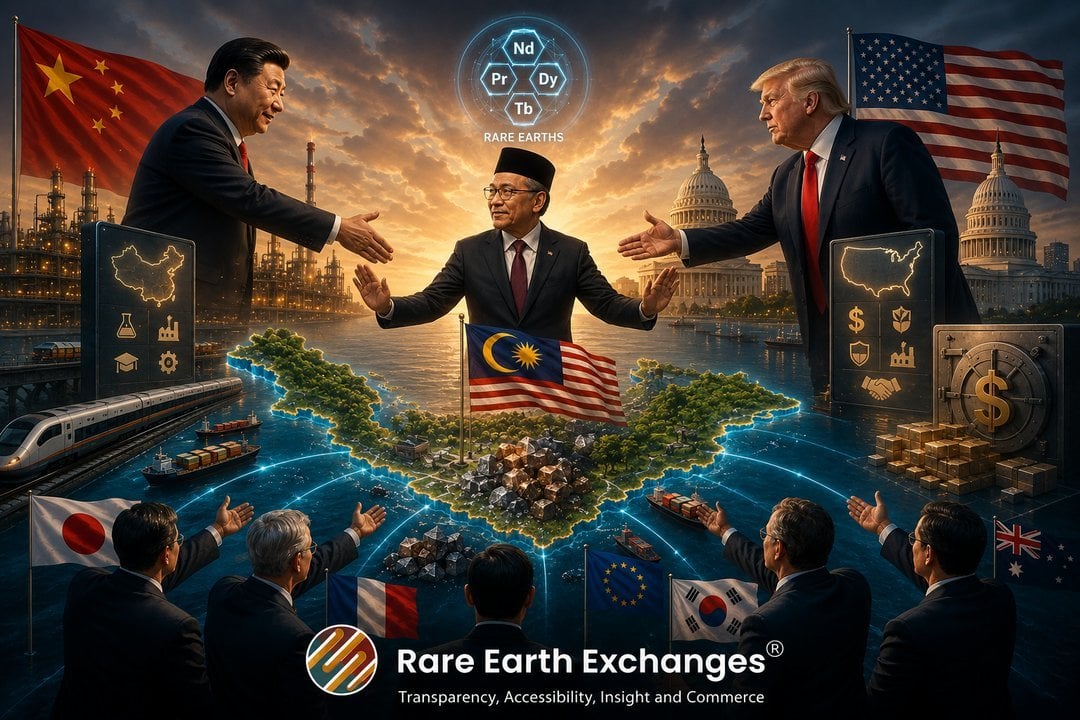
Malaysia has the rocks. China has much of the recipe. The West raises the prospect of capital. And increasingly, Kuala Lumpur wants it all.
Chinese state news agency Xinhua reports that Universiti Kebangsaan Malaysia geoscientist Dr. Syed Muhammad Ibad Mahmoodi, who was also interviewed on the Rare Earth Exchanges podcast, believes Chinese cooperation could help Malaysia expand resource processing, train engineers, and climb into higher-value manufacturing. Ibad is not merely commenting from the sidelines: his research includes Malaysian rare earth geology and hydrometallurgical approaches. UKM lists his specialties in petrophysics and geochemistry.
REEx Insight: Technology Transfer—or Technology Rental?
The Xinhua thesis gets the industrial economics right. Malaysia needs more than deposits. It needs extraction technology, separation chemistry, engineers, capital, and downstream customers. But will China actually transfer the crown jewels?
Beijing has already signaled limits, and then some. Malaysia's government disclosed that President Xi Jinping expressed willingness to provide rare-earth processing technical and technological assistance—but emphasized technology safeguarding and requested cooperation through government-linked companies. That is cooperation, but hardly evidence of unrestricted intellectual-property transfer.
The same question applies to the West. Lynas Rare Earths (opens in a new tab) has built extraordinary operational capability in Malaysia and is expanding heavy rare earth separation there. But operating sophisticated Australian-owned separation assets on Malaysian soil is not synonymous with transferring the underlying IP and creating an independently Malaysian technology stack. Malaysia's renewed Lynas license even requires contributions equal to 1% of annual gross sales toward domestic rare-earth research and development—evidence that Kuala Lumpur itself wants greater local capability.
Great Powers Era 2.0 Lands in Kuala Lumpur
REEx has been tracking this convergence for months. In “Malaysia Becomes the Heavy Rare Earth Battleground,” we documented Malaysia's effort to capture processing, technology transfer, and local value rather than remain a feedstock exporter. Read the REEx analysis
A day later, “America's Bigger Checkbook Touted in Malaysia” examined U.S., Japanese, French, Belgian, and South Korean interest alongside China's entrenched position. Read the REEx analysis Our Great Powers Era 2.0™ thesis argues that strategic power increasingly resides in industrial chokepoints—separation, metals, alloys, and magnets—not simply ownership of mines. Great Powers Era 2.0 Arrives in Malaysia
That makes Xinhua's interview notable. China is effectively offering Malaysia a vision of industrial partnership precisely as Western governments court Kuala Lumpur with their own capital, technology, and supply-chain alliances.
For investors, watch what is actually transferred—not what is promised.
Xinhua News Agency — Chinese state news agency and publisher of the August 13 interview.
Xinhua should not be treated as an independent news organization in the conventional Western sense. Xinhua itself describes the organization as China's state news agency, operating a worldwide multilingual news network. Its reporting can contain valuable factual information and legitimate interviews, but REEx readers should recognize its institutional relationship with the Chinese state—particularly when coverage presents Chinese technology, investment, or international cooperation favorably. The interview's central industrial argument is plausible; its principal omission is the harder geopolitical question: how much strategically valuable Chinese rare-earth know-how Beijing is actually prepared to surrender.


0 Comments
No replies yet
Loading new replies...
Moderator
Join the full discussion at the Rare Earth Exchanges Forum →