
Highlights
- Hydrogen Plasma Smelting Reduction (HPSR) reduced oxygen in end-of-life NdFeB hard-drive magnet scrap by up to 66% in just 2.5 minutes at 10-gram lab scale.
- Treated uncoated scrap achieved a maximum energy product of 72.4 kJ/m³ versus 46.5 kJ/m³ for untreated scrap-derived material, a roughly 56% improvement, with no virgin rare earths added.
- Nickel coatings dissolved into the melt rather than separating, degrading magnetic properties and underscoring the importance of scrap pretreatment.
- Modeled costs of €11,500–€15,500 per tonne suggest potential competitiveness with short-loop recycling alternatives, but all economics remain theoretical pending pilot-scale validation.
- If scaled successfully, HPSR could keep neodymium, praseodymium and dysprosium circulating inside Western magnet supply chains, reducing reliance on newly mined material.
Researchers led by Rafael Gitti Tortoretto Fim of the Max Planck Institute for Sustainable Materials (opens in a new tab) (MPI-SusMat), with Matic Jovičević-Klug, Dierk Raabe and collaborators from Fraunhofer IWKS (opens in a new tab) and Brazil's Institute of Energy and Nuclear Research (IPEN) (opens in a new tab), report a potentially important new route for recycling end-of-life neodymium-iron-boron (NdFeB) magnets. Their Hydrogen Plasma Smelting Reduction (HPSR) process reduced oxygen contamination in mixed hard-drive magnet scrap by up to 66% in just 2.5 minutes, while largely retaining valuable neodymium, praseodymium and dysprosium. Uncoated scrap subsequently processed into melt-spun material achieved a maximum energy product of 72.4 kJ/m³ versus 46.5 kJ/m³ for untreated scrap-derived material—without adding virgin rare earths. The results are intriguing for a Western magnet industry searching for additional sources of Nd, Pr and Dy, but this remains a 10-gram-scale laboratory study published as a September 2, 2026 ChemRxiv preprint and has not been peer reviewed.
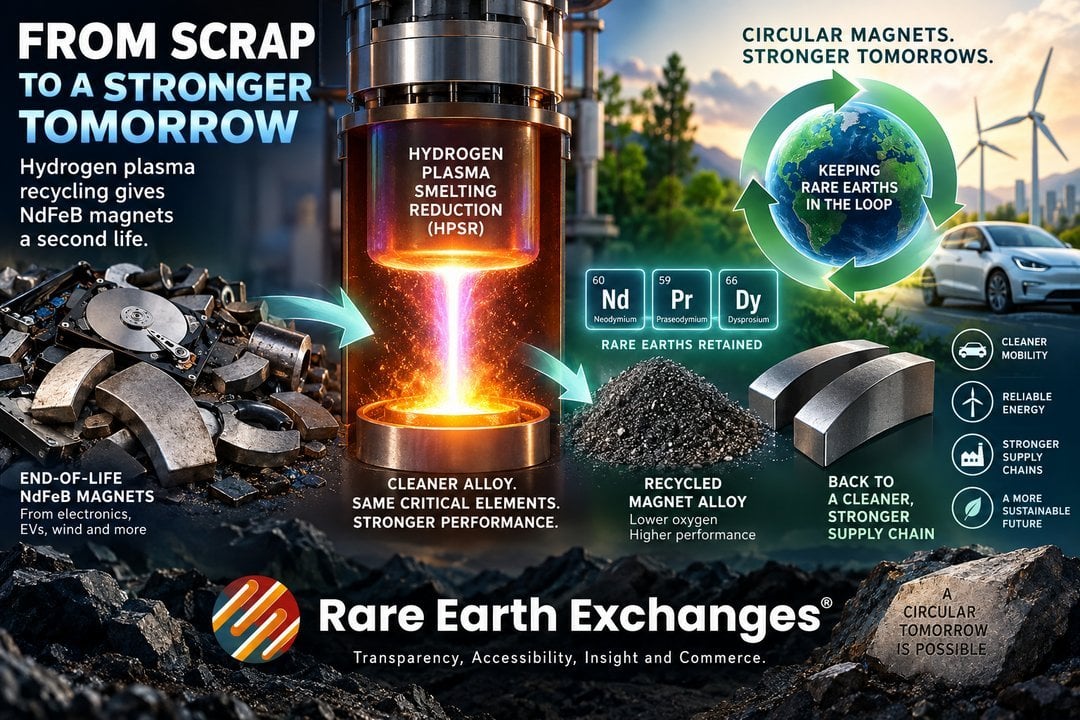
REEx Insight | The Prize Is Keeping the Rare Earths Inside the Magnet Loop
The most interesting finding isn't simply "better recycling." It is the possibility of avoiding unnecessary destruction and rebuilding of an already valuable engineered rare-earth alloy.
Conventional recycling can send magnets through longer chemical recovery routes or use shorter magnet-to-magnet/alloy routes. But oxidation and contamination complicate direct recycling, often causing material losses or requiring fresh rare earths to restore chemistry. The researchers position HPSR between these approaches: clean up the alloy, retain its embedded Nd-Pr-Dy value and send it back toward magnet manufacturing.
Does this possible breakthrough make HPSR potentially more interesting as a midstream circularity technology than simply another recycling process? For example, if industrial scale-up works, discarded magnets become a secondary feedstock for magnet alloy production—reducing, though certainly not eliminating, dependence on newly mined and separated rare earths.
REEx Snapshot
| Metric | Study Result | REEx Interpretation |
|---|---|---|
| Feedstock tested | Mixed end-of-life HDD NdFeB magnets | Encouraging because real scrap is heterogeneous, but HDD scrap does not establish performance across EV, wind or industrial magnet streams. |
| Experimental scale | ~10 g/sample | Proof-of-concept, not industrial validation. Scale-up is now the central question. |
| Best HPSR treatment point | ~2.5 minutes | Extremely rapid chemistry is potentially attractive for throughput if replicated at scale. |
| Starting oxygen | ~2,360 ppm | Oxidation is a major obstacle to short-loop magnet recycling. |
| Lowest measured oxygen | 743–816 ppm | Up to 66% reduction—the study's central technical result. |
| Fresh REEs added during experimental processing | None | Potentially important: retaining Nd/Pr/Dy already embedded in scrap could reduce demand for virgin make-up material. |
| Maximum energy product | 46.5 → 72.4 kJ/m³ | ~56% increase for material derived from HPSR-treated uncoated scrap versus untreated scrap-derived material. This is recycled ribbon/powder performance—not proof of a commercially qualified sintered magnet. |
| Maximum coercivity | 0.93 → 1.45 T | ~55% improvement at the best condition, indicating better resistance to demagnetization. |
| Nickel coating | Dissolved into alloy | Important weakness: HPSR removes oxygen but does not remove Ni; elevated Ni degraded magnetic properties. |
| Modeled 1-ton energy | ~320 kWh + 0.27 kg H₂/t | Interesting—but predictive scale-up, not measured industrial consumption. |
| Modeled HPSR cost | €9,400–€10,000/t scrap | Authors estimate ~12% of assumed €81,000/t scrap value; economics remain theoretical until pilot scale. |
| Modeled finished recycling cost | €11,500–€15,500/t | Suggests competitiveness with short-loop alternatives, but excludes the certainty that comes from operating a commercial line. |
| Strategic significance | Intermediate-loop recycling | Potential new secondary source of magnet alloy, not a replacement for primary mining, separation, metallization or magnet capacity. |
Study Methods and Results
Researchers manually crushed mixed HDD magnets and treated approximately 10-g batches in an arc furnace under 90% argon/10% hydrogen, applying a 200-amp plasma arc for one to 10 minutes. They also ran argon-only controls. The resulting alloys were melt-spun and tested for chemistry, microstructure, oxygen and magnetic properties. No primary rare earths were added.
The hydrogen effect was striking. Starting scrap averaged roughly 2,360 ppm oxygen; the best 2.5-minute treatments reached 816 ppm for uncoated and 743 ppm for coated scrap. By contrast, short-duration argon-only treatment increased oxygen substantially, supporting the authors' interpretation that reactive hydrogen species drive oxide reduction.
There was a catch. Nickel coatings dissolved into the melt rather than being separated. Increasing Ni contamination reduced subsequent magnetic performance, highlighting why scrap quality and pretreatment may still matter, despite the authors describing HPSR as composition-independent.
Limitations and What Comes Next
This is not yet an industrial recycling breakthrough. It is a promising laboratory proof-of-concept. HPSR requires high-temperature plasma melting and produces an unfinished master alloy requiring additional processing before becoming a finished magnet. The 320-kWh/t energy estimate and €11,500–€15,500/t projected finished recycling cost come from modeled scale-up; the actual experiments involved grams.
The next milestone should therefore be straightforward: kilogram-to-pilot-scale operation using representative EV, wind-turbine, industrial-motor and electronics scrap, followed by full sintered-magnet production, lifecycle analysis and independently validated economics. If performance survives those tests, HPSR could become something strategically valuable: a way of keeping Nd, Pr and Dy circulating inside the Western magnet supply chain instead of repeatedly returning to the mine.
REEx Connect
| Organization | Role / People | Why It Matters | |
|---|---|---|---|
| Max Planck Institute for Sustainable Materials (MPI-SusMat) | Rafael Gitti Tortoretto Fim; Dierk Raabe; Matic Jovičević-Klug | Lead research institution; circular metallurgy and HPSR development | |
| Fraunhofer IWKS | Oliver Diehl; Jürgen Gassmann | Magnet recycling and resource-strategy collaborator | |
| IPEN — Nuclear and Energy Research Institute | Melissa Röhrig Martins da Silva | Brazilian materials-science collaborator | |
| MaRS Project | Fraunhofer–Max Planck collaboration | "Critical Materials lean Magnets by Recycling and Substitution"; research funding | |
| European Research Council / EU | ERC Advanced Grant "ROC" | Additional research funding |
Citation: Fim, R.G.T., et al. Sustainable recycling of end-of-life Nd-Fe-B permanent magnets through hydrogen-based plasma reduction. ChemRxiv, September 2, 2026. DOI: 10.26434/chemrxiv.15008192/v1. Preprint; not peer reviewed.


0 Comments
No replies yet
Loading new replies...
Moderator
Join the full discussion at the Rare Earth Exchanges Forum →