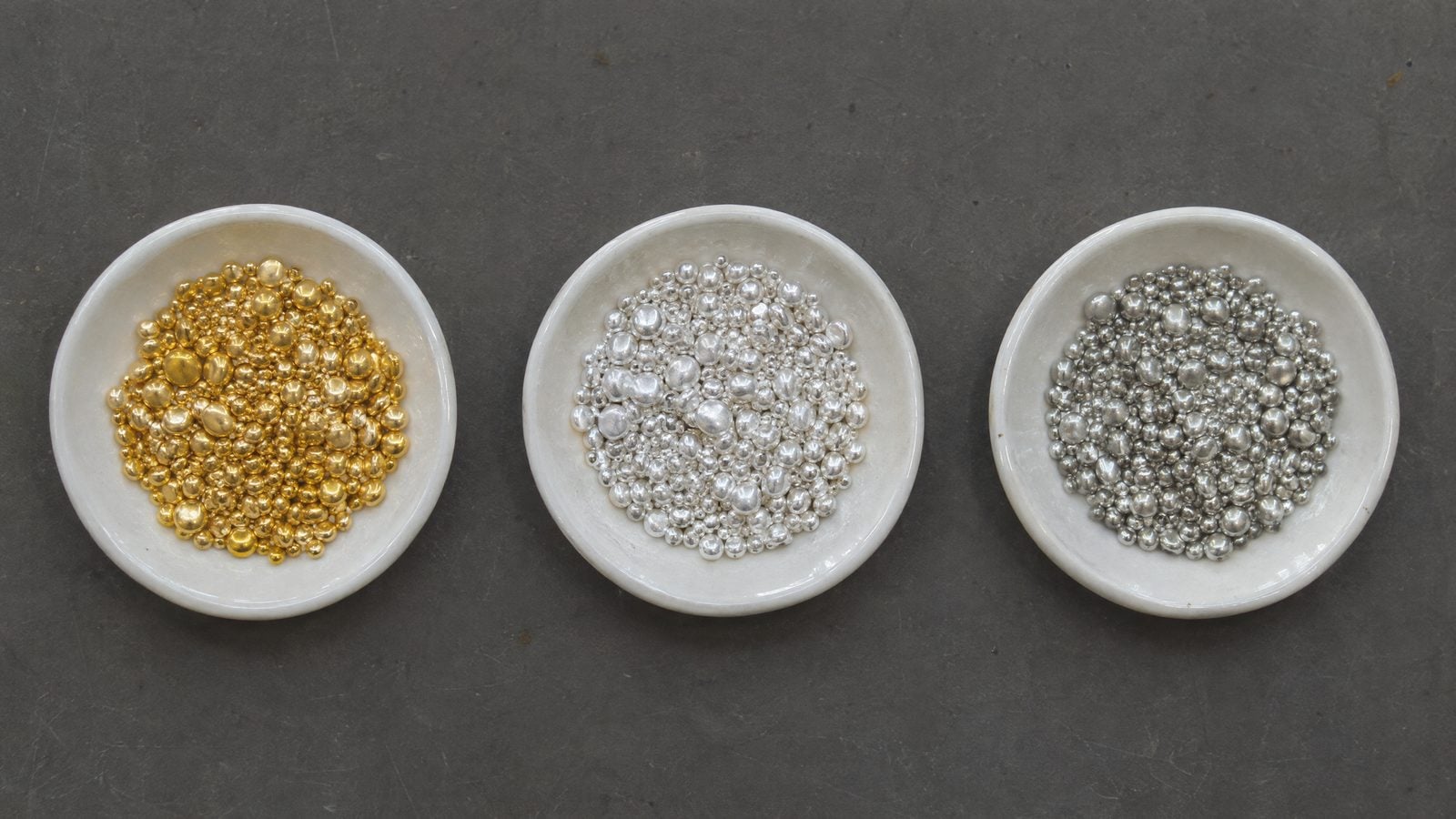
The precious metals list has eight names: gold, silver and the six platinum group metals (platinum, palladium, rhodium, iridium, ruthenium and osmium). Iridium was the most expensive of the seven that refiner Umicore quoted on November 24, 2026, at $10,200 per troy ounce, and silver was the cheapest at $42.40. Rare earths are a separate family of 17 reactive metals. Nearly all are more common in the crust than gold or silver, yet they are harder for a buyer to secure.
Table of Contents
What is on the precious metals list, ranked by price?
USGS geologists and U.S. trade law both arrive at eight. The USGS platinum-group report (opens in a new tab) names the six platinum group metals as precious alongside gold and silver. Chapter 71 of the U.S. Harmonized Tariff Schedule says "precious metal" means silver, gold and platinum, then defines "platinum" to cover all six. The prices come from one dealer on one day, the Umicore daily price page (opens in a new tab). They are one desk's sale prices, so others will differ slightly.
| Metal (symbol) | Price, $ per troy oz, Nov 24, 2026 | Melting point,°C | Top mine producer and share, 2025 | Main uses |
|---|---|---|---|---|
| Iridium (Ir) | 10,200 | 2,446 | South Africa, 80% | Industrial electrodes, spark plugs |
| Rhodium (Rh) | 8,850 | 1,963 | South Africa, over 80% | Catalytic converters, chemical catalysts |
| Gold (Au) | 3,626.50 | 1,064 | China, 12% | Jewelry, bars, central bank reserves |
| Ruthenium (Ru) | 1,900 | 2,333 | South Africa, over 85% | Chemical catalysts, chip resistors, hard disks |
| Platinum (Pt) | 1,310 | 1,768 | South Africa, 71% | Catalytic converters, jewelry, hard disks |
| Palladium (Pd) | 896 | 1,555 | Russia, 44% | Catalytic converters, ceramic capacitors |
| Silver (Ag) | 42.40 | 962 | Mexico, 24% | Electronics, solar cells, bars and coins |
| Osmium (Os) | Not quoted by Umicore | 3,033 | Not reported | Hard alloys for pen tips and pivots |
Osmium is unranked because it has no exchange benchmark and its quotes vary enormously by form. Shanghai Metals Market launched price points for powder and ingot in March 2026. The specialty site osmium-preis.com listed crystalline osmium at 2,412.70 euros per gram and purified metal at 54.15 euros on November 24, 2026. The first is far above iridium's $328 per gram and the second far below it.
Osmium does lead the densest metals, a ranking on which price has no bearing. Strength is ranked separately in the guide to the strongest metal on earth.
What makes a metal precious
A list of precious metals is a convention. Nobility and rarity are the common requirement, and a monetary role is a bonus that some members barely have.
- Nobility (required). Precious metals resist chemical attack. Gold is chemically unreactive, although a mix of nitric and hydrochloric acids will dissolve it, and iridium is the most corrosion-resistant metal known. Standard reduction potentials (opens in a new tab) put numbers on it: about +1.5 volts for gold, +1.2 for platinum and +0.8 for silver, against +0.34 for copper. Silver is the least noble of those three and tarnishes slowly as sulfur compounds in air form silver sulfide.
- Rarity (required). When Earth separated into core, mantle and crust, platinum group metals became progressively scarcer toward the surface. The upper crust holds about 0.5 part per billion platinum. Rhodium and iridium, at roughly 0.018 and 0.022 part per billion, are candidates for the rarest metal on earth.
- A monetary or investment role (optional). Jewelry, bars and official buyers took 85% of global gold consumption in 2025, excluding exchange-traded funds. In the first nine months of 2026, central banks bought 675 metric tons, by World Gold Council count. Platinum, palladium and rhodium are also held as coins, bars or funds.
The investment role fades for the minor metals. Johnson Matthey counts only industrial demand for iridium and ruthenium. It leaves strategic stockpiling out of its totals, though it says such buying has tightened both markets. Gold moves with savers and central banks, while iridium and ruthenium move with factories and stockpilers.
Why the platinum group metals come from so few places
Platinum group metals reach the crust in magnesium-rich magma that needs a high degree of melting, and they concentrate when sulfide liquid separates out and interacts with a very large volume of that magma. Almost all reported production and identified resources tie back to three places where this happened: South Africa's Bushveld Complex, Zimbabwe's Great Dyke and the Noril'sk-Talnakh intrusions in Russia.
The USGS platinum-group summary (opens in a new tab) shows the result. Russia and South Africa together mined about 81% of 2025 palladium, and South Africa alone about 71% of platinum. Gold is far more spread out, with its five leading producers at 41%. South African platinum group output fell an estimated 9% in 2025. USGS blamed declining palladium prices first, then deep-mining costs and power disruptions.
The places to watch are South African mines for platinum, rhodium, iridium and ruthenium, and Russia for palladium.
Why prices on the list move so differently
Supply of the smallest metals barely responds to their own price. The final U.S. critical minerals list (opens in a new tab) records iridium, rhodium and ruthenium as byproducts or co-products of platinum and nickel. An industry fact sheet from the International Platinum Group Metals Association explains that iridium output depends on pricing and demand for the whole platinum group basket. Johnson Matthey's market report (opens in a new tab) of May 2026 forecast new iridium supply unchanged this year at 229,000 troy ounces, with demand up from 236,000 to 240,000.
In a market that thin, rankings flip. Umicore's iridium price rose from $4,400 in November 2025 to $10,200 and passed rhodium on October 19, 2026. Ruthenium set a then-record near $1,750 in March 2026 as supply constraints met AI-driven hard disk demand. Umicore quoted it at $1,950 on most days between October 20 and November 19.
Liquid metals swing on money flows. Umicore's silver price on November 24, 2026 was about 65% below its January 29 level, and gold about 33% lower. Gold lost more than 9% in the week before November 23 as some investors sold it to raise cash and meet margin calls.
The practical rule is to compare prices from one source on one day, and to treat minor-metal quotes as ranges: Umicore's note for November 24, 2026 put ruthenium anywhere from $1,700 to $1,950.
Where rare earths fit: reactive, abundant and harder to secure
The rare earth elements are scandium, yttrium and the 15 lanthanoids, the definition used by the chemistry body IUPAC. They fail the nobility test. Cerium and lanthanum have reduction potentials near -2.3 and -2.4 volts, level with magnesium.
They fail the rarity test too: all but promethium are more abundant in the crust than silver, gold or platinum. Average abundance is 66.5 parts per million for cerium and 41.5 for neodymium, against 0.075 for silver. Neodymium-praseodymium oxide averaged $69 per kilogram in 2025, when silver's average worked out to about $1,222.
Mine concentration alone does not explain why they are harder to secure, since China's 69% of 2025 rare earth output is close to South Africa's share of platinum. Three other things do.
- Refining. Rare earths occur together in the same minerals, so ore processing must separate them one after another. China is the top refiner, and the International Energy Agency (opens in a new tab) puts the top supplier's share of rare earth refining at 85% in 2025, down from over 90% in 2023.
- Licensing. China's April 2025 controls on seven rare earths forced some automakers to cut production or pause it. The controls remain in force, although some exporters hold general licenses. The wider October 2025 package is suspended until January 10, 2027.
- Stock and scrap. About 140,000 kilograms of palladium and platinum were recovered from scrap worldwide in 2025, against limited quantities of rare earths. The pure metals are also awkward to hold: Ames Laboratory handling guidance (opens in a new tab) calls for storing lanthanum, cerium, praseodymium and neodymium metal under vacuum or inert gas, because they oxidize in air.
Gold and silver carry mostly price risk. Rare earths carry mostly access risk, and the platinum group sits between the two.
Precious and critical are two different tests
The U.S. critical minerals list published on November 7, 2025 covers 60 minerals. It includes six of the eight precious metals: silver, added that year, plus platinum, palladium, rhodium, iridium and ruthenium. Gold and osmium are absent. Sixteen of the 17 rare earths are on it, all except promethium.
The government updates the list to reflect supply, demand, concentration of production and policy priorities, so a high price is no guarantee of a place. Net import reliance in 2025 was an estimated 89% for platinum, 77% for silver and 57% for palladium. A metal can be precious without being critical (gold), critical without being precious (neodymium), or both (platinum).
Read the latest rare earth news on REEx
Frequently asked questions
What are precious metals?
Precious metals are rare, corrosion-resistant metals used in industry and held as investments. The recognized eight are gold, silver, platinum, palladium, rhodium, iridium, ruthenium and osmium. USGS ties their high value to practical uses plus their role as investment instruments and a store of value.
What is the most expensive precious metal?
Iridium is the most expensive of the seven precious metals Umicore quotes, at about $328 per gram on November 24, 2026. Rhodium, at about $285, led from December 4, 2024 until October 19, 2026. Crystalline osmium is listed far higher, at 2,412.70 euros per gram, but that is a specialty retail price.
Is copper a precious metal?
No, copper is a base metal. USGS projected its 2025 COMEX average at $4.80 per pound, which works out to about 33 cents per troy ounce. Copper gives up electrons more readily than silver or gold, and its main U.S. use is building construction. It joined the U.S. critical minerals list in November 2025.
Is rhenium a precious metal?
Rhenium is not on the standard precious metals list, even though it cost more than silver in 2025. Its 2025 average was about $2,600 per kilogram, roughly $81 per troy ounce, and Shanghai Metals Market put Chinese pellets near 46,000 yuan per kilogram in mid-2026. About 80% goes into superalloys for turbine engines.
Are rare earth elements precious metals?
No. Rare earth metals are reactive, nearly all are more plentiful in the crust than gold, and they are priced mainly as oxides by the kilogram. They do share two traits with the platinum group metals: a few countries dominate supply, and most members of both groups are on the U.S. critical minerals list.
Which precious metals can a U.S. IRA hold?
Section 408(m) of the tax code treats metals as collectibles but exempts gold, silver, platinum or palladium bullion fine enough for delivery on a regulated futures contract, if a trustee holds it. A separate exemption covers certain U.S. gold, silver and platinum coins and coins issued under state law. This is general information, not tax advice.