
Highlights
- India is running a two-track strategy: engaging Myanmar's military government diplomatically while separately pursuing heavy rare earth access through the Kachin Independence Army (KIA).
- The KIA controls over 500 rare-earth sites in Kachin State as of 2026, making it the world's top rebel-controlled heavy rare earth upstream asset according to REEx rankings.
- India's real bottleneck is not geology but separation, refining, and magnet-making—all still dominated by China downstream.
- The Kachin Independence Army dates to 1961, predating the 2021 coup by six decades; its control of Pangwa's dysprosium and terbium resources is the product of a generations-long ethnic conflict.
- All Kachin rare earth output currently flows to China for separation, meaning India has no clear path to a complete supply chain without solving the processing gap.
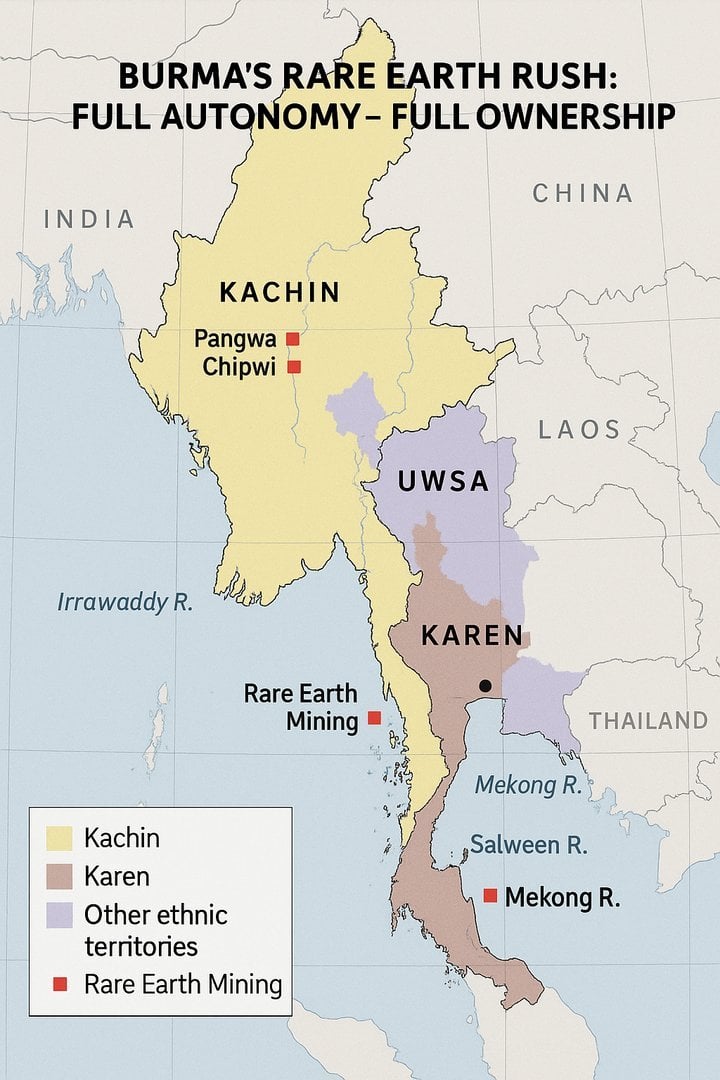
India is pursuing Myanmar's rare earths, but the agency story blurs the decisive fact: New Delhi is running a two-track strategy. It is engaging Min Aung Hlaing's military-backed government at the state level while separately exploring heavy-rare-earth access through the Kachin Independence Army (opens in a new tab) (KIA), which controls the Chipwi-Pangwa mining belt. That distinction determines whether India has a supply strategy—or diplomatic theater.
REEx Insight | Sovereignty Is Split; the Supply Chain Is Not
Investors should not model Myanmar as a normal sovereign-country supplier. The chain has three power centers: Naypyidaw provides diplomatic legitimacy; the KIO/KIA controls much of the relevant ground; China still dominates downstream processing. Reuters confirms India sought KIA-controlled samples, while REEx has identified India's real bottleneck as separation, refining, and magnet-making—not geology.
REEx Insights Rankings places "Myanmar Rebels," led by the Kachin Independence Army (KIA)-controlled Kachin position, No. 1 globally among rebel-controlled heavy-rare-earth upstream assets. The investor test is therefore four-linked: security → transport corridor → Dy/Tb separation → qualified magnets. Break one link and the strategic value of the ore collapses. That is why REEx calls Kachin the world's most important HREE battlefield.
Who Is India Actually Calling?
Officially, India is talking to the military-backed government: India's Ministry of External Affairs confirmed critical-mineral and rare-earth discussions during Min Aung Hlaing's June 2026 visit; AP documented New Delhi's continuing engagement. India's Yangon embassy also records technical delegations in December 2024 and February 2026. Operationally, however, India's Ministry of Mines, IREL, and Hyderabad-based Midwest Advanced Materials explored samples and possible bulk exports through the KIA. This is specifically KIA outreach—not engagement with every resistance faction.
Source: PowerMentor
The Minefield Behind the Mine
The KIA (along with the Kachin Independence Organization) sits within a wider resistance landscape that includes the National Unity Government (opens in a new tab) (NUG) and its People's Defence Force (opens in a new tab) (PDF), alongside powerful ethnic armed organizations including the Arakan Army (AA), Karen National Liberation Army (opens in a new tab) (KNLA), Myanmar National Democratic Alliance Army (opens in a new tab) (MNDAA), and Ta'ang National Liberation Army (TNLA (opens in a new tab)). A Kachin researcher citing Stimson Center data puts the number of rare-earth sites in Kachin above 500 in 2026. Human Rights Watch (HRW) documents continuing military abuses, while other investigations have documented serious environmental damage associated with rare-earth mining.
What many underlying media outlets such as Times of Oman (opens in a new tab) fail to convey is that "Myanmar" does not necessarily control Myanmar's most valuable heavy rare earth element (HREE) ground.
Did You Know? Myanmar's Resistance Didn't Begin in 2021
- ☑ Myanmar became independent in 1948 — and some of its ethnic conflicts date almost to the birth of the country.
- ☑ The Karen struggle is among the world's longest-running armed conflicts. The Karen National Union began its armed resistance in 1949.
- ☑ The Kachin Independence Army dates to 1961. Its struggle for greater Kachin autonomy therefore predates the current military junta by roughly six decades.
- ☑ Christianity is particularly important among the Kachin and Karen. Large portions of these ethnic communities are Christian, although Myanmar's resistance is religiously and ethnically diverse.
- ☑ These are not simply "rebels" created by the 2021 coup. Long-established ethnic armed organizations have fought Myanmar's central government for autonomy, federalism, and ethnic rights across generations.
- ☑ The 2021 military coup transformed the battlefield. New pro-democracy People's Defence Forces emerged and increasingly fought alongside—or in parallel with—older ethnic armies.
- ☑ Rare earths have now collided with this 75+ year struggle. The Kachin Independence Army seized the strategically important Pangwa rare-earth mining region in 2024, putting one of the world's most consequential heavy rare-earth supply sources under Kachin control.
- The junta has intensified violence against not only the rebel groups but civilian populations.
- ☑ That history matters to investors. Calling the Kachin simply "Myanmar rebels" misses the deeper reality: this is a long-established ethnic movement that today controls territory containing strategically important dysprosium- and terbium-bearing rare-earth resources. To date, all the output is shipped to China for separation.


0 Comments
No replies yet
Loading new replies...
Moderator
Join the full discussion at the Rare Earth Exchanges Forum →