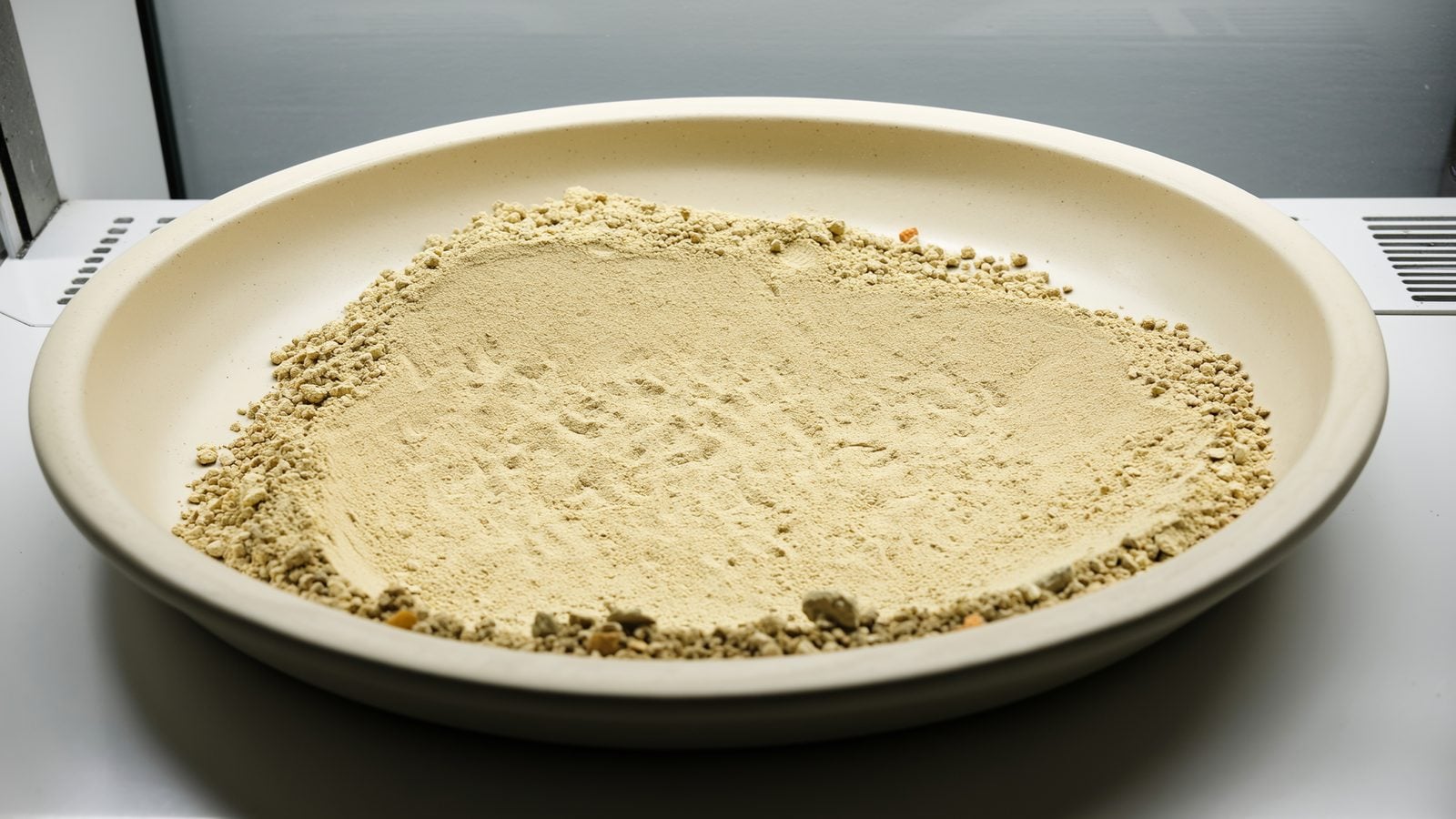
Rare earth elements are tested in four stages: a representative sample is ground to a fine powder, its minerals are dissolved or fused, an instrument measures each element, and reference materials run in the same batch show whether the numbers hold. For most ores and concentrates, the working route is a lithium borate or sodium peroxide fusion read by ICP-MS, with fused-bead XRF, or ICP-OES where its lines are clear, for high grades.
Key takeaways
- Order a fusion when you need a total. In one roasted Mount Weld ore reference material, four-acid digestion found 97% of the total rare earth oxide but only 79% of the ytterbium and 91% of the yttrium.
- Bench XRF and fusion ICP agree closely on the main light rare earths in that material. Its uncertified XRF figures for dysprosium and gadolinium run about 30% high.
- A 50 kV handheld XRF is a screening tool for lanthanum, cerium and yttrium. Praseodymium and neodymium are rough indications at best, and dysprosium and terbium are out of reach.
- A "99.9%" oxide is usually a share of the rare earths alone. The product can carry as little as 98.9% of the named oxide once moisture is removed, and less as received.
- Judge a reference material result against its uncertainty. A recovery of 95.6% can sit inside a 5% window and still show real bias.
How are rare earth elements tested in each material?
The limits come from different laboratories' packages, so they are not comparable row to row. Magnets need their own plan, set out in the guide to magnet composition testing.
| Material | Preparation, digestion and instrument | Usable range | What it cannot see | Order this |
|---|---|---|---|---|
| Low-grade rock or sediment | Peroxide sinter, ICP-MS | From 0.02–0.3 ppm, by element (USGS) | Yttrium and lutetium in the USGS method, which spends lutetium as internal standard | Fusion or sinter ICP-MS with Y and Lu confirmed |
| Monazite or bastnaesite ore | Borate or peroxide fusion (ALS also sells ammonium bifluoride as near complete), ICP-MS, over-range finish | La and Ce to 50,000 ppm by borate, 25,000 by peroxide, 10,000 by bifluoride; eight elements up to 30% over range after borate (ALS) | Lithium and boron after a borate fusion; europium if barium oxide is not corrected | Ore-grade fusion ICP-MS plus the over-range code |
| Xenotime or zircon-hosted ore | Extended peroxide sinter or borate fusion, ICP-MS | Y 3–50,000 ppm (borate, ALS); 0.2–25,000 ppm (peroxide, ALS) | Anything in undissolved grains; yttrium above the cap | Fusion with a residue check and a named yttrium finish |
| High-grade ore and concentrate | Borate bead, wavelength-dispersive XRF, loss on ignition | 0.01–50% for CeO2 and La2O3; 0.01–10% for the other oxides (ALS) | Elements under about 100 ppm; heavy rare earths in the hundreds of ppm are doubtful | XRF for the light elements, ICP-MS for the heavies |
| Ion-adsorption clay | Ammonium sulfate leach, plus fusion of a split; ICP-MS on both | Leach: Ce and Y to 500 ppm, Dy and Tb to 1,000 ppm (ALS) | The leach misses mineral-bound rare earths | Both tests, reported side by side |
| Powder that resists digestion | No digestion; INAA | From 0.05–5 ppm up to 10,000 ppm (one Actlabs package) | Pr, Gd, Dy, Ho, Er, Tm and Y in that package | Low-grade referee check only, with uranium fission correction |
| Outcrop, core or pulp | Dry, ground, flat surface; site-calibrated 50 kV handheld XRF | Screening: La, Ce, Y; rough indication: Pr, Nd | Sm to Lu | Use to choose samples, never to settle |
| Separated oxide or metal | Acid dissolution, ICP-MS and ICP-OES; separate ignition test | ICP-OES: 0.001–0.2% for Mg, Al, Si and Ca; 0.001–0.5% for Fe (ISO 24181-1) | Water, carbonate and any element not on the list | Oxide: impurity list, total oxide and ignition loss. Metal: impurity list, total rare earth, and O, N, C |
| High-purity solid | Pressed into or held on a conductor, GDMS | ppm to below ppb on pure silicon (Eurofins EAG); for oxides in a binder, ask | Atmospheric gases; not fully quantitative without matrix standards | A survey, then a calibrated ICP method on contract limits |
Read the caps before shipping. Pure xenotime (YPO4) is 48% yttrium, so a good concentrate exceeds the yttrium limits of both the fusion ICP-MS and XRF rows. The 10% XRF cap can also bind Nd2O3 in a monazite concentrate. Thorium and uranium decide how the sample must be classified for transport and whether the laboratory is licensed to accept it. Repeats drive the cost of rare earth testing.
How do sampling and preparation limit the result?
They set the ceiling, because a fusion for ICP-MS often uses only 0.1–0.2 grams. Rare earth sample preparation starts at the lot: cut increments across every bag or the moving stream, since grab samples from the top of a bag miss settled heavy grains. Each later split must carry the same mix of grains.
Suppose every monazite grain in a pulp is a 75 micron sphere with a density of 5.15 grams per cubic centimeter. Each weighs about 1.14 micrograms, so a 0.1 gram portion of rock with 1% monazite holds about 880 grains, with a counting error of about 3.4%. At 0.1% it holds about 88 grains, an error of about 11%. Those are worst cases only if the whole pulp passes 75 microns. At low grade, pay for finer grinding, a larger portion or repeat digestions before blaming the instrument.
Moisture also shifts results. Ore from Mount Weld was so hygroscopic that the maker of the OREAS 465 reference material (opens in a new tab) roasted it at 900°C (1,652°F). Its certificate gives fusion ICP values as packaged and XRF values on a dry basis. Ask for drying at 105°C (221°F) and the moisture figure. For ion-adsorption clay, agree a gentler drying and no extra grinding before the leach.
Which digestion suits which mineral?
No single flux is the only route to a total. The certificate for OREAS 465 pools borate and peroxide fusion results in a single certified value for that roasted ore. If the host is unknown, run X-ray diffraction or automated mineralogy on the same split first.
- Monazite: either fusion works. A University of the Witwatersrand thesis on South African monazite (opens in a new tab) found complete dissolution with both fluxes and only partial dissolution with mixed acids. It concluded that acid still freed the rare earths, and its ICP-MS results agreed with certified values, though yttrium differed by route. Agreement on certified materials does not guarantee full recovery on yours, so treat acid recovery as something to prove. Options are compared in the guide to monazite testing methods.
- Xenotime and zircon: allow time. Tests on zircon-bearing rocks measured zircon, not xenotime, so ask for xenotime recovery evidence. In them, zirconium recovery improved with two hours at 480°C (896°F) and six parts peroxide to one of sample. The USGS rare earth procedure uses that ratio but heats for 30 minutes, so ask whether the laboratory checks for residue.
- Bastnaesite: fuse it. The mineral supplies fluoride, and rare earth fluorides are insoluble in dilute nitric acid. Acid attacks using hydrofluoric acid must drive the fluoride off or redissolve the precipitate.
- Ion-adsorption clay: run two tests. Ammonium sulfate releases the ions held on clay surfaces, which is the portion a leach plant can win. Fusion gives the total. In weathered rock from Madagascar, zircon and other refractory minerals held a significant share, so fusion alone overstates leachable grade.
- Sulfide-rich ore: above about 4% sulfide, use peroxide. A borate melt cannot oxidize the sulfide well.
What can each instrument read?
ICP-MS and ICP-OES
ICP-MS is the default for rare earth element analysis because it reaches every lanthanide at trace level. Its main fault is oxide ions: light rare earths and barium combine with oxygen in the plasma and appear at the masses of heavier rare earths. ICP-OES tolerates more dissolved solids and suits percent grades, but line overlap is severe and the monazite thesis found it inconsistent in fusion solutions, so the table keeps it for product impurities. The trade-offs are set out in ICP-MS versus ICP-OES.
Bench XRF on a fused bead
Fusion removes grain size and mineral effects, so bench XRF is strong at percent grades. In OREAS 465 it gave 2.84% La2O3 against 2.83% by fusion ICP, and 1.38% Nd2O3 against 1.37%. The match is approximate, because the XRF basis is dry and the packaged powder held about 0.3% moisture.
The certificate's uncertified XRF figures for Dy2O3, Gd2O3 and Yb2O3 are 329, 870 and 80 ppm against 249, 674 and 21.6 by fusion ICP. Terbium, holmium and ytterbium sit below the 100 ppm floor in the main table, so neither the matches (Tb4O7 67 against 67, Ho2O3 30.0 against 31.7) nor the ytterbium miss can be relied on. Dysprosium and gadolinium are above it and still run about 30% high.
Handheld XRF
The limit is tube voltage. Dysprosium needs 53.8 keV to excite its K lines and terbium 52.0, while lanthanum needs 38.9 and neodymium 43.6. A 50 kV tube barely excites samarium and europium and cannot reach gadolinium at 50.2. That leaves weak, crowded L lines: dysprosium's main L line falls at 6.495 keV, beside a manganese line at 6.490 and iron at 6.404.
On 32 phosphate samples holding 99 to 1,499 ppm rare earths, a British Columbia Geological Survey test (opens in a new tab) compared a 50 kV unit with fusion ICP-MS. Corrected against the same samples, mean errors were 24% for lanthanum, 41% for cerium, 65% for praseodymium, 63% for neodymium and 7% for yttrium, the usual pathfinder for heavy rare earths. Those are in-sample fits, so expect worse on new rock. The authors call corrected praseodymium qualitative at best.
Newer 80 kV portables are sold for terbium and dysprosium. Ask for blind results at your grade.
Neutron activation
INAA needs no digestion and can take a 30 gram portion, so it can referee low-grade rock. At percent grades the range cap and neutron self-absorption rule out the Actlabs package in the table. It also skips seven of the fifteen elements in the oxide sum. Uranium is the trap: its fission makes the isotopes used to measure lanthanum, cerium and neodymium. In one pegmatitic granite, virtually the entire signal (opens in a new tab) for those three came from fission.
How are concentrates and separated oxides tested?
China's concentrate standard, GB/T 18114.1, sets a classical route to total rare earth oxide (TREO). It precipitates the rare earths as oxalate, ignites and weighs them, and subtracts thorium oxide, for 20% to 80% TREO. For individual metals and oxides, a separate standard uses titration. By common practice, a contract names the settlement method and splitting limits, and a gap beyond them goes to an umpire laboratory.
Purity of a separated oxide is found by difference. The laboratory adds up the measured impurities and subtracts from 100, so the answer covers only what was on the list.
The Chinese neodymium oxide standard (opens in a new tab), GB/T 5240, shows the two numbers to separate. In a translated draft, the 99.9% grade requires at least 99.9% Nd2O3 as a share of rare earth oxide, and at least 99.0% rare earth oxide in the product. At both limits the powder is 99.0 × 0.999, or 98.9%, Nd2O3 before any moisture. The listed rare earth caps add to 0.10%, exactly the gap between 99.9% and 100%. Water, carbonate, iron and calcium sit outside that sum.
A Japanese national metrology institute study of lanthanum oxide (opens in a new tab) shows what a label leaves out. The powder was sold as 99.999%. Rare earth and thorium impurities totaled 1.0 ppm, counting undetected elements at half their limit. Direct gravimetric assay on ignited powder gave 99.977% ± 0.057%, an interval that contains the labeled 99.999% but is too wide to confirm it. The as-received powder lost about 3.5% of its mass on ignition, which changes contained weight.
Use ICP-MS for rare earth impurities. In neodymium products, NdO ions fall on terbium and dysprosium. In praseodymium products, PrO falls on gadolinium and its minor oxygen-18 form on terbium. Ask for MS/MS or matrix separation. Use ICP-OES for iron, calcium, silicon, aluminum and magnesium. GDMS surveys a solid with no dissolution, but oxides must be held on or pressed into a conductor, and without matched standards the numbers are not fully quantitative.
How do you check a result before relying on it?
Rebuild the total from the elements
Multiply each element by its oxide factor and add. Below, the factors apply only to the four-acid column; the fusion column is certified as oxide.
| Oxide | Four-acid, element (ppm) | Oxide factor | Four-acid, as oxide (ppm) | Fusion ICP, oxide (ppm) | Four-acid as share of fusion (%) |
|---|---|---|---|---|---|
| CeO2 | 39,100 | 1.2284 | 48,030 | 48,600 | 99 |
| La2O3 | 22,700 | 1.1728 | 26,623 | 28,300 | 94 |
| Nd2O3 | 11,000 | 1.1664 | 12,830 | 13,700 | 94 |
| Pr6O11 | 3,670 | 1.2082 | 4,434 | 4,557 | 97 |
| Sm2O3 | 1,307 | 1.1596 | 1,516 | 1,578 | 96 |
| Gd2O3 | 581 | 1.1526 | 670 | 674 | 99 |
| Y2O3 | 478 | 1.2699 | 607 | 665 | 91 |
| Eu2O3 | 282 | 1.1579 | 327 | 331 | 99 |
| Dy2O3 | 215 | 1.1477 | 247 | 249 | 99 |
| Tb4O7 | 57 | 1.1762 | 67 | 67 | 100 |
| Er2O3 | 47.3 | 1.1435 | 54.1 | 58 | 93 |
| Ho2O3 | 26.8 | 1.1455 | 30.7 | 31.7 | 97 |
| Yb2O3 | 14.9 | 1.1387 | 17.0 | 21.6 | 79 |
| Tm2O3 | 3.82 | 1.1421 | 4.4 | 5.16 | 85 |
| Lu2O3 | 1.72 | 1.1372 | 2.0 | 2.39 | 82 |
| Total | 95,459 | 98,840 | 97 |
The certificate lists fusion results both ways, so test the factors: 524 ppm Y × 1.2699 = 665, and 19.0 ppm Yb × 1.1387 = 21.6. The oxides then sum to 9.88%. The four-acid total is only 3.4% short, while ytterbium is 21% short. Do not turn these ratios into a correction factor. The ore was roasted, so raw ore may dissolve differently, and in OREAS 464, from the same project, yttrium agrees between the two routes, ytterbium is 9% short, and lanthanum's 9% gap sits inside its wide four-acid interval (0.86–1.27% La). Conventions for the sum are in what TREO means.
Test the reference material against its uncertainty
Suppose a laboratory fuses OREAS 465 on six separate days and averages 1.31% Nd2O3, with a long-run standard deviation of 0.03%. The certified value is 1.37%, with a 95% confidence interval of 1.34 to 1.41%. The European Commission's method for comparing a result with a certified value (opens in a new tab) runs in four steps.
- Difference: 1.37 − 1.31 = 0.06.
- Laboratory uncertainty: 0.03 ÷ √6 = 0.0122. Certificate uncertainty: half the interval, 0.035, divided by Student's t of 2.179 for the 13 accepted laboratories in the certificate's data file = 0.0161.
- Combined: √(0.0122² + 0.0161²) = 0.0202. Doubled: 0.040.
- Decision: 0.06 is larger than 0.040, so the bias is significant.
The recovery is 95.6%. The 1.31% mean passes the certificate's 5% window of 1.30% to 1.44% Nd2O3 and its two-standard-deviation gate of 1.25% to 1.49%. Both watch routine batches, and the standard-deviation gate includes differences between laboratories. The certificate says its confidence limits are not laboratory control limits, so use them only for this bias test. For a traded concentrate, run the test on a certified concentrate of matching grade.
Read recoveries with their reference values
The USGS peroxide method (opens in a new tab) reports syenite SY-3 at 92% for lanthanum and 95% for cerium, which looks like lost mineral until the neighbors are read: praseodymium 85%, neodymium 100%, gadolinium 114%. The targets are proposed values listed without uncertainties, so rerun on a certified material of matching mineralogy and never scale client results by such recoveries.
What should the request say?
Rare earth assay methods are ordered by code, and a code fixes the digestion, the element list and the ceiling.
- Material and host mineral: expected grade, sulfide, uranium and thorium.
- Purpose: total, leachable or product purity.
- Preparation: drying temperature, pulp fineness, test portion, who keeps the reserve split.
- Digestion and finish: flux, method code, residue check and over-range route for each element, yttrium included.
- Accreditation: the ISO/IEC 17025 scope entry for this method and element, and its range, or the validated range in writing where the scope states none.
- Reporting: elements or oxides, the factors used, scandium in or out, dry or as received, and how results below the limit enter the total.
- Batch evidence: blanks, duplicates from the coarse split and the pulp, a certified material with the same host mineral and grade, and for ICP-MS the CeO/Ce ratio with the oxide correction. One monazite thesis lists 2.5% or less in helium collision mode but holds its daily setup check below 0.5%, so ask which mode the figure covers.
Coarse duplicates add splitting and pulverizing error; pulp duplicates show test-portion and analytical error. Set limits for both before samples leave. The numbers then belong on a certificate of analysis that names every one of these choices.
Request Rare Earth Testing or Independent Laboratory Verification Through REEx
Rare Earth Exchanges connects participants across the rare earth and critical minerals supply chain.
Whether you need elemental analysis, concentrate characterization, mineralogical testing, or independent laboratory verification, clearly defining your testing requirements is the first step toward identifying an appropriate provider.
When submitting an inquiry, include your material description, expected composition, sample quantity, required measurements, and intended use of the results.
Need Rare Earth testing? Submit Rare Earth Testing Request (opens in a new tab)