
Highlights
- Saudi Aramco and Ma'aden form a 51%-49% joint venture covering 182,000 square kilometers near the Arabian Shield targeting copper and critical minerals.
- USGS research identified Arabian Shield granites prospective for REEs, yttrium, niobium, tantalum, and zirconium, including 14 plutons favorable for rare-element mineralization.
- Saudi Arabia's $2.5 trillion mineral valuation reflects geological potential, not economically recoverable reserves—a key distinction for investors.
- A separate Ma'aden-MP Materials-U.S. government partnership aims to build rare earth separation capacity inside the Kingdom, reducing dependence on domestic ore discovery.
- Saudi Arabia may emerge as a midstream critical minerals hub leveraging capital, cheap energy, and imported expertise regardless of what exploration yields.
Saudi Arabia is beginning to connect two halves of a potentially formidable critical-minerals strategy: find the ore at home, build the processing capacity anyway. Saudi Aramco and Ma’aden are forming a 51%-49% exploration venture (opens in a new tab) covering roughly 182,000 square kilometers near the Arabian Shield, targeting copper and other critical minerals. The geology offers legitimate reasons for exploration—but Saudi Arabia’s headline $2.5 trillion mineral valuation is not equivalent to economically recoverable reserves.
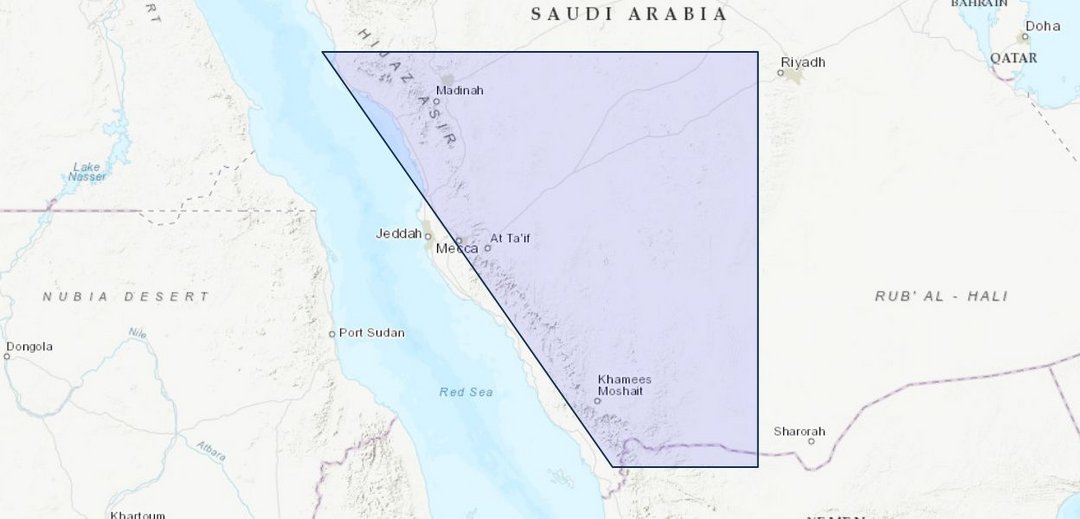
Source: USGS
REEx Insight: The Rocks Are More Interesting Than the Headlines
There is real geological smoke here. The United States Geological Survey (USGS) research (opens in a new tab) identified Arabian Shield granites prospective for rare earth elements (REEs), yttrium, niobium, tantalum, and zirconium, including 14 plutons considered favorable for rare-element mineralization. A 2026 study (opens in a new tab) of Jabal Qutn went further, identifying bastnäsite and unusual yttrium- and niobium-bearing minerals within highly evolved granites.
But investors should keep both boots on the ground: another USGS survey found HREE enrichment in eastern Shield granites without economically significant concentrations in its samples.
Find the Ore—or Import It
Here is the bigger strategic picture. REEx previously detailed Saudi Arabia’s developing Ma’aden-MP Materials-U.S. government rare-earth refining partnership, designed to build separation capacity inside the Kingdom while sourcing Saudi and potentially imported feedstock.
That changes the equation. Saudi Arabia does not necessarily need a Mountain Pass beneath its desert to matter. With capital, cheap energy, infrastructure, Aramco geoscience, and imported technical expertise, it could become a midstream control point connecting Africa, Asia, Europe, and America. The geology now gets its test. Saudi Arabia is building the chessboard before knowing exactly how many pieces lie underground.


0 Comments
No replies yet
Loading new replies...
Moderator
Join the full discussion at the Rare Earth Exchanges Forum →